

Key points:
- The Fresh Expressions movement is gaining steam in The United Methodist Church, with its latest annual convention drawing about 700 people — 500 in person and 200 online.
- Ministries set in tattoo parlors, yoga studios and restaurants are among current Fresh Expressions ministries.
- There was a significant presence by the Evangelical Lutheran Church in America at the 2026 meeting, a sign that the movement is becoming more ecumenical.
The graceful arc of a mime in motion or the sting of a tattooist’s needle can start people on the road to redemption just as surely as attending church.
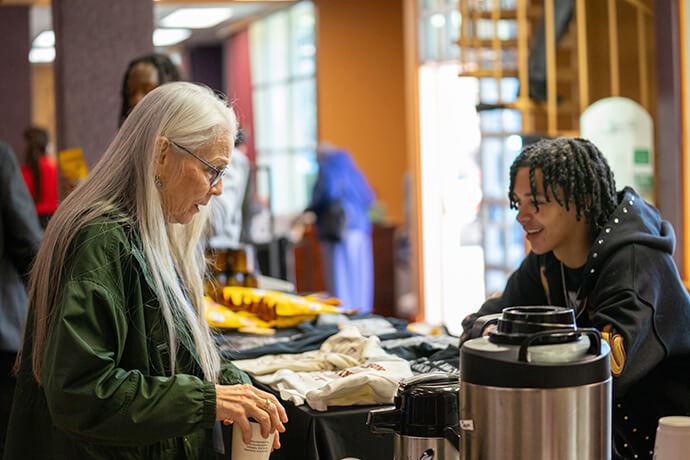
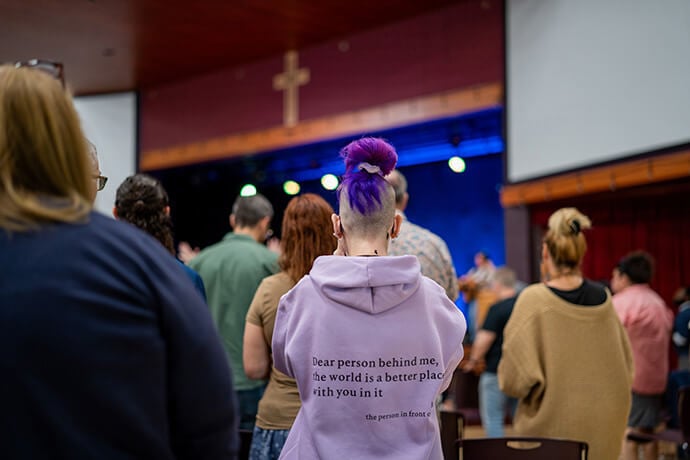
That was the message at the Feb. 26-28 Fresh Expressions United Methodist National Gathering, a meeting at First United Methodist Church that drew 500 people — plus 200 online — to be inspired by ministries held in brew pubs, burrito restaurants, rehab groups and other unconventional settings.
Fresh Expressions attempts to do church work in other contexts and more informally than Sunday worship services, in hopes of attracting people who are turned off by traditional methods.
“Scripture says, ‘Praise God with a joyful dance,’” said Taeron Flemming, a mime and community pastor at The Well Church in Washington, D.C., during a presentation about his Fresh Expressions ministry.
“Movement is the easiest way to make a fresh expression because you don’t have to buy nothing,” he added. “What does the music say to you? And how do you portray that?
“Now you understand how I feel about the song, and a lot of times, you feel the same way. Now we got that common bond, that common link with God. So, it really is an amazing thing to do.”
Flemming performs in churches and offers instruction in mime. Some of his students come from a contract with a juvenile detention center in New Jersey to work with former youth offenders living in a halfway house.
“I’ve been cussed out,” he admitted. “We were casting the bait, but you still got to bite it, you know?”
Flemming said he has worked with hundreds of students, and about 20 have gone on to become mimes themselves.
But will those mimes train others so that seven generations down the road there is a large contingent of Christian mimes?
Maybe yes and maybe no. In a way, it doesn’t matter. The Fresh Expressions ethos is to continually innovate and adapt to the times, whatever the destiny of any single ministry.
If mime doesn’t work, you move onto something else.
“A sanctuary becomes a daycare becomes a retirement center, is torn down and becomes green space,” said the Rev. Matt Rawle, pastor of Carrollton United Methodist Church in Louisiana and co-founder of the Hub4Innovation, which aims to “create that safe space for leaders to think outside of the box and move their teams, communities, ministries and companies forward.”
Building lasting ministries is good, but being determined that they last forever may be overreaching, he said.
“We like to plant and build and take up space with the bold assumption that it will be here forever,” he said. “The sadness in that I see in my own kids because I have crowded them out from their own footprint.
“I would say, build things for their seventh (generation) purpose,” he added.

The concept of looking ahead to envision how today’s decisions affect people far into the future derives from Indigenous nations in northeastern North America that include the Mohawk, Oneida, Onondaga, Cayuga, Seneca and Tuscarora peoples. Together, they are known as the Haudenosaunee, or the Iroquois Confederacy.
“Oral tradition says that this confederacy has existed since time immemorial,” said Bishop David Wilson of the Great Plains Conference. Wilson, a member of the Choctaw Nation of Oklahoma, made a presentation on the seventh-generation concept at last year’s Fresh Expressions meeting in Atlanta.
Subscribe to our
e-newsletter
It went so well that he was asked back to do it again, and this year’s conference was subtitled “Altogether Now: Seven Generations and Beyond.”
“Make your decisions on behalf of the next seven generations coming so that they may enjoy what you have today,” Wilson said. “The nations of the Haudenosaunee people believe that we borrow the earth of our children’s children, and it’s our duty to protect it and its culture for future generations. All decisions made now are made with future generations in mind.”
The Fresh Expressions movement began in the United Kingdom in 2003, and has been active in the U.S. for about two decades, said the Rev. Michael Beck, the head of Fresh Expressions in the Florida Conference and also of the movement within The United Methodist Church.
“Bishop (Ken) Carter, who was the Florida bishop and is now the North Carolina bishop, was the first bishop to convene and create my position and really give institutional support to the movement in Florida,” Beck said.
“I’d say pretty significantly, at least since 2010, The United Methodist Church has been a huge part of the Fresh Expressions movement and helping it take root in the United States.”


At the Florida meeting, United Methodists were joined by 172 members of the Evangelical Lutheran Church in America and one from the United Church of Christ.
“The last few years, Lutherans have been exploring it,” said Sarah Schaaf, assistant to the bishop for emerging church and community engagement in the Northwestern Ohio Synod of the Evangelical Lutheran Church in America.
“Fresh Expressions should be an ecumenical movement,” she said. “If all that we do as the church is what we’ve already done, who will never find a space to experience a love of God? I think that’s the question that Fresh Expressions wrestles with all the time.”
The idea that God stays in a church building after “we turn the lights off on a Sunday morning,” is absurd, Schaaf said.
“That’s never been the case,” she added. “We’re always encountering God in the world, and what’s been the most fun about Fresh Expressions is that all the time, I’m learning about God from people that I encounter.
“It’s not just like you’re sent out to save them. You’re reshaped by the people that you meet.”
Patterson is reporter for UM News. Contact him at 615-742-5470 or [email protected]. To read more United Methodist news, subscribe to the free UM News Digest.


