

Key points:
- United Methodists at the Leadership Gathering continued the work of imagining The United Methodist Church of tomorrow.
- Speakers encouraged participants to look at what they have to grow their movement.
- They argued that God has given United Methodists abundant resources to nurture faithful disciples of Jesus who can take on the world’s problems and resist the rise of tyranny around the globe.
More than 230 United Methodists closed morning worship at the Leadership Gathering by waving their glowing mobile phones in the air while singing a rousing rendition of “This Little Light of Mine.”
Less than an hour later, African church leaders got all those gathered on their feet to sing an impromptu, exuberant chorus of “We Are Marching in the Light of God.”
The message of the morning was clear: God has provided United Methodists with enough light to overcome even the world’s darkest reaches.
“Whenever it feels like things are falling apart, God’s getting ready to gather,” said the Rev. Tyler Ho-Yin Sit, one of the morning presenters and a church planter in the Minnesota Conference.
“And you and I happen to be stewards of a tradition that knows the power of gathering circles of people to minister with one another in the world.”

On the third full day of the unprecedented event on the denomination’s future, the international group of United Methodists — including more than a third under the age of 35 — continued the work of imagining the possibilities for where the Holy Spirit might be leading the church.
A season of church disaffiliations has left many United Methodists worried about shrinking worship attendance and shaky church finances — especially in the U.S.
Sit and other young United Methodist leaders encouraged those gathered to embrace an alternative view. God, they argued, has given United Methodists abundant resources to nurture faithful disciples of Jesus who can take on the world’s problems.
As perhaps an example of that abundance, organizers announced during the morning session that bishops and other church leaders had raised enough money to fully fund the Leadership Gathering, with a budget of nearly $1 million.
In the best Wesleyan tradition, the speakers encouraged those gathered to consider how United Methodists can use their resources to both spread the good news of Jesus and bear prophetic witness to how that good news can change the world.


Sit offered his perspective as the planter of Minneapolis’ New City Church, a multiethnic United Methodist congregation with a building within walking distance of where federal agents killed U.S. citizens Renee Good and Alex Pretti.
Sit talked about the brutal experience this past winter of Operation Metro Surge, which brought 4,000 federal agents into Minneapolis and St. Paul in what the Trump administration officials said was “the largest immigration operation ever.”
Coming Monday
UM News plans to report Monday on the Leadership Gathering’s recommendations and the bishops’ response.
Read previous stories on the gathering here.
Sit talked of how agents drove armored vehicles through residential streets, broke windows to drag people from their cars and menaced people in their own homes. He shared the story of Humberto Castañeda Mondragón, who immigrated to the U.S. legally but had overstayed his visa. Immigration and Customs Enforcement agents arrested him and took him to a detention facility, where beatings left him with eight skull fractures and five life-threatening brain hemorrhages.
Amid such horrors, Sit said, he saw different types of people across his community come together to live out Jesus’ command to love their neighbors.
“I saw nursing mothers sharing their breast milk because there were other babies in our community whose mothers were deported,” said Sit, who is now pastor of Northeast United Methodist Church and associate director of multicultural ministry in the Minnesota Conference. “I saw retirees who spend most of their life at home take their walkers out into the snow … to make sure that kids could go to school safely.”


He also saw the United Methodist connection in action when a local public school teacher asked for help in saving families from eviction at a time when the federal siege prevented many people from going to work. At the time, Sit thought, “I’m a church planter whose main membership is poets, and Dungeon and Dragons players, but I’ll see what I can do.”
View more photos
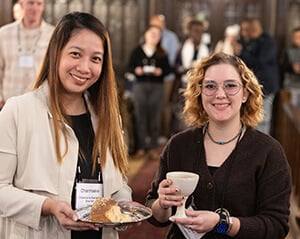
See photos from every day of the Council of Bishops Leadership Gathering on UM News’ Flickr page.
But that same day, he heard from a United Methodist at another church, who told Sit that he and two adult children had, after prayer, decided to spend down the children’s inheritance to support families who would be evicted. “Do you happen to know any?” the man asked.
Beyond the experience of Minneapolis and St. Paul, Sit noted that authoritarianism is on the rise around the globe. In fact, he said, 89% of the United Methodists attending the Leadership Gathering live in countries that either live under an authoritarian regime or in one moving in that direction.
Authoritarianism happens when a charismatic leader identifies overly simplistic solutions to difficult problems by targeting marginalized individuals like Black people, LBGTQ people and immigrants. That leader inevitably goes after other people’s basic freedoms as well.
Sit attributed the rise of such authoritarianism to “a lack of discipleship in our communities.”
“Populist authoritarian leaders derive their power from a society that is hungry, sick and looking for someone to blame,” he said. “When we attend to our discipleship and feed the hungry, care for the sick, and welcome the stranger — when we remember that God made us as a family — then authoritarianism crumbles.”


If each United Methodist around the world drew 25 more people to the movement, he added, that would be about 3.5% percent of the world’s population — a key percentage for resisting authoritarianism.
Leah Wandera also testified about the impact of faithful, persistent service. She is a United Methodist deaconess in Kenya who is spreading the deaconess and home missioner movement in Africa. Deaconesses and home missioners, who are far more common in the Philippines and the U.S., belong to a lay order who commit to a lifetime ministry of love, justice and service. Initially when she began to work to join the movement, she learned that she had not completed the right preparation for consecration.
“Beloved, sometimes leading courageously does not mean breaking down the door,” she told those gathered. “Sometimes it means saying: ‘Show me the right door. I am still coming.’”
She was able to complete the right formation and be consecrated in 2022. Today, thanks in part to her leadership, there are 19 active deaconesses and home missioners serving in Nigeria, Kenya, Zimbabwe, Tanzania and Malawi.

The Revs. Dorlimar LeBron and Laura B. Kigweba, in a joint presentation on stewardship, urged those gathered to see, connect and steward differently to help United Methodist churches flourish.
The invitation to faithful stewardship is not about denying what is missing but a refusal to let what is missing be the only thing we see, said Kigweba, the director of grassroots organizing for the United Methodist Board of Church and Society.
Subscribe to our
e-newsletter
“We can look at a church building and ask: ‘How might this space participate in God’s mission?’” she said. “We can look at our finances and ask: ‘What ministry might these resources make possible?’ We can look at our relationships, our people, our property, our investments, and all that God has placed among us and ask: ‘What might become possible through what is already in our hands?’ These questions invite a new imagination.”
LeBron, who leads church relations for Wespath, the denominational retirement and benefits agency, challenged those gathered to consider what God has placed in United Methodists’ hands.
“Throughout our worldwide connection, people carry different experiences, resources, wisdom and ways of seeing,” she said. “Stewardship through our connection means learning both to offer what we carry and to receive what God has entrusted to others.”
Those gathered spent the afternoon meeting in small covenant groups to develop recommendations for the denomination’s future.
The Rev. Rhoda Gowarto Manzo of Nigeria is among the United Methodists excited to be among those developing those ideas.
“Seeing people all around the world gives me a sense of belonging,” she said. “The United Methodist Church has a great future ahead.”
Hahn is assistant news editor for UM News. Contact her at (615) 742-5470 or [email protected]. To read more United Methodist news, subscribe to the free UM News Digest.


