
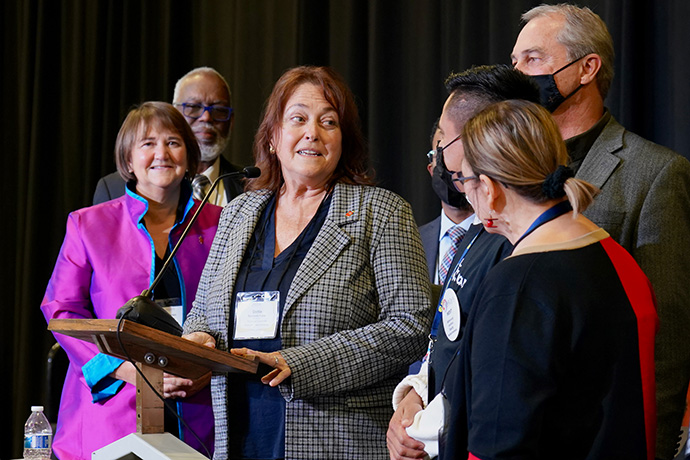
The Rev. Dottie Escobedo-Frank, senior pastor of Paradise Valley United Methodist Church in Paradise Valley, Arizona, was elected a bishop by The United Methodist Church’s Western Jurisdiction.
Delegates elected Escobedo-Frank, the jurisdiction’s third Hispanic bishop, on Nov. 4 at the jurisdiction’s meeting at Christ United Methodist Church on the 19th ballot. She received 85 votes out of 93 valid ballots cast. She needed 63 to be elected. Western Jurisdiction rules require two-thirds of valid ballots.
Escobedo-Frank was the third bishop elected at the Nov. 2-5 meeting, along with Carlo Rapanut and Cedrick Bridgeforth.
In her election remarks, Escobedo-Frank acknowledged her rich family history and how it calls her to ministry. Her great-grandfather on her mother’s side was a Methodist circuit rider. Her grandmother crossed the Rio Grande while in labor with her father to find religious freedom.
“I have deep roots in the Methodist tradition and I have deep connection to the Latinos of our country and of the world,” she said. “Today it feels like they’re being married somehow, two parts of me again.”
Escobedo-Frank was elected by the Western Jurisdiction’s 96 total delegates, an equal number of United Methodist clergy and laity from the eight annual conferences — church regional bodies — forming the jurisdiction. The jurisdiction encompasses the 12 westernmost states in the U.S. and the territories of Guam and Saipan.
The assignments of bishops in the Western Jurisdiction will be announced Nov. 5. Her term of service begins Jan. 1. In the United States, bishops are elected to serve for life.
Escobedo-Frank, an elder in the Desert Southwest Conference, has served appointments as pastor to churches ranging from the small and rural to the big and urban. For three years, she also was an associate pastor at an Evangelical Lutheran Church in America megachurch in Glendale, Arizona.
She also has experience as a district superintendent based in Tucson and dean of the bishop’s cabinet. She served twice as Hispanic Ministries chair in the Desert Southwest Conference.
She has a Master of Social Work degree from Arizona State University, a Master of Divinity from Claremont School of Theology and a Doctor of Ministry from George Fox Evangelical Seminary in semiotics and future studies.
She also is a prolific writer, publishing seven books about church life and church seasons with Abingdon Press, an imprint of the United Methodist Publishing House.
In The United Methodist Church, bishops are ordained elders who are called to “lead and oversee the spiritual and temporal affairs of The United Methodist Church.” Bishops, in consultation with district superintendents, are responsible for appointing clergy. They also preside at annual conferences, jurisdictional conferences and General Conference, the denomination’s top lawmaking assembly.
Bishop candidates typically are endorsed by their home conference or other groups within the denomination. This year, the Western Jurisdiction invited each of its annual conferences to lift up multiple potential candidates, with the hope of drawing the circle wide. The elders interested in being considered for election were then asked to signal their willingness to be considered by Sept. 1. Throughout, the jurisdiction has put an emphasis on discernment by both the candidates and the voting delegates.
She and other new bishops are coming aboard as the denomination deals with the continuing fallout of the COVID-19 pandemic and rising congregational disaffiliations amid a denominational splintering.
Escobedo-Frank said in her post-election remarks that there is still room for everyone around the table, and that the church needs to make even more room around the table and hear the cries from those who suffer from injustice.
“We are here for one simple thing, and that is to love,” she said. “The more perfect we can be, the more loving we can be, that’s the only perfection that’s needed. That’s the only method that we need. That’s the only grace that we need.”
Caldwell is communications manager in the Oregon-Idaho Conference. Ewing is communications director for the California-Nevada Conference.
Find all of UM News’s coverage of the 2022 episcopal elections of The United Methodist Church on our landing page.


