

Key points:
- Charles H. Webb was a keyboard prodigy, playing organ and piano at his Dallas Methodist church as a small boy. He would go on to become longtime dean of Indiana University’s Jacobs School of Music.
- Webb also served on The United Methodist Church’s Hymnal Revision Committee in the 1980s and for decades played the organ at First United Methodist Church in Bloomington, Indiana.
- He died April 13 at age 93.
Charles H. Webb was a cradle Methodist, and he was barely out of his cradle when he began dazzling church folk and others with his piano and organ playing.
He first performed in public at age 4, and at age 6 gave an organ concert at Dallas’ Oak Lawn Methodist Church. Soon the tow-headed prodigy was playing around Dallas and beyond.
Webb would grow up to be longtime dean of Indiana University’s renowned Jacobs School of Music, while also conducting orchestras and giving keyboard concerts across the world.
Through his long, packed life, he remained a faithful United Methodist, playing the organ for decades at his local church and having a key role in the creation of The United Methodist Hymnal.
Memorial service
Charles H. Webb’s survivors include his four sons, three daughters-in-law and 10 grandchildren.
A memorial service will be held on May 16, beginning at 10:30 a.m., at First United Methodist Church in Bloomington, Indiana.
Gifts in his memory may be made to the Charles H. Webb Music Scholarship, in care of the Indiana University Foundation, P.O. Box 6460, Indianapolis, Indiana, 46206-6460, or to First United Methodist Church, 219 E. Fourth St., Bloomington, Indiana, 47408 (Charles H. Webb Music Endowment).
“Webb was one of the most renowned music administrators in the 20th century,” said C. Michael Hawn, professor emeritus of church music at Southern Methodist University.
“In addition to an active career in higher education, composition and performance, he was a thorough United Methodist church musician, contributing to the 1989 United Methodist Hymnal by composing, harmonizing, or adding descants to nearly 150 hymn tunes, many of which were published in other denominational hymnals.”
Webb died April 13, surrounded by family, at his home in Bloomington, Indiana. He was 93. His passing made TV news in Indiana and brought an outpouring of tributes.
“Charles was a treasure: an incredible academic leader, musician, cultural diplomat, husband, father and friend to many,” leaders of Indiana University’s music school said in a press release.
Webb was born into a Dallas banking family, on Valentine’s Day, 1933. As a tiny boy, he would come home from Oak Lawn Methodist Church, hoist himself onto the piano bench and play hymns he’d heard that morning.
The Dallas Morning News archives contain article after article documenting his boyhood concerts in churches, department stores and on local radio. By age 5, he had a Sunday afternoon gig playing the Aeolian-Skinner pipe organ at Dallas’ Hillcrest Mausoleum chapel.
Webb — who combined an acute ability to play by ear with rigorous instruction from top Dallas piano teachers — would as a teenager become the regular Sunday morning keyboard player at Oak Lawn Methodist.

He remained musically active as a student at Southern Methodist University but studied business at his father’s insistence. Then young Webb got a life-changing summer job: accompanist for workshops led by Fred Waring, a famous choir director and bandleader.
Waring soon sought out Webb’s father and persuaded him that Charles had what it took to make a good living in music. Webb changed majors and earned a bachelor’s and master’s degree in music from SMU.
An ROTC student, Webb did a stint as an Air Force officer, leading choirs of airmen along the way. While assigned to a base in Big Spring, Texas, he got involved in the local Methodist church and met a young pianist and harpist named Kenda McGibbon.
They married in 1958, and soon moved to Bloomington, where Webb began working toward a doctorate in music.
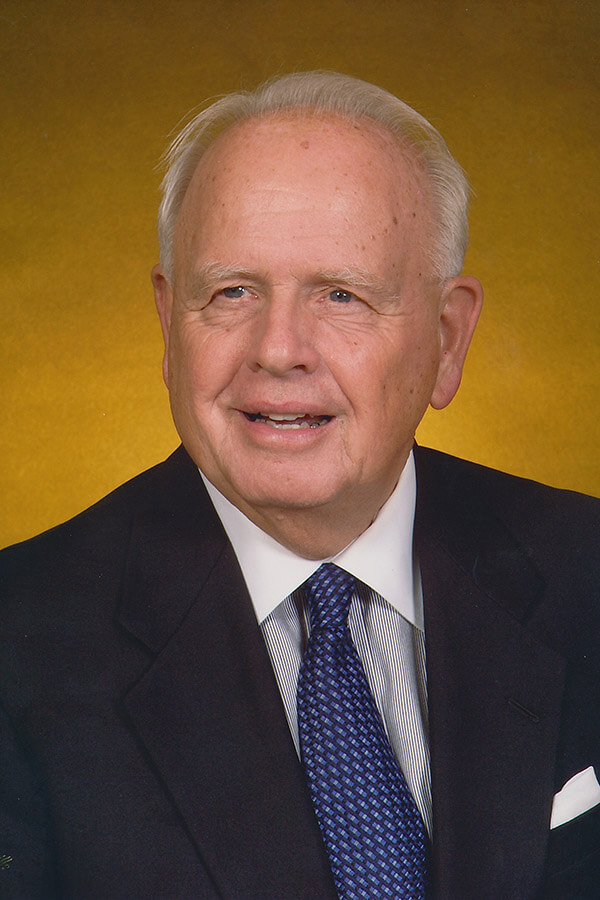
He joined the university’s music school faculty in 1960, becoming assistant dean in 1964 and associate dean in 1969. He rose to dean in 1973 and held the post for 24 years.
“During that time, he bolstered the school’s reputation from nationally respected to internationally revered, making visionary curriculum enhancements, adding premier artist-faculty members and implementing ambitious initiatives,” school leaders said after his death.
While an administrator, Webb continued to perform as a pianist and organist, and he conducted symphonies and operas in Bloomington and elsewhere. He and Kenda became locally famous as entertainers on behalf of Indiana University, their church and other nonprofits, over the decades welcoming some 30,000 guests to their home.
One who came often during a six-week residency at the music school was Leonard Bernstein. The great conductor and composer wrote a song in tribute to his hosts: “Mr. and Mrs. Webb Say Goodnight.” It still gets performed as part of Bernstein’s “Arias and Barcarolles.”
Busy as Charles Webb was — colleagues recall how fast he walked across campus — he never neglected the church.
For 62 years, he was either minister of music or organist at First United Methodist in Bloomington. He rarely missed a Sunday, even when concerts or conferences had him on the road during the week.
“We’re like, ‘Dad, you can have a guest organist,’” recalled Malcolm Webb, one of Charles and Kenda’s four sons. “Most of the time he’d hear nothing of it. He’d be back in town on Saturday night to be on the organ bench Sunday morning.”
Charles Prestinari is the current director of music at First United Methodist in Bloomington, and joined the church choir in his first days at Indiana University. He recalled how worshippers would linger after the benediction to hear Webb’s organ postludes.
All through worship, Webb’s organ playing proved compelling.
Subscribe to our
e-newsletter
“He was a magnificent service player,” Prestinari said. “He had such an incredible ear and feeling for harmonies. He could launch at any minute into a free harmonization of a hymn that would uplift the entire congregation.”
In the 1980s, Webb served on The United Methodist Church’s Hymnal Revision Committee. He and fellow members made news as they debated gender-inclusive language and whether to include “Onward, Christian Soldiers.” (Some Methodists found that hymn’s text militaristic. Many others disagreed and wrote the committee in support of the hymn. It stayed in.)
“The history of hymnology is the history of revision,” Webb said in a newspaper interview about the committee’s work. “Even Charles and John Wesley, the founders of Methodism, revised each other’s poetry. Over the centuries hymns have always been revised to reflect contemporary thinking and to remain relevant to an ever-changing society.”
Mary Brooke Casad served with Webb on the committee.
“‘Quality’ was his operative word, whether we were considering traditional or contemporary music,” she said. “I appreciated his desire to have the hymnal fully reflect the diversity of our worldwide church.”
Along with helping decide the contents of the hymnal, Webb wrote extensively for it. He composed the music for the hymn “Woman in the Night,” text by Brian Wren, and contributed many fresh harmonies to familiar hymn melodies.
“The Art of Descant and Free Harmonization,” published by the Indiana University Jacobs School of Music, collects more than 200 choral and organ descants, harmonizations and arrangements by Webb.
Webb was much honored in his life, including receiving Indiana University’s Thomas Hart Benton Medal Mural Medallion and its President’s Medal for Excellence. His 1997 retirement as dean of Indiana University’s music school prompted a 30-minute documentary about him by WTIU, a public TV station in Indiana.
Kenda Webb — a trustee at First United Methodist in Bloomington who also was an acclaimed interior decorator — died in 2001.
Charles Webb stayed active, including playing for his church, until his last few years. He wrote a memoir, “The Emergence of a Musical Life,” published in 2021.
In talking about his father’s life last week, Malcolm Webb chose an adjective other than “musical.”
“He had a great life. There’s no question about it.”
Sam Hodges is a Dallas writer.
News media contact: Julie Dwyer at (615) 742-5470 or [email protected]. To read more United Methodist news, subscribe to the free UM News Digest.


