
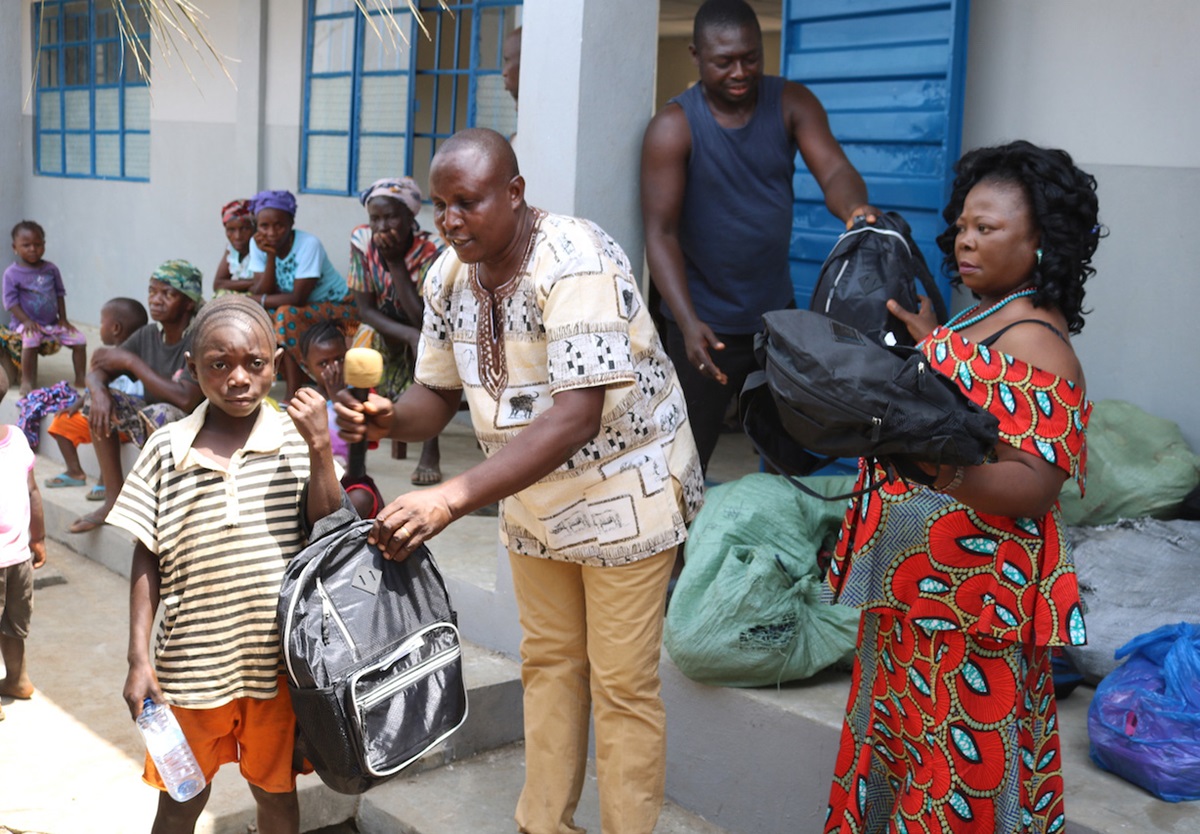
About 100 students from The United Methodist Church Primary School in this remote community now have the materials they need to start school in September.
The children received backpacks, uniforms, shoes, books and other supplies last month from the Sierra Leone Conference’s Community Empowerment for Livelihoods and Development.
The primary school — in the home village of Sierra Leone Area Bishop John K. Yambasu — was scheduled to open in September after an April dedication last year, but a lack of educational materials and teachers willing to work in the remote community delayed the opening, said Leonard Ben Gbloh, the conference’s education secretary.
“Teachers have now been recruited and the supply of the learning materials has further galvanized plans for the school to open this September,” Gbloh said.
Community Empowerment for Livelihoods and Development also provided initial funding to buy teaching materials for the school, he said. The denomination’s community-empowerment program supports remote communities with resources that enhance education, health and the provision of social services.
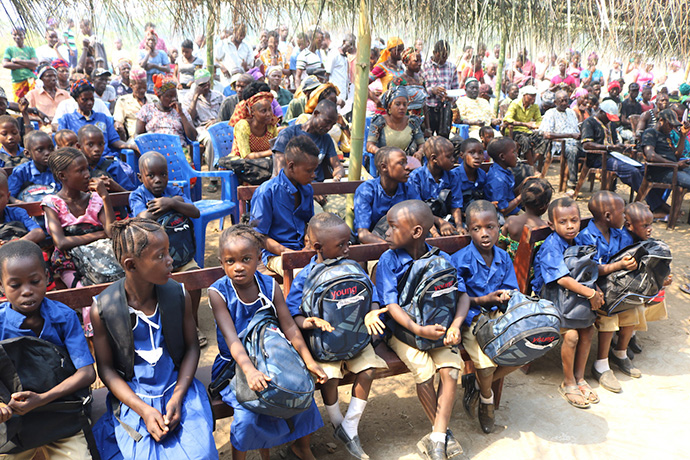
Future students at The United Methodist Church Primary School in Sayllu, Sierra Leone, listen to speakers from the Sierra Leone Conference’s Community Empowerment for Livelihoods and Development. The group provided the children with school supplies. Photo by Phileas Jusu, UMNS.
At the distribution ceremony on the school grounds, Gbloh appealed to parents to ensure that their children attend the school, warning them not to hastily marry off their children, as education would liberate them from poverty and dependence.
Section Chief Kadiatu Nabir, who oversees several villages in the area, said she was excited about the new primary school because it would bring development to the community.
Sayllu has a growing population of about 1,000, with children accounting for more than one third of that number. The rugged motorway to Sayllu was constructed in 2017.
Before that, residents and visitors to the village would have to walk a minimum of 7 miles from the nearest village.
Bo District Council chairman Joseph Munda Bindi, who was the guest speaker at the distribution, recalled days in Sayllu when the people used to carry crops on their heads to faraway places to sell because there was no motorway leading to the village.
“People used to leave here to go to other communities just to access education. That must have been responsible for a lot to drop out of school. But today brings a new day of hope and happiness because we’re talking about education at your doorsteps,” he said to loud applause.
“Out of the children here today, there might be a president tomorrow. You might have had many promises from people to open a school here, but today, it is your own brother, son or uncle Yambasu that has made it possible,” Bindi said, referring to the bishop who pioneered the primary school.
Bindi also asked parents not to send their children to work on the farms as an alternative to school, reminding them about the new government’s free education policy, which strongly encourages all parents to send their children to school.
“Your children must not be illiterate farmers but educated farmers who would be skilled to produce more and earn income from their farming instead of remaining poor subsistence farmers, which was all (that) illiteracy could provide,” he said.
The district administrator emphasized the relationship between the government’s free education policy and its recent declaration that rape and sexual violence are a national emergency in the country, making sex with minors punishable by life imprisonment.
Bindi spoke about the alarming rate of rape in the country and his hope that the new law would minimize girls’ dropout rate in schools.
Louisa Kamanda, Community Empowerment for Livelihoods and Development field coordinator, urged parents to do their part in keeping their kids in school.
“When I look around and see the children smartly dressed in their beautiful uniforms today, I know that the future of Sayllu is bright. … To the parents, please take care of these children. … Don’t keep them at home, especially the girls,” Kamanda said.
“Encourage them to come to school. … We hope to see a president someday from Sayllu; nothing is impossible. President (Julius Maada) Bio never knew he would be president someday. I am here today speaking to you because I went to school.”
Kamanda said Community Empowerment for Livelihoods and Development is committed to supporting students from remote communities and poor backgrounds. She noted the group’s recent work providing aid to children whose parents suffered from Ebola or were affected by the 2017 landslide.
Yambasu said the construction of another school building would begin shortly, providing more classrooms for further enrollment of new children. He asked the community to contribute local materials like sand and stones for the new building and said the church would work with the community on the construction of teachers’ quarters and the building of a junior secondary school.
The bishop said the staff quarters will help convince qualified teachers to come to the remote community and stay, noting that the lack of decent accommodations was one of the reasons the new school was not able to open on schedule.
Yambasu said it has always been his dream to open a school in his village. He encouraged the community to continue to invest in the education of children, especially the girls.
“The children gathered here today are our profit. Let’s invest in them.”
Jusu is director of communications for The United Methodist Church in Sierra Leone.
News media contact: Vicki Brown at (615) 742-5470 or [email protected]. To read more United Methodist news, subscribe to the free Daily or Weekly Digests.
Like what you're reading? Support the ministry of UM News! Your support ensures the latest denominational news, dynamic stories and informative articles will continue to connect our global community. Make a tax-deductible donation at ResourceUMC.org/GiveUMCom.


