
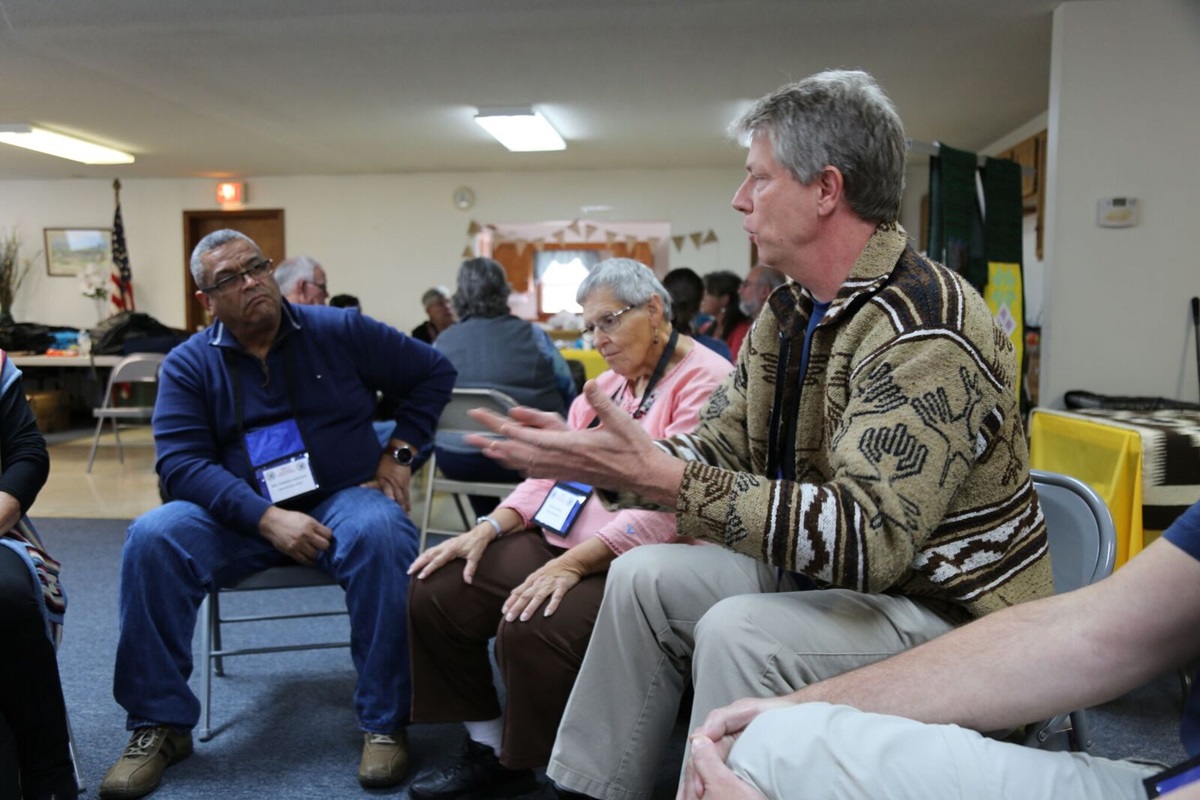
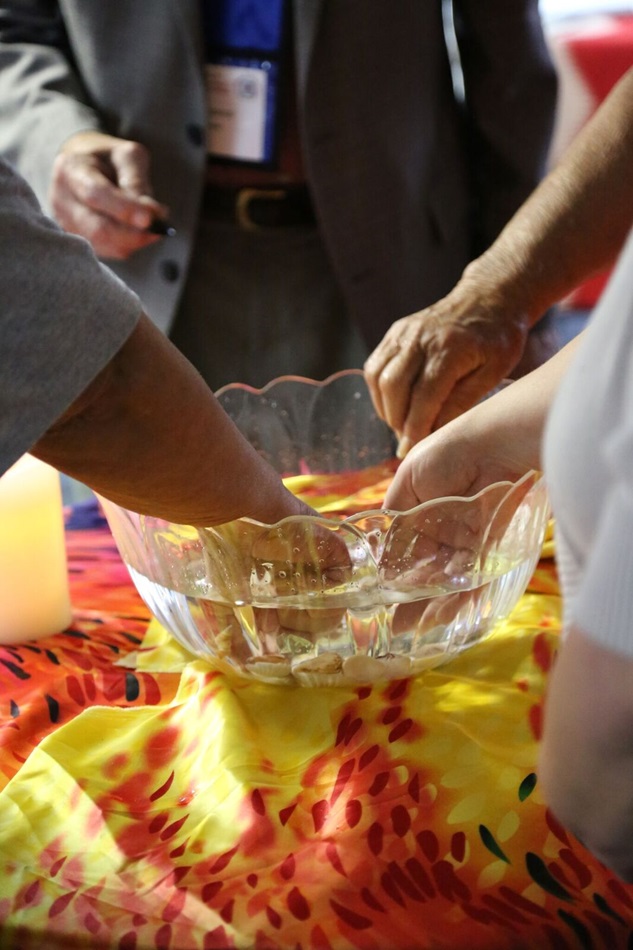
The Northeastern Jurisdiction Native American Ministries Committee annual gathering exemplified the importance of relationships while acknowledging painful realities as The United Methodist Church continues to walk the path of repentance.
Chairperson Patricia Parent from the New England Committee on Native American Ministry opened the Oct. 12-14 meeting at Eliot United Methodist Church with a prayer spoken in the Abenaki language. Following a long tradition of gifting, she presented representatives from nine of the 10 sister conferences with food from each of the five states located within the New England Conference.
She also offered prayers and tributes for Oliver “Black Feather” Suprenant, a respected elder and former New England Conference CONAM chairperson who died in 2014.
Cynthia Kent, chairperson of the Northeastern Jurisdiction Native American Ministries Committee, praised the conferences for their completion of worship services with Acts of Repentance and the ways they continue the journey of repentance by “advocating for Native people and working with them within our gospel.”
She said the jurisdiction is “leading the church in this ministry” and urged them to keep moving and helping other jurisdictions. She reminded them that every conference according to The Book of Discipline shall have a committee on Native American ministries.
New England Conference Bishop Sudarshana Devadhar praised the group for their witness to the whole church. “We still have a long way to go so our Native American voices are heard and celebrated at every level, but as we stand together and include future generations, we will continue the work together,” he said.
The educational focus of the ongoing Acts of Repentance was reflected at the annual meeting when attendees engaged in two plenary presentations concerning the “Loss of Turtle Island.” Turtle Island is the title used by many Native American tribes to describe North America.
The first, “Loss of Turtle Island: A Narragansett Perspective,” invited participants to consider their own identity while weaving stories of the Narragansett people and how their identity is connected to the land they inhabit.
The second session helped participants understand the price that is paid when that identity is threatened. Developed by the Mennonite Church, “Loss of Turtle Island: What Does the Doctrine of Discovery Mean to Us Today?” used blankets to represent land.
Participants were led through an experience that illustrated the progressive loss of land, culture and life of Native peoples in the United States. The leaders brought the history of assimilation, relocation and land removal to life by asking participants to read landmark decisions, move from place to place, and stand on ever-shrinking territory until very few remained standing.
At the end of the exercise, they shared ways in which their worldview had been expanded concerning history, white privilege, identity formation, generational differences and ancestry. Some of the participants were overcome with emotion and several non-Native participants shared their surprise about their own lack of historical knowledge.
The exercise so deeply affected attendees that they decided to obtain similar training for CONAM committees across the connection in 2018.
In addition to educational opportunities, the gathering spotlighted CONAM efforts to continue to engage with annual conferences concerning Native American ministries. Several corresponded to recommended action steps found in the Native American Comprehensive Plan and the Northeast Jurisdiction's Native Ministries Plan of Action.
Delegates shared ways in which they united liturgy and social action. Calls for Columbus Day to be replaced with Indigenous People’s Day have been strengthened with worship resources such as those developed by Upper New York for an Indigenous Peoples Day liturgy. Concerns surrounding land and water rights were reflected in A Remembrance of Baptism liturgy that incorporated images of baptism and prayer for water protectors.
They also shared their efforts to strengthen relationships and raise up Native American leaders, including the return of Native American Family Camp and the development of Native youth leaders through the Peg-Leg Flamingos program.
A notable example of advocacy came from the Peninsula-Delaware Conference CONAM. At the 2016 annual conference, the committee proposed a resolution to return the property of closed churches to local Native American tribes. As a result, when Union Wesley United Methodist Church closed it was transferred to the Accohannock Tribe of Maryland, who is now utilizing it as a community center and museum.
Ragghi Rain Calentine, chairperson of the Peninsula-Delaware CONAM, reminded everyone that this is just one way to spread the news that “Native American ministries can be celebrated every month, not just once a year as a remembrance of Native peoples!”
Suzanne Wenonah Duchesne is an ordained elder in the Eastern Pennsylvania Conference and the communications chairperson of the Northeastern Jurisdiction Native American Ministries Committee.
Like what you're reading? Support the ministry of UM News! Your support ensures the latest denominational news, dynamic stories and informative articles will continue to connect our global community. Make a tax-deductible donation at ResourceUMC.org/GiveUMCom.


