

Key points:
- Sacred Ground is a mobile outdoor walking/spirituality app developed by a United Methodist pastor. It combines creation care and Indigenous history with calls to action.
- Focused mostly on northern California, Sacred Ground is expanding to new regions and parts of it will be translated into Spanish.
- Sacred Ground brings together participants not only from multiple United Methodist churches in Sonoma County, but also people of multiple faiths or those with no church focus.
Standing alongside a creek amid California Live Oaks where Pomo, Wappo and Miwok tribes once gathered food, healed and loved, the Rev. Laurie Bayen is preaching the Gospel. The Gospel of respect for creation. The Gospel of unity among cultures. The Gospel of paying attention.
“I think one of the formative Scriptures for me is the passage of the Sermon on the Mount about not storing up treasures on Earth. It continuously calls me to account. Jesus is saying the most important things are right in front of you.”
Bayen pastors a small congregation at nearby Windsor Community United Methodist Church in Sonoma County, but on this day in mid-April, she is an outdoor, historical and spiritual guide for United Methodists participating in a Sacred Ground field trip to Laguna de Santa Rosa. The area is about an hour’s drive north of San Francisco.
At Laguna de Santa Rosa Trail, chirping birds and gentle winds mask the sounds of rush-hour traffic on a busy Sebastopol highway just half a mile away. “What are you hearing?” she asks the group. “What are you seeing?” Some noticed oak galls (leaf buds that look like apples formed by wasp eggs), and others heard the soft breeze and the sound of water in the Laguna.


Laguna de Santa Rosa is one of 84 sites featured on the Sacred Ground mobile site that Bayen launched three years ago and is housed on the free OtoCast app. Bayen divides her time between Sacred Ground and Windsor, and she has received United Methodist grants to help pay for the costs of being hosted on OtoCast. Sacred Ground is a Global Ministries EarthKeepers project.
Though nearly all the Sacred Ground sites are in Northern California, additional ones are being developed in other parts of the state and in Nevada, Oregon and Canada. Bayen’s dream is to offer the Sacred Ground program across the United States.
“I couldn’t believe what an inspired brilliance it was,” said Denise Newkirk, a Windsor member who accompanied Bayen on a field trip earlier in the day to Tolay Lake Regional Park. “It’s been amazing to watch her manifest this thing.”


How Sacred Ground works
Sacred Ground can be accessed on a website and has an Instagram account; however, the primary interactive features are on the OtoCast app. Each site includes an info page, photos, a short narration and instructions on getting there. There is often a call to action for users.
Sacred Ground app
To view screenshots of how the features of the Sacred Ground OtoCast app work, click below.
Besides opening users’ eyes to God’s bounty in nature, Sacred Ground focuses on Indigenous histories and continuing violence against peoples and lands in 2026. At a stop at Bita-Kom-Tara (Flat Rock Park) tucked into suburban Santa Rosa, Bayen talks about efforts to fight commercial development near the confluence of Santa Rosa Creek and Brush Creek and to restore the park name to its Indigenous roots.
Standing on the rocks overflowing with cool waters, Bayen leads visitors through the song, “Water Be My Teacher,” written by Connie Lim. “Tell me how to break through rock/flow around what tries to block/water be my teacher/water carry me,” the group sings. Bayen said the lyrics are especially poignant as climate protections are being dismantled.


While mobile phones provide entrée into Sacred Ground, walkers do not access their phones (even for photos) to the exclusion of being present. “The more you look, the more you see,” Bayen said. “The more you listen, the more you hear.”
Bayen leads field trips at least monthly, though the dry summer months may include fewer trips. The sites include overlooks, redwood forests, historical sites and stops along the Pacific Coast near Bodega Bay. A rainbow of wildflowers is blooming on many trails, and if Bayen doesn’t know one of the wildflower’s names, other Sacred Ground regulars probably do.
At Tolay Lake near Petaluma, Bayen mourns the near disappearance of the lake to ranching many decades ago. At the separate Sonoma Overlook Trail, damage from recent wildfires is visible, and the group pauses to recall the smoke trauma. Looking at vineyards on the same trail, she challenges walkers to support workers who depend on the wine industry for their livelihoods.


How Sacred Ground got started
Bayen said she had been thinking about the idea for Sacred Ground for a while, and more than three years ago, the roots began forming. She took a two-month renewal leave, sailing parts of the Washington state coast with her husband, Albert, simultaneously reading a book about North American Indigenous history.
“I worshipped at one place in Canada, and I went to a couple of parks there. I noticed there was more land acknowledgement stuff going on there,” she said. “Reading that book, and going to all those beautiful places, it all kind of coalesced. I had a sense that the decline of the church is perhaps a result of all the horror that has been wrought on the earth in God’s name.”
Bayen was also undergoing United Methodist conference-level discernment to help identify her strengths and interests. She joined the denomination’s Creation Justice Movement, and also went on a camping trip to the coast near her home.
On the dramatic cliffs of Bodega Head, she recalled a “mystical experience.”
“I was enjoying the waves and thinking about those who had been there, including those who had parts of efforts to save it from a nuclear power plant. I thought, ‘there should be an app for this.’”


In the 1960s, Pacific Gas and Light planned to build a nuclear power plant in Bodega Bay, but plans were scrapped because of its proximity to the San Andreas faultline.
On the Sacred Ground app, Bayen narrates what visitors see at this remote northern California coastal town. “Geologically speaking, you are actually not in North America at all, but on an island, which is temporarily merged with the North American plate,” according to the app. “This is a prime viewing spot for migrating California gray whales, but there are breathtaking views no matter what the weather or season.”
Sacred Ground has received three grants from the Los Rios District of the California-Nevada Conference. Money from a Peace with Justice grant (funded through a Special Sunday offering) has been earmarked for the costs of translating a portion of the app into Spanish.
The district allows Bayen to spend about a quarter of her time on Sacred Ground and the remainder on leading Windsor. As Sacred Ground has grown, its activities and focus have blended into the rhythms at Windsor. Several members are regulars on field trips. They help research new sites, and the leadership board considers Sacred Ground in decision-making.


Even the concept of movement makes its way into a recent worship service at Windsor. Forty minutes into the service, the 20 worshippers stand up, stretch through exercises and breathe deeply — just in time for the sermon.
The sermon’s focus is the disciples’ Emmaus Road encounter with a resurrected Jesus, as described in the Gospel of Luke. Bayen connects the passage to Earth Day, that Sunday’s recognition of Native American Ministries and Sacred Ground. It’s all a resurrection story, she said.
“Bringing all these threads together is part of what I’m trying to do with the Sacred Ground project: Connecting with the healing power of creation, calling painful history to mind, leaning in with our senses and imaginations, offering a form of hospitality to visitors and gathering in community.”


Accessing the sites
Sacred Ground was never intended just to be for United Methodists. Bayen hopes to open anyone’s eyes to the wonder of nature.
“The chair of the district union suggested (the grant proposal) would be stronger not only if I pitched it as a way for people outside the church to connect to the holy and nature, but also that I have a component where people who are in the church get outside. We need people to build a community and get outside, post-COVID,” she said.
The sense of community is evident on the April field trips. United Methodists from Napa, Sebastopol, Windsor and Santa Rosa congregations are among the participants.


Phyllis Draper from Windsor uses a wheelchair and is a frequent field tripper. At Bita-Kom-Tara, she has little hesitation about joining others on the rocky ledge while using her chair. Barbara Thompson from Napa is a longtime Sonoma County resident and said she had never been to Tolay Lake until mid-April. Her friend Susan Quintana said Sacred Ground “has awakened me to places I’ve never stopped to think about.”
Some participants use canes and/or cope with other age-related challenges. Most of the locations have sections that are accessible and when they are not, the “info” tab of the app makes a note. The app also makes it clear when dogs are welcome.
Bayen works with people from other denominations to help identify new sites, and she has connections with multiple Indigenous groups to ensure the app is accurate and culturally sensitive.

Indigenous roots
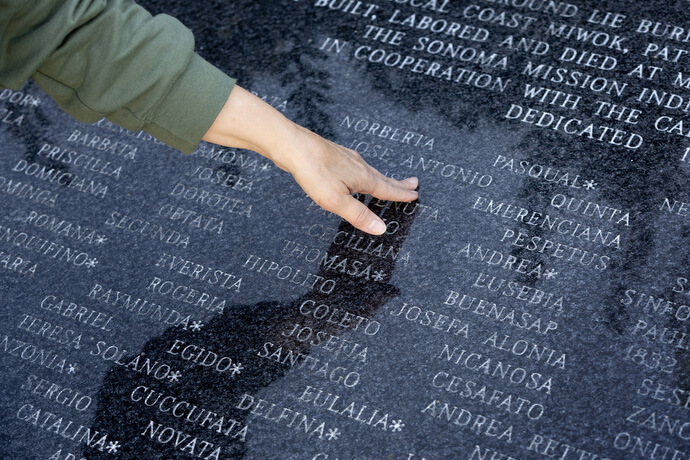
Better understanding history through an Indigenous lens is crucial to Sacred Ground participants. At the Mission San Francisco Solano mission in Sonoma, Bayen asks field trippers to choose a name from a historical marker outside the mission’s museum. These Spanish names were bestowed on native Pomo, Wappo and Miwok Indians at baptisms; many were killed by disease and violence in colonial settlements in the 1820s-1830s.
“Nearly two-thirds of all children in the mission system died in the first five years of their lives,” Bayen said. “They either survived by assimilating or going into the interior (of the territory).”
Later, at Sugarloaf State Park, Bayen asks walkers to honor the natives’ past by reciting their names near a cool mountain waterfall. On that day, for a few minutes, Gerardo, Bruna and Angel are remembered.
Supporting Sacred Ground


Tolay Lake once had charmstones, which were used by medicine men to help cure illness. Once the charmstone was used, it had to be destroyed as tribal members believed it carried the illness, according to Greg Sarris, author, professor and chairman of the Federated Indians of Greater Ranchiera.
“This seasonal lake has long been considered a sacred gathering and healing place by the Indigenous peoples who gather in this region,” according to Sacred Ground. The hills offer panoramic views of the Bay area as far away as San Francisco. Tolay Lake, once home to one of the largest concentration of Indians in the U.S., is a protected park now, hosting bird watchers, horseback riders and a fall festival honoring Native traditions.
“I understand something about renewal — about what must have occurred as Indian doctors and their patients left the lake. Didn’t the ridgetop views confirm healing, that one was located in place again?” Sarris writes.


Preserving forests and oceans
The most visited site on the Sacred Ground app is Armstrong Redwoods State Natural Reserve, just a few miles from the coast. In the 1850s, redwoods were at risk because of logging, and nearly all of them had been cut down. Today, they are protected treasures throughout the region.
Volunteer Joan Bacci escorts a Sacred Ground group along well-trod paths at Armstrong, explaining redwood roots (not deep, but wide), how the trees thrive on fog, and spotting unique animals, such as banana slugs, which attract admirers wherever they are spotted. The largest tree, called Colonel Armstrong, is 308 feet high at last count and approximately 1,400 years old.
Bacci describes recent California wildfires and how close they came to making deeper scars into the forest than the fallen trees and branches clearly visible with black wood. “I just think it’s amazing how redwoods can heal themselves,” she said, pointing to a redwood still growing tall after a 1920s fire.


Healing is a big part of Sacred Ground. For Bayen, healing is part of her favorite place: Bodega Head, a peninsula four miles wide and about 20 miles west of Santa Rosa. It’s a site for marine research and a big spot for whale watching. Herons and seagulls dot the wildflower-covered cliff faces.
Bodega Bay represents the Sacred Ground beginnings, and the end. You can go no farther than the cliff’s edge. “The relentlessness of the waves reminds me of the everlastingness of God. Time keeps going on. God’s grace and goodness keep going on, despite everything,” Bayen said as she recounts her inspiration for this ministry.
“I feel small at a place like this in a sense of how things continue long after we are gone. We come with our anxious thoughts and good plans, and we regain our perspective that we are just little, that God is great.”


Jane DuBose is a freelance writer and Mike DuBose is a freelance photographer in Nashville, Tenn. News media contact: Julie Dwyer at [email protected]. To read more United Methodist news, subscribe to the free UM News Digest.


