
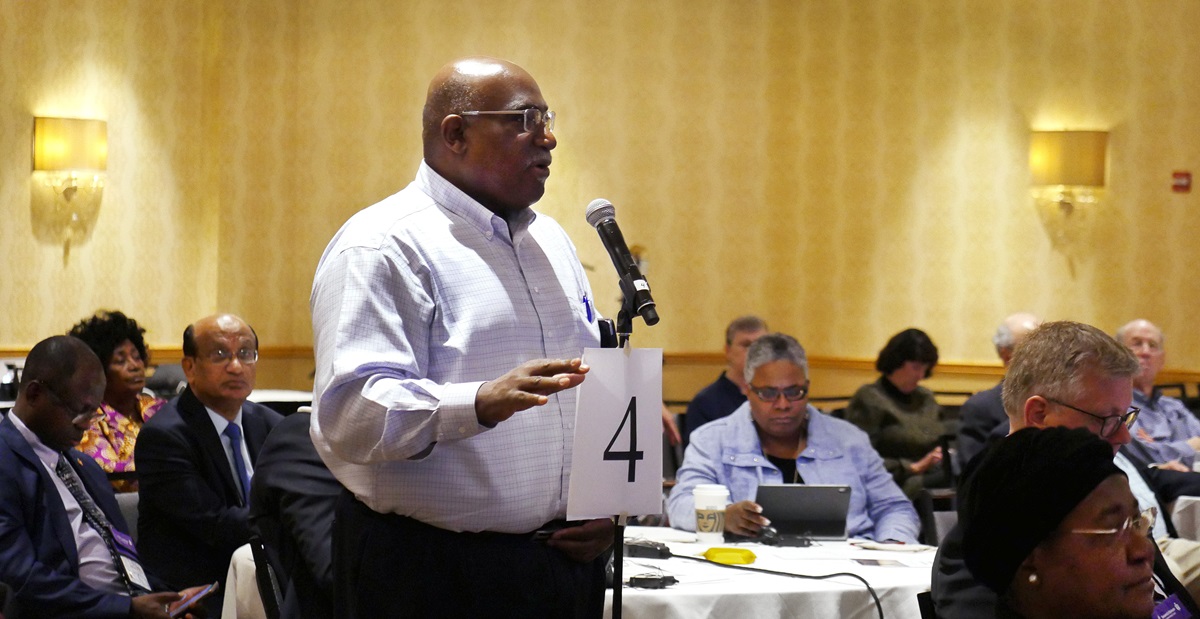
At a meeting that saw questions about United Methodist unity, bishops had no debate about moving toward closer ties with The Episcopal Church.
By unanimous voice vote May 9, the Council of Bishops approved asking General Conference to agree to full communion with a denomination that, like The United Methodist Church, has historic ties to John Wesley’s Church of England.
Also, like The United Methodist Church, The Episcopal Church has experienced its own divisions around the role of LGBTQ Christians in church life.
Full communion means each church acknowledges the other as a partner in the Christian faith, recognizes the validity of each other’s baptism and Eucharist, and commits to work together in ministry. Such an agreement also means Episcopalians and United Methodists can share clergy.
“It’s always a great opportunity when we talk about full communion to say what it is and what it is not,” Bishop Gregory V. Palmer told his colleagues. “It’s not an organic merger, two denominations becoming one, but the reminder that we see in one another the signs of church — one holy catholic and apostolic church.”
Palmer, who leads the West Ohio Conference, also serves as co-chair of the United Methodist and Episcopal dialogue committee.
By virtue of the long-scheduled church meetings, The United Methodist Church’s top lawmaking body will have first crack at the full-communion agreement when it meets May 5-15, 2020, in Minneapolis.
If the pact wins approval there, it will next head to The Episcopal Church’s General Convention in July 2021 in Baltimore.
The bishops’ decision to press ahead with full communion comes after the special General Conference in February that saw about 53 percent of delegates vote to reinforce bans on same-sex weddings and “self-avowed practicing” gay clergy.
Since that time, United Methodists of varying views have been holding discussions around the church about plans to resist General Conference action and possible ways to separate and still maintain some shared mission. At the same May 4-9 meeting that had bishops supporting drawing closer to Episcopalians, they agreed to explore new forms of denominational unity.
In some ways, The Episcopal Church has already made the same journey United Methodists are on but in a different direction. The denomination ordains openly gay clergy and has opened the way for clergy to perform same-gender weddings. Church members who disagreed with these moves, and in many cases the ordination of women, separated to form the Anglican Church in North America.
Bishop Kenneth H. Carter, the president of the Council of Bishops, said that after General Conference, he heard from Episcopal bishops who offered solidarity. The majority of United Methodist bishops had backed a plan that would have allowed more freedom on questions of marriage and ordination.
In April, the United Methodist-Episcopal dialogue committee met for a previously scheduled meeting and February’s General Conference was part of the discussion.
“We feel the pain and inexpressible weight of discrimination that is the burden of LGBTQ Christians whose lives are so often objectified, debated, dismissed,” the committee said in a joint statement. The committee includes five leaders from each denomination as well as a United Methodist and two Episcopal staff members.
The committee members went on to say they acknowledge the special General Conference had deepened divisions within The United Methodist Church and raised questions about the prospects of full communion.
“And yet, we believe that what we are experiencing in the various crises of our denominational life is the birth pangs of something remarkable, something new,” the statement said. “We believe that the forces of polarization, mistrust, and animosity in our society and in our ecclesial life will not have the last word.”
In short, Palmer told his colleagues, the dialogue team agreed to continue to walk hand in hand toward the future.
Retired Bishop Rosemarie Wenner told the Council of Bishops she appreciated that the statement acknowledged The United Methodist Church’s situation but still struck a hopeful note.
“There is no silence about where we are, and yet we move forward in relationship,” said Wenner, who served in Germany and now works as Geneva secretary for the World Methodist Council.
She acknowledged that like all retired bishops she has voice but not vote at council meetings but offered her hearty gratitude.
The United Methodist Church already has full-communion agreements with the Evangelical Lutheran Church in America, five Pan-Methodist denominations and the Moravian Church in North America. These denominations have differing teachings related to homosexuality.
“The goal of full communion and the role of bilateral conversations was to find the common ground, but it was not primarily driven by a mission of fixing one another,” Palmer said.
The ultimate goal, he said, is being together with one another.
Hahn is a multimedia news reporter for United Methodist News Service. Contact her at (615) 742-5470 or [email protected]. To read more United Methodist news, subscribe to the free Daily or Weekly Digests.
By unanimous voice vote May 9, the Council of Bishops approved asking General Conference to agree to full communion with a denomination that, like The United Methodist Church, has historic ties to John Wesley’s Church of England.
Also, like The United Methodist Church, The Episcopal Church has experienced its own divisions around the role of LGBTQ Christians in church life.
Full communion means each church acknowledges the other as a partner in the Christian faith, recognizes the validity of each other’s baptism and Eucharist, and commits to work together in ministry. Such an agreement also means Episcopalians and United Methodists can share clergy.
“It’s always a great opportunity when we talk about full communion to say what it is and what it is not,” Bishop Gregory V. Palmer told his colleagues. “It’s not an organic merger, two denominations becoming one, but the reminder that we see in one another the signs of church — one holy catholic and apostolic church.”
Palmer, who leads the West Ohio Conference, also serves as co-chair of the United Methodist and Episcopal dialogue committee.
By virtue of the long-scheduled church meetings, The United Methodist Church’s top lawmaking body will have first crack at the full-communion agreement when it meets May 5-15, 2020, in Minneapolis.
If the pact wins approval there, it will next head to The Episcopal Church’s General Convention in July 2021 in Baltimore.
The bishops’ decision to press ahead with full communion comes after the special General Conference in February that saw about 53 percent of delegates vote to reinforce bans on same-sex weddings and “self-avowed practicing” gay clergy.
Since that time, United Methodists of varying views have been holding discussions around the church about plans to resist General Conference action and possible ways to separate and still maintain some shared mission. At the same May 4-9 meeting that had bishops supporting drawing closer to Episcopalians, they agreed to explore new forms of denominational unity.
In some ways, The Episcopal Church has already made the same journey United Methodists are on but in a different direction. The denomination ordains openly gay clergy and has opened the way for clergy to perform same-gender weddings. Church members who disagreed with these moves, and in many cases the ordination of women, separated to form the Anglican Church in North America.
Bishop Kenneth H. Carter, the president of the Council of Bishops, said that after General Conference, he heard from Episcopal bishops who offered solidarity. The majority of United Methodist bishops had backed a plan that would have allowed more freedom on questions of marriage and ordination.
In April, the United Methodist-Episcopal dialogue committee met for a previously scheduled meeting and February’s General Conference was part of the discussion.
“We feel the pain and inexpressible weight of discrimination that is the burden of LGBTQ Christians whose lives are so often objectified, debated, dismissed,” the committee said in a joint statement. The committee includes five leaders from each denomination as well as a United Methodist and two Episcopal staff members.
The committee members went on to say they acknowledge the special General Conference had deepened divisions within The United Methodist Church and raised questions about the prospects of full communion.
“And yet, we believe that what we are experiencing in the various crises of our denominational life is the birth pangs of something remarkable, something new,” the statement said. “We believe that the forces of polarization, mistrust, and animosity in our society and in our ecclesial life will not have the last word.”
In short, Palmer told his colleagues, the dialogue team agreed to continue to walk hand in hand toward the future.
Retired Bishop Rosemarie Wenner told the Council of Bishops she appreciated that the statement acknowledged The United Methodist Church’s situation but still struck a hopeful note.
“There is no silence about where we are, and yet we move forward in relationship,” said Wenner, who served in Germany and now works as Geneva secretary for the World Methodist Council.
She acknowledged that like all retired bishops she has voice but not vote at council meetings but offered her hearty gratitude.
The United Methodist Church already has full-communion agreements with the Evangelical Lutheran Church in America, five Pan-Methodist denominations and the Moravian Church in North America. These denominations have differing teachings related to homosexuality.
“The goal of full communion and the role of bilateral conversations was to find the common ground, but it was not primarily driven by a mission of fixing one another,” Palmer said.
The ultimate goal, he said, is being together with one another.
Hahn is a multimedia news reporter for United Methodist News Service. Contact her at (615) 742-5470 or [email protected]. To read more United Methodist news, subscribe to the free Daily or Weekly Digests.
Like what you're reading? Support the ministry of UM News! Your support ensures the latest denominational news, dynamic stories and informative articles will continue to connect our global community. Make a tax-deductible donation at ResourceUMC.org/GiveUMCom.


