Faced with a potential denominational split put on hold by pandemic, many United Methodists feel stuck.
That has not stopped heated disputes over church life among United Methodists, especially on social media channels.
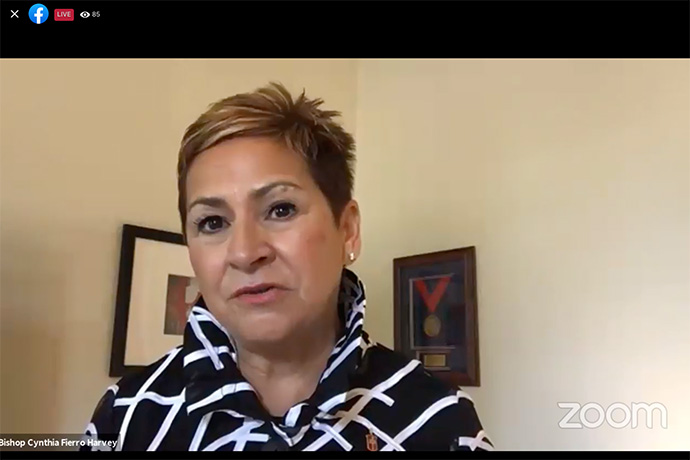
In her second public address as Council of Bishops president, Bishop Cynthia Fierro Harvey encouraged church leaders to use this time of waiting to focus on the church’s outward mission — not on its internal turmoil.
“We must stop stirring the pots and creating our own chaos,” said Harvey, who also leads the Louisiana Conference. “We have the power within us, by the Holy Spirit, to speak truth, to act on the injustices in our world. We must speak the truth with love, and in love.”
Harvey spoke to United Methodists spread across four continents — bishops meeting by Zoom and the wider church watching on the bishops’ Facebook page. She spoke at the beginning of a weeklong meeting in which bishops will discuss the work the denomination is already doing to address injustice — starting with its anti-racism efforts.
Harvey used her address to speak to both fellow bishops and delegates elected to General Conference, the denomination’s top lawmaking assembly.
The COVID-19 pandemic has twice postponed General Conference from its original dates in May 2020, and the international meeting is now scheduled for Aug. 29-Sept. 6, 2022, in Minneapolis.
After decades of intensifying debate over the status of LGBTQ Christians, the lawmaking assembly faces multiple proposals to split along theological lines. One such proposal, if adopted, would allow the withdrawal of annual conferences — regional bodies of the denomination that bishops lead. Bishops preside but do not vote at General Conference.
In this time of uncertainty, the bishops plan to use their spring meeting also to discuss the changing role of the episcopacy.
More than a dozen U.S. bishops hope to retire this year. But the Council of Bishops is urging a hold on electing their successors, citing financial concerns and the fact that it’s still uncertain who will stay and who will go.
In the meantime, a group of U.S. delegates is urging bishops to call special jurisdictional conference sessions in the U.S. to elect bishops and agency board members.
In her address, Harvey told delegates that legislation and electing bishops are just a part of their work.
“You have agency to help focus our narrative on the mission of the church, focus our narrative on love in action,” she said.
As the church waits for the work of General Conference, the bishops used the first day of their meeting to talk about what some of that action looks like.
Amid the deaths of unarmed Black and brown people at the hands of law enforcement and attacks on Asian Americans in the U.S., the bishops initiated efforts to dismantle racism.
Bishops gave examples of what those efforts look like in their conferences. A number of bishops have appointed leaders within their conferences to oversee the work of racial reconciliation. They have also initiated studies and conversations within local churches.
Bishop Tracy S. Malone of the East Ohio Conference noted that all conference clergy had to participate in “Critical Conversations,” a daylong training in how to stand against racism.
She said the decision to require the training brought pushback but also results. “Guess what, friends,” she told fellow bishops. “We had 100 percent attendance.”
Bishop L. Jonathan Holston of the South Carolina Conference noted that the Palmetto State’s history “screams racism,” from Charleston’s having been a major slave market to the 2015 mass shooting at that city’s Emanuel African Methodist Episcopal Church, with many episodes in between.
Holston described for his colleagues how the South Carolina Conference has rolled out a six-part resource called “Our Response to Racism.”
“We are doing this step by step, district by district, church by church,” he said.
Still, the work is not easy. Bishop Gary Mueller, who leads the Arkansas Conference, said he and other church leaders always try to describe the problem of racism in terms of human sin.
“The biggest challenge we face is that white people only want to deal with racism long enough for our guilt to go away or at least seriously diminish,” Mueller said. “We have a challenge to keep after this.”
Mueller also spoke about the conversations churches are engaging in.
Subscribe to our
e-newsletter
“I am not threatened by the disagreement,” said the Council of Bishops president. “I actually think it’s good for us to come together as we would at a table to agree, to disagree, to create, to use our best thinking in order to create a new thing. I humbly request we do this in the spirit of love for the church and one another.”
Jessica Vittorio, a North Texas Conference delegate who is among those urging special jurisdictional conferences, said that the bishop’s imagery resonated.
“I so deeply appreciated Bishop Harvey’s metaphor on coming together as a family and the importance and power of sharing our experiences and lives around the table,” she told United Methodist News.
“But the power of the table can be both inclusive and exclusive, as we have seen far too often in the UMC. My hope is that the council will act more intentionally going forward in inviting the rest of the church to join the episcopacy at their table.”
Harvey also used her address to reflect on the beloved Psalm 23, which promises that God guides people to what they need and prepares a table for them.
That resonated with Bishop Lawson Bryan of the South Georgia Conference.
“I appreciate Bishop Harvey’s focus on Psalm 23 as an important resource for leading in chaotic times,” he said. “Her address connects directly to our theme here in South Georgia: Alive Together at the Table. To paraphrase N. T. Wright, not to come to the table first is already to get the answer wrong. Let’s be alive together at the table.”
Hahn is assistant news editor for UM News. Sam Hodges, a UM News reporter in Dallas, contributed to this story. Contact them at (615) 742-5470 or [email protected]. To read more United Methodist news, subscribe to the free Daily or Weekly Digests.
Like what you're reading? Support the ministry of UM News! Your support ensures the latest denominational news, dynamic stories and informative articles will continue to connect our global community. Make a tax-deductible donation at ResourceUMC.org/GiveUMCom.