

Key points
- The United Methodist Church and The United Church of Canada, which share Wesleyan roots, have formed an interim covenant as they work toward full communion.
- Adding urgency to the growing cooperation is migration of United Methodists to Canada.
- The move also comes as the Council of Bishops prepares to hold its Leadership Gathering in Canada with the blessing of The United Church.
Two denominations with historic ties to John Wesley are strengthening their ties with each other.
Driving the move, in part, is the increasing migration of United Methodists from around the globe to Canada.
The United Methodist Council of Bishops and leaders of The United Church of Canada, at separate meetings this spring, each approved an interim covenant that mutually affirms both denominations’ clergy and opens the door to greater cooperation across national borders.
The covenant also declares the leaders’ intention to propose a formal relationship between the two denominations to their top policymaking bodies — the United Methodist General Conference and the Canadian church’s General Council. Both assemblies are next set to meet in 2028.
The denominations’ leaders see the interim agreement as a crucial step toward full communion, which would allow clergy from one denomination to serve in the other.
“This interim covenant deepens a friendship in Christ that allows The United Methodist Church and The United Church of Canada to walk more closely together in witness, worship and shared mission for the sake of a world God so loves,” said Council of Bishops President Ruben Saenz Jr. He is also bishop of the Horizon Texas Conference.
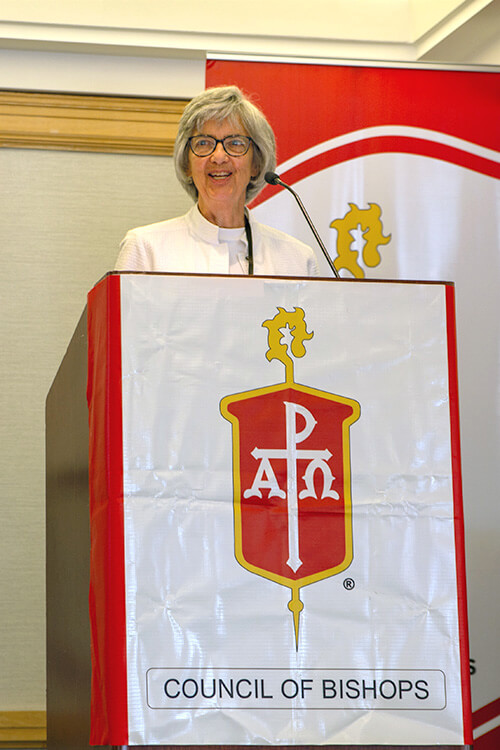
The Council of Bishops approved the interim covenant April 28 at its spring meeting in Jacksonville, Florida. The United Church’s General Council Executive, the denomination’s decision-making body between General Council meetings, approved the agreement at its online May 8-9 meeting.
The interim covenant comes as The United Church of Canada is preparing to welcome the 2026 Council of Bishops Leadership Gathering, which is scheduled Oct. 20-24 at Knox United Church in Calgary.
Hosting the gathering, Saenz said, “is both a sign and a catalyst of this growing partnership, embodying the kind of ecumenical imagination and cross-border collaboration we believe the Holy Spirit is awakening in our churches today.”
The United Church of Canada, the largest Protestant church in its country, formed in 1925 as a union of the Methodist Church in Canada, the Congregational Union of Canada, and most of The Presbyterian Church in Canada. When The United Methodist Church formed in 1968, the Evangelical United Brethren’s Canadian Conference opted to join The United Church of Canada.
Today, The United Church of Canada has more than 300,000 members while the international United Methodist Church has about 11 million members in Africa, Europe, the Philippines and the United States.
The Rev. Michael Blair, The United Church of Canada’s general secretary, said he is grateful that the two denominations are at a point where they can now officially move forward with conversations that have mainly taken place on the side over the years.
“I think that it’s a critical step forward in building the relationship with The UMC,” Blair said. “But also, I think one of the payoffs will be how we support migrant Methodist communities here in Canada.”
The rise in migrant communities has added urgency to the push for closer cooperation between the denominations. In recent years, an increasing number of United Methodists from the Philippines and Africa, especially Zimbabwe, have moved to Canada and sought to form worship communities like they had at home.
Both The United Methodist Church and United Church are members of the World Methodist Council — an ecumenical organization of more than 80 denominations in the Wesleyan family. The group encourages its members to consult with each other before planting churches in each other’s territory. After all, the group’s goal is to spread the Methodist expression of Christianity, not create competition.
Some United Methodist newcomers requested permission from The United Church of Canada before setting up their own congregations. But that hasn’t always been the case.
“The United Methodist Church acknowledges insensitivity in this developing reality as we express deep appreciation for the generous conversations with The United Church of Canada,” Bishop Hope Morgan Ward, United Methodist co-ecumenical officer, said in a statement to The United Church of Canada.
“We express a deep desire to humbly and faithfully work in relationship with The United Church of Canada,” she said. “We anticipate with you the gift of new possibility and potential for partnership that is mutually honoring and enriching.”
Ward told United Methodist News that The United Church of Canada and The United Methodist Church have been in relationship for a long time.
“The present agreement is an expression of hope for a deeper and more practical working relationship,” she said.
Under the agreement, United Methodist leaders pledge to consult with their Canadian counterparts before establishing any new United Methodist congregations in the country. The leaders of both denominations also commit to the development of shared ministries among migrant populations.
“What the agreement will eventually create, I think, is an opportunity where those congregations can be in a much more direct relationship with The United Church, so in some ways they may end up being joint United Church-United Methodist congregations,” said Blair, The United Church of Canada leader.
Eventually he expects The United Church to help provide both oversight and support for personnel serving those congregations as well as opportunities for more United Methodist clergy to serve within the Canadian context.
The United Methodist Board of Global Ministries, the denomination’s mission agency, has long worked with migrant communities around the globe.
Roland Fernandes, the top executive of Global Ministries as well as the United Methodist Board of Higher Education and Ministry, cheered the interim covenant.
“This interim covenant reflects our commitment to deeper unity — not as an abstract goal, but as a lived reality expressed in shared ministry,” he said.
“At a time when so many communities are seeking connection and hope, this step strengthens our ability to serve more faithfully together. In these times of challenge, working together across denominations is even more critical for all God’s people.”
With The United Church’s blessing, the United Methodist Upper New York and Pacific Northwest conferences already support congregations started by United Methodist migrants in Ontario and British Columbia.
Subscribe to our
e-newsletter
The oldest of these is First United Methodist Church of Canada, a multisite congregation that ministers with predominantly Filipino immigrant families across 110 miles of British Columbia.
The Rev. Norman Feliciano, the church’s lead pastor, is an ordained United Methodist elder from the Middle Philippines Conference who came to Canada in 2016. The church grew out of a Bible study he led with co-workers.
Bishop Cedrick D. Bridgeforth, whose Greater Northwest Area encompasses the Vancouver-area congregation, said the interim agreement helps give language and structure to a relationship that already has been taking shape on the ground.
“This is not only about denominational documents,” he said. “It is about people … seeking spiritual home, familiar worship, pastoral care and a connection to the Methodist tradition while living and serving in Canada.”
Strengthening the denominations’ ties is both practical and missional, Bridgeforth said. “At their best, they are spiritual commitments to walk together, learn from one another and join God’s work in the world,” he said. “We do not need to compete where we can collaborate. We do not need to duplicate what can be shared.”
Bridgeforth expects migration will continue to be a reality affecting Christian life around the globe.
“The question before us is not simply, ‘Whose church is this?’” he said. “The better question is, ‘How do we faithfully care for the people God has placed before us?’”
Hahn is assistant news editor for UM News. Contact her at (615) 742-5470 or [email protected]. To read more United Methodist news, subscribe to the free UM News Digest.


