
Key Points:
- United Methodist bishops seek to ease concerns about a decision by the denomination’s top court leaving same-sex weddings up to pastors.
- How the decision applies in practice will be largely up to local context, the bishops said.
- The decision does not supersede local laws banning same-sex weddings nor take away central conferences' rights to set their own marriage policies, the bishops said.
- The bishops also urged pastors in areas where same-sex marriage is legal to consider the views of their congregations.
United Methodist bishops are hoping to clear up confusion about a recent decision by the denomination’s top court dealing with same-sex weddings.
The Judicial Council on April 29 released Decision 1516, which reaffirms the longtime principle that pastors have discretion in whether they officiate at any marriage ceremony. Specifically, the ruling says a church’s trustees can neither forbid nor compel their pastor’s performance of same-sex weddings within the church facility.
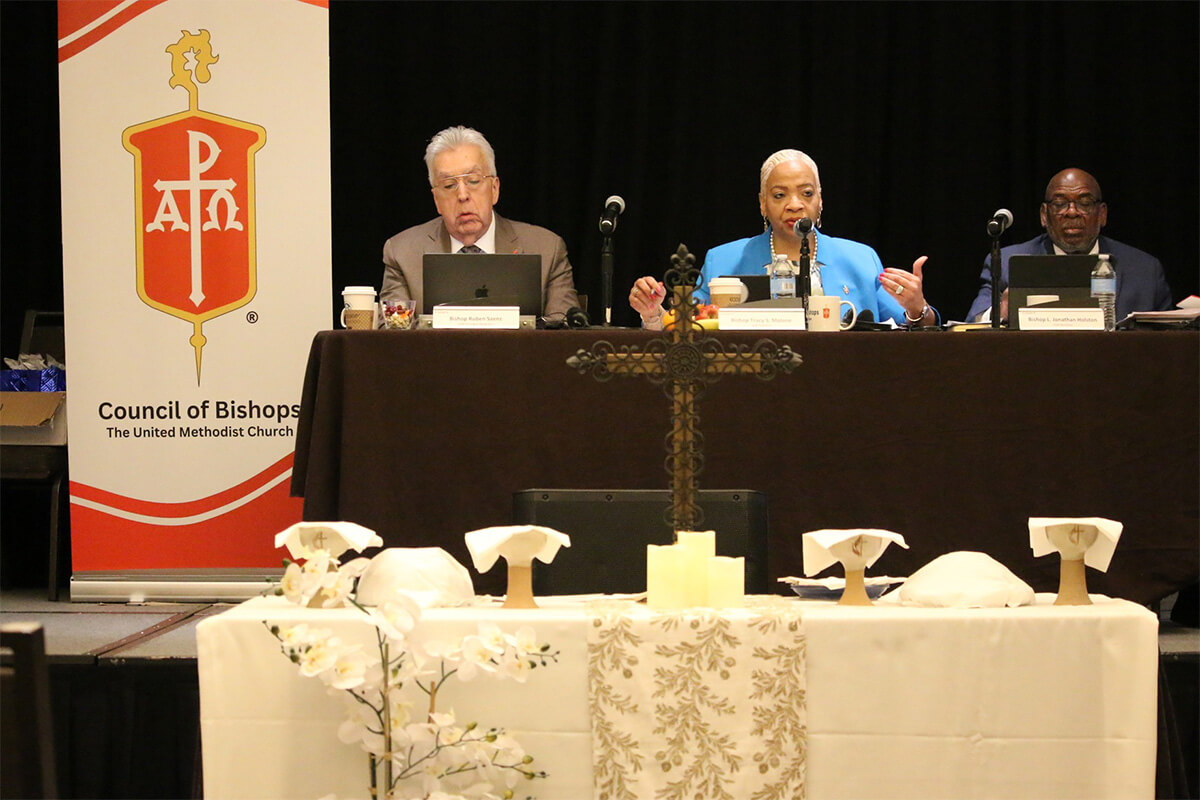
The decision became public while the bishops were holding their April 27-May 2 meeting in Chicago. A number of bishops subsequently saw their email boxes fill with notes from United Methodists and others concerned about the ruling. On the final day of the meeting, the Council of Bishops approved a statement in response.
Learn more
The Council of Bishops released its statement on Judicial Council Decision 1516.
The bishops’ overall message: Context matters in how the decision applies.
“As bishops, we expect that the pastors we appoint will continue to exercise their authority with deep pastoral sensitivity to the congregation and community to which they are appointed,” said the bishops’ statement, released late May 2, after the meeting adjourned.
“We also affirm that the Judicial Council decision does not negate the powers and duties that apply only in the central conferences.”
Central conferences are United Methodist regions in Africa, Europe and the Philippines. In many of the countries within central conference borders, same-sex weddings not only go against local understandings of Scripture but also national law.
“Decision 1516 does not authorize United Methodist clergy to violate civil law in their practice of ministry,” the bishops’ statement said.
Last year, General Conference — the denomination’s top lawmaking assembly — also passed legislation submitted by the Council of Bishops that explicitly allows central conferences to set their own standards for clergy ordination and marriage rites. The international gathering approved this measure days before eliminating denomination-wide bans on gay clergy and same-sex weddings. The legislation is now Paragraph 544.15 in the denomination’s Book of Discipline, the church’s law book.
The Philippines, West Africa and Africa central conferences, which have met since General Conference, have put policies in place that recognize marriage only between a man and woman.
“It is our understanding that Judicial Council Decision 1516 does not take away the rights of central conferences given in the Book of Discipline to determine policies on rites and ceremonies, including marriage,” said Bishop David Bard, who submitted the central-conference legislation on behalf of the bishops.
He also drafted the bishops’ response to the decision with input from bishops around the globe.
Subscribe to our
e-newsletter
“So this Judicial Council decision does not give pastors authority in those places where it may be against civil law to officiate at certain kinds of wedding ceremonies,” Bard said. He leads the Michigan Conference and co-leads the Illinois Great Rivers Conference.
“Nor does it give them the authority of their central conferences that set policies about marriages.”
United Methodist lay and clergy at annual conferences worldwide are currently voting on regionalization, a package of amendments to the denomination’s constitution that, if ratified, would essentially strengthen central conferences’ right to set marriage and ordination standards and extend that same right to the U.S.
Even where same-sex marriage is legally recognized, bishops are urging their pastors to take the context of their appointment into consideration.
After the ruling, Bishop Laura Merrill offered a pastoral word to the Arkansas Conference, which brought the question to the Judicial Council about the role of trustees and pastors with regard to same-sex weddings.
“It is our earnest hope that clear, respectful, caring conversation will be the standard for our Christian leaders in our congregations,” Merrill said in a statement after the ruling. She leads the Arkansas, Oklahoma and Oklahoma Indian Missionary conferences.
“The relationship between pastor and congregation must be built on trust,” she added.
Bishops have final authority on where clergy are appointed, but appointments are typically made after hearing from local churches. Pastors at odds with their flock may find themselves facing a change in appointments.
“While the Judicial Council ruled what it ruled, there are some contextual realities with that, that still need to be honored, particularly in our central conferences … and even within the U.S. context,” Council of Bishops President Tracy S. Malone told United Methodist News.
The bishops ended their response with the hope that they eased anxiety.
They also stressed what United Methodists share in common.
The same week as the Judicial Council ruling, bishops and other denominational leaders unveiled a new vision for The United Methodist Church, identifying the denomination as Christian disciples “who, empowered by the Holy Spirit, love boldly, serve joyfully, and lead courageously in local communities and worldwide connections.”
United Methodists “continue to desire and strive to be a world-wide church that is one with Christ, one with each other and one in ministry to all the world,” the bishops’ statement said, “while recognizing the unique contexts for that ministry.”
Hahn is assistant news editor for UM News. Contact her at (615) 742-5470 or [email protected]. To read more United Methodist news, subscribe to the free UM News Digest.


