
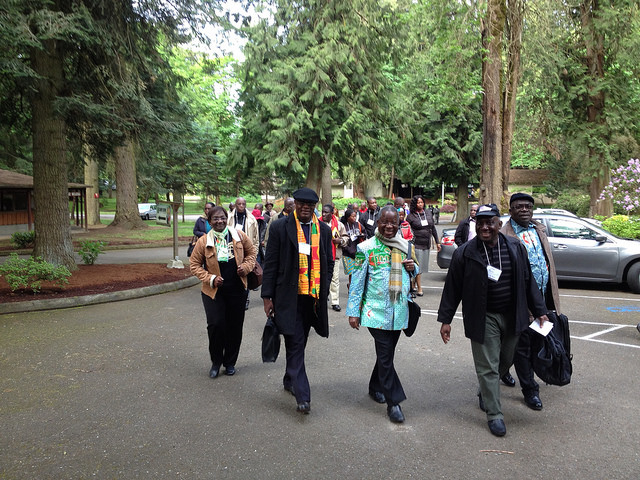
African delegates say they enter this General Conference 2016 better prepared than at past legislative gatherings, and determined to gain more clout and resources for their continent’s part of The United Methodist Church.
“We are more organized. Our people are more informed,” said the Rev. Jerry Kulah, a delegate from the Liberia Conference. “Africans in the past would come to General Conference and be mute because they did not know what was going on.”
The United Methodist Church is growing in Africa, and Africans constitute about 30 percent of the 864 delegates to the General Conference, set for May 10-20 in Portland. Only the United States has a bigger delegate share.
Kulah is a leader of the Africa Initiative, an organization that brought together African delegates for a retreat focused on issues and on how General Conference works.
They met at a retreat center in Portland May 7-8. An overwhelming majority of the 260 African delegates attended, joining in briefings and prayer sessions.
“We are not a pressure group, we are not a caucus group, we are a movement intending to work along with our bishops to enhance the growth of the church in Africa,” Kulah, dean of Gbarnga School of Theology in Liberia, said.
The group heard from Thomas Kemper and the Rev. Kim Cape, top executives of the United Methodist Board of Global Ministries and Board of Higher Education and Ministry, and from Lonnie Brooks, who heads the legislative committee of the Association of Annual Conference Lay Leaders.
Logistical and financial support for the meeting came from the Renewal and Reform Coalition, which includes the unofficial evangelical caucus Good News. The coalition advocates for maintaining church teachings.
“Our goal is to really empower the Africans to be full participants in the church,” said the Rev. Thomas Lambrecht, vice president of Good News. “We’re not trying to tell them how they ought to vote and how they ought to think, but rather how to understand the process and accomplish the goals they want to accomplish.”
A push for more bishops
The Africa Initiative will be focused on supporting petitions that enhance the African presence on decision-making bodies, including future General Conferences, the Connectional Table, Judicial Council and boards of agencies.
The Rev. Forbes Matonga, a delegate from the West Zimbabwe Conference, said Africans constitute about a third of church membership but don’t have commensurate representation in the circles of power.
“Everything has to be proportional. That’s the position,” Matonga said.
Matonga predicted that would lead to African support for Plan UMC Revised, an effort to reorganize church agencies that also includes broadening central conference representation on boards.
Kulah offered a slightly different interpretation.
“We are supportive of all the petitions … that encourage more representation for Africa,” he said. “Plan UMC is just one of them.”
The Africa Initiative group also wants this General Conference to approve more bishops for Africa.
The Standing Committee on Central Conference Matters favors first having a comprehensive Africa plan, to decide where boundaries of episcopal areas and central conferences in African should be drawn for more effective ministry and mission. Five bishops would be added as part of the plan – but not until after General Conference 2020.
But the Africa Initiative wants at least two or three bishops added right away, given the growth of the church in Africa and the acknowledged need for more leadership.
“We are trying to send a signal that we are frustrated on the studies, endless studies,” Matonga said. “If they have money for studies, why don’t they have money for leadership?”
Matonga added that African delegates are willing to guarantee that funding for new African bishops would come from within Africa for the first four years.
Another issue the African delegates said they will push is greater funding for theological education on their continent. The Board of Higher Education and Ministry is advocating a renewal of the $5 million funding for the Central Conference Theological Education Fund.
But the African delegates would like to see that doubled, benefiting schools in Africa, but also in the Philippines and Europe, Kulah said.
He and Matonga praised the denomination for its longstanding, extensive financial support of Africa University, a United Methodist school in Zimbabwe. But they said the more than two dozen other United Methodist-affiliated theological schools on the continent have been much less well-supported than Africa University or the 13 United Methodist seminaries in the United States.
That view was echoed by the Rev. Kimba Evariste, another leader of the Africa Initiative, a delegate from the North Katanga Conference and president of Kabongo Methodist University in the Democratic Republic of Congo.
“I produce clergy every year,” he said. “We need more funding.”
Rule 44, sexuality
Kulah and Matonga said the African delegates are wary of the proposed Rule 44, which would provide a group discernment process at this General Conference as an alternative to Robert’s Rules of Order – to be used in petitions related to sexuality and possibly other contentious issues.
African delegates remain strongly opposed to changing church law that declares the practice of homosexuality to be incompatible with Christian teaching, prevents ordination of “self-avowed practicing” homosexuals, and keeps United Methodist clergy and churches from performing and hosting same-sex unions.
The church’s positions are roiling its membership in the United States, especially now that same-sex marriage is legal nationwide; but Africa Initiative leaders say delegates from their continent won’t support petitions for change.
“It’s not an issue of the church law remaining the same. It’s an issue of what the Bible teaches, and the Bible teaches one man, one woman for life, as far as marriage is concerned,” Kulah said.
Hodges, a United Methodist News Service writer, lives in Dallas. Contact him at (615) 742-5470 or [email protected]
Like what you're reading? Support the ministry of UM News! Your support ensures the latest denominational news, dynamic stories and informative articles will continue to connect our global community. Make a tax-deductible donation at ResourceUMC.org/GiveUMCom.


