
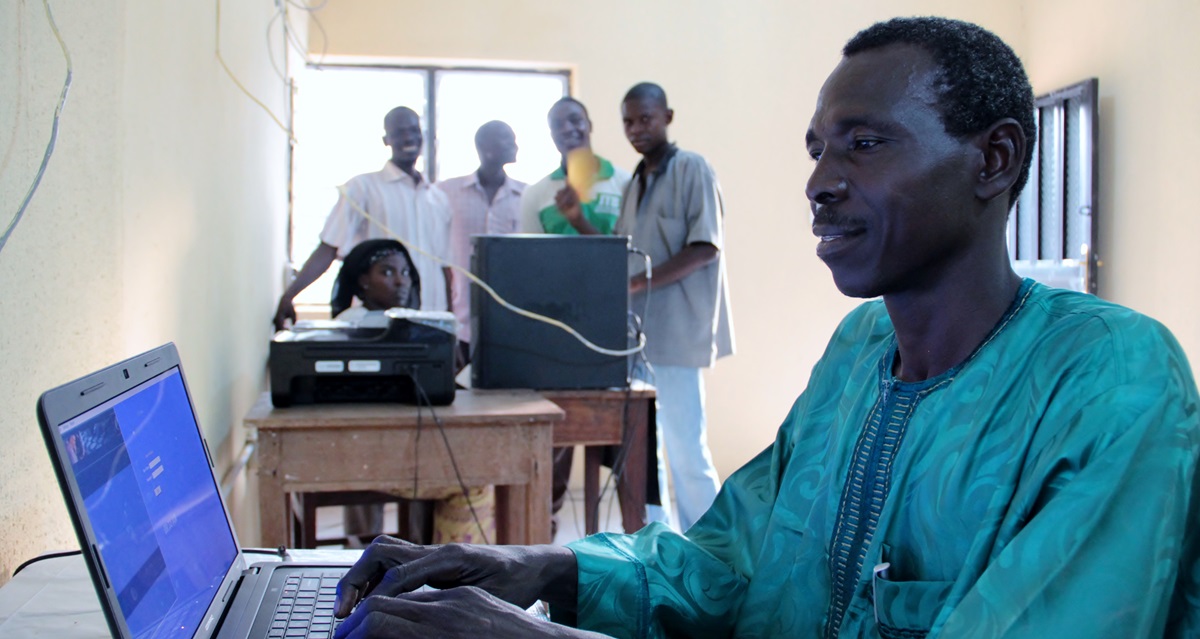
Before help came from the Central Conference Theological Education Fund, Banyam Theological Seminary depended on antiquated, gasoline-powered generators for electricity.
Often gas was unavailable, so the campus in remote, rural Nigeria would go dark after sunset. But a $50,000 grant from the fund allowed solar electrification of the library, the cyber-café and some classrooms.
Students can study later – and safer.
“With the presence of light on campus, it scares the snakes away,” said the Rev. John Pena Auta, Banyam’s provost.
He added that several students had suffered snake bites before the solar project, and only one since.
General Conference 2012, in Tampa, Florida, created the Central Conference Theological Education Fund, and General Conference 2016, set for May 10-20, in Portland, Oregon, will be asked to keep it going at the same funding level — $5 million over four years.
While the Banyam project may be unique in offering snake-bite protection, grants from the Central Conference Theological Education Fund have provided support to many far-flung United Methodist schools, pastors and pastors-in-training.
“It is helping to equip disciplined leaders for our church globally,” Liberia Area Bishop John Innis said.
In Liberia, for example, the fund assists Gbarnga School of Theology by providing money for scholarships, library restoration and e-readers loaded with theological books and articles, many from a Wesleyan focus.
The Rev. Jerry Kulah, dean of the school, does have one complaint.
“The major change I would like to see is that the fund is doubled,” he said. “The fund is helpful but inadequate to cater to the needs.”
Touching 22 countries
Along with approving the fund, General Conference 2012 assigned the Council of Bishops to elect an administrating body: the Commission on Central Conference Theological Education.
General Conference set general priorities, though, including strengthening theological schools and building Courses of Study for local and lay pastors. Scholarships and faculty development also made the list.
The commission, chaired by Innis, meets to review and award grants for projects in Africa, Asia and Europe. In one round, 73 grants totaling $1 million went to applications from 22 countries.
Grants have included $3,500 to The United Methodist Church in Romania for developing the first year of a Course of Study, and $3,000 for scholarships to the John Wesley College Divinity School in the Philippines.
A grant of $27,500 went to support theological education for United Methodist pastors in Mozambique.
As an executive of the United Methodist Board of Higher Education and Ministry, the Rev. Myron Wingfield has traveled to Africa, Europe and the Philippines, observing how the grants are working – and the enormous needs.
That’s particularly true in places where the church is trying to gain a foothold, or is growing rapidly.
“It reminds me of early Methodism, where the growth and the need for leadership was in some cases outpacing the denomination’s ability to meet that need,” Wingfield said. “But I know the effort made here, through the Central Conference Theological Education Fund, is having a huge impact.”
Toward self-sustainability
Wingfield noted that General Conference 2012 wanted the fund to support associations and networks of faculties and schools.
Grants have gone to the Africa Association of United Methodist Theological Institutions to enhance academic writing for theological education in the African context, and for help with funding and resourcing theological libraries on the continent.
The Methodist e-Academy, a project of United Methodist seminaries in Europe to educate church leaders through online distance learning courses, also has received financial support.
Wingfield credits Bishop Patrick Streiff of the Central and Southern Europe Episcopal Area with leading the effort to start an endowment to supplement theological education funding from General Conference. Streiff hopes to raise $25 million.
The Rev. Sergei Nikolaev is president of the United Methodist Moscow Theological Seminary, and he stresses that self-sustainability is the goal of that school and others like it in the central conferences.
But he sees the Central Conference Theological Education Fund as a crucial bridge, noting that it has helped his school equip its library and develop a teaching network across 11 time zones in Russia, Central Asia and Ukraine.
“It would be a great continued investment for The United Methodist Church to renew and even increase this fund,” Nikolaev said.
The fund’s U.S. cheerleaders include Sue Kromminga, who leads the Iowa Conference’s partnership with United Methodist churches and schools in Nigeria. Her several trips there have convinced her that the effort to offer better training for United Methodist clergy is worthwhile.
“They have so many things they’re fighting against, such as low life expectancy,” she said. “Just to walk beside them and help them move forward in life is part of what I feel is God’s call.”
New England Area Bishop Sudarshana Devadhar has reviewed grants made in Nigeria and many other places, as part of the commission. He too champions the Central Conference Theological Education Fund, and is willing to guarantee General Conference 2016 a return on its money.
“This investment of $5 million will continue to bear fruit for generations,” Devadhar said.
Hodges, a United Methodist News Service writer, lives in Dallas. Contact him at (615) 742-5470 or [email protected]
Like what you're reading? Support the ministry of UM News! Your support ensures the latest denominational news, dynamic stories and informative articles will continue to connect our global community. Make a tax-deductible donation at ResourceUMC.org/GiveUMCom.


