
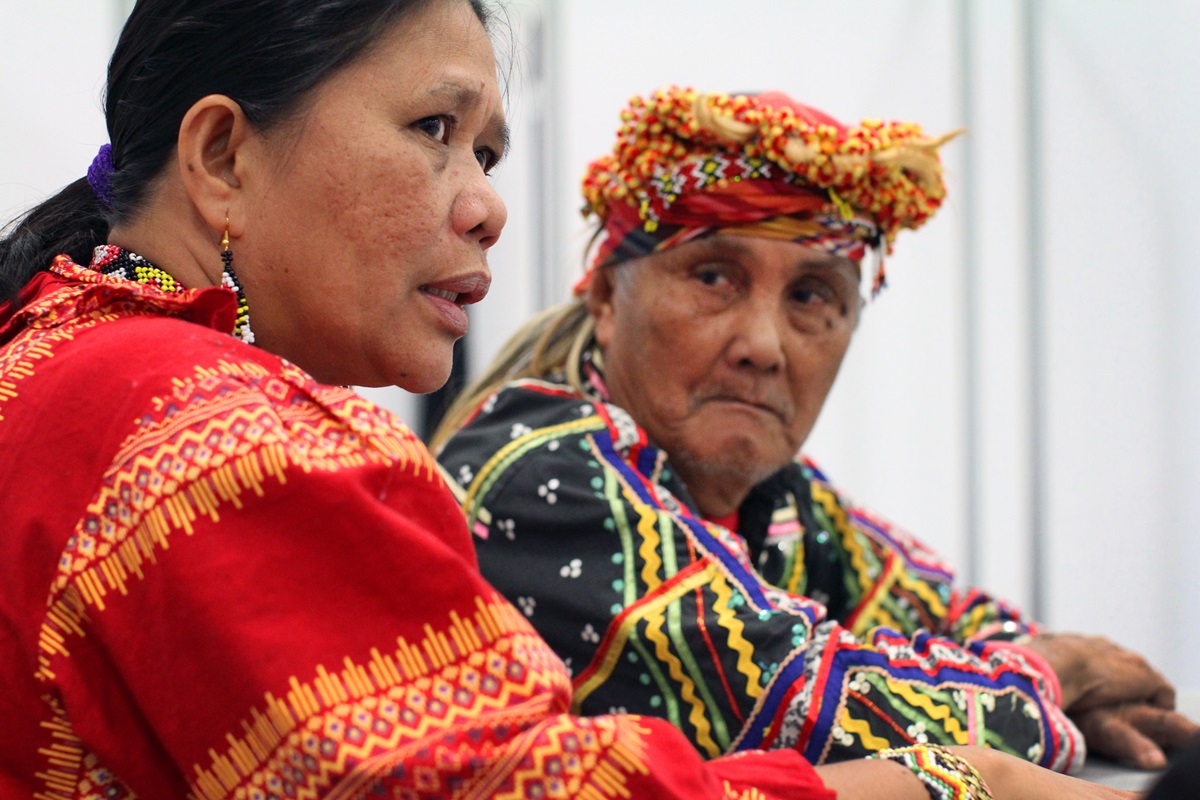
Lumads, the indigenous people of Southern Philippines, have been the target of cruelty for decades.
Ancestral land owned by the Lumads is a jewel rich in resources that tempts many, including the government.
A small group of Lumads are in the U.S. to bring the atrocities to light. On May 16, 2016 United Methodist General Conference will view a video produced by United Methodist Communications.
Norma Capuyan and Monico Cayog spoke with United Methodist News Service on May 13.
Cayog told of an “evil day” in September 2015 when 150 men, women and children were rounded up to witness militia murder two village leaders. A schoolteacher was tortured and killed in his classroom and the school burned down.
On April 1, 2016, the plight of the peaceful farmers caught the attention of the world when police forces fired on 6,000 unarmed protesters who were begging the government for food.
According to news reports, 5,000 farmers from eight municipalities of North Cotabato province assembled March 30 along the Quezon Boulevard, blocking the national highway. Whole families were part of the protest, Capuyan said.
Swat teams, snipers, started shooting at the crowd. Three were killed, 116 injured — 21 seriously — and 78 were arrested. Among those arrested were three pregnant women and three elderly, she said.
“They were compelled to protest because everyone was starving, especially the children,” said Capuyan, chair of an indigenous group advocating for the farmers.
A severe drought killed all the crops, mainly rice fields, turning a bad situation desperate.
“Children are hunting for rats,” Capuyan said. “At night, mothers gather stones from the water and boil them as soup for their crying children. The stone tastes a little like fish and it makes the children comfortable enough to sleep.”
Seeking solidarity
Kerlan Fanagel, spokesperson of the Lakbay Lumad USA and chair of Pasaka Confederation of Lumad Organization in Southern Mindanao region, said they came to the U.S. seeking solidarity, asking church people and other groups “to support and understand the struggles of indigenous peoples."
“We thank the United Methodist Church and other church people for having been an endless sanctuary to the Lumads who have evacuated, hurt and dispersed,” he said.
Cayog said violence has been happening for decades as the people struggle to protect their land.
Both Cayog and Capuyan have sacrificed much to come to the U.S. to tell their stories.
“My husband has Stage 3 cancer and my daughter just had a baby,” Capuyan said. She also said she has an arrest warrant out for her when she returns home.
Cayog said he was standing strong to bring make leaders accountable for what they have done.
“You get killed by doing nothing, it is better to do something.”
Mangiduyos is a correspondent for United Methodist News Service. Gilbert is a multimedia news reporter for United Methodist News Service. Contact her at (615) 742-5470 or [email protected].
Like what you're reading? Support the ministry of UM News! Your support ensures the latest denominational news, dynamic stories and informative articles will continue to connect our global community. Make a tax-deductible donation at ResourceUMC.org/GiveUMCom.


