
-Key points:
- For Wesleyan abolitionist Asa Mahan, sanctification meant obeying the moral law by loving God and “our neighbor as ourselves.”
- Mahan’s book “Christian Perfection” is a classic of the Wesleyan-Holiness Movement, which holds treasures that can be applied to today’s struggle for human dignity.
- While saying “no” to injustice, we must also say “yes” to affirming human life and value, writes the Rev. Dr. Christopher P. Momany.
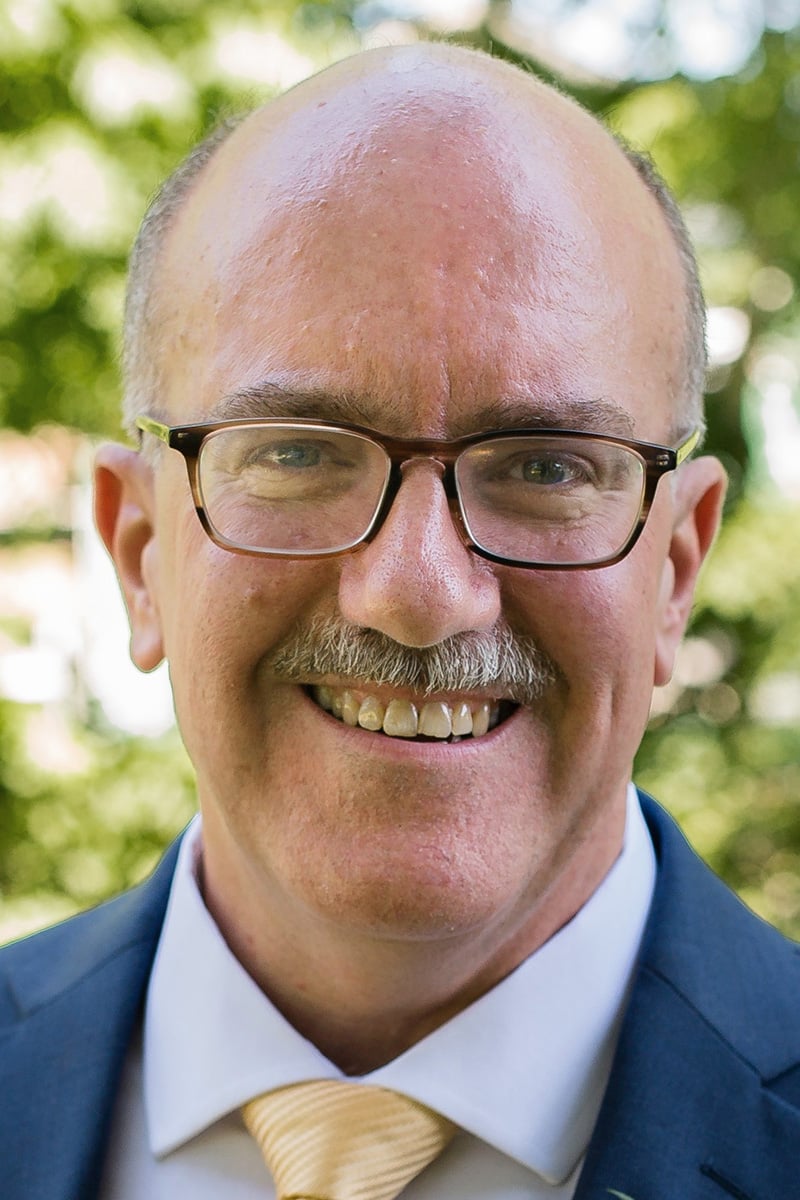
Photo by Kristen Schell.
Commentaries
In March, I received a telephone call inviting me to speak at the beginning of a demonstration. This event of resistance was organized to confront today’s abuse of political and economic power in America.
I accepted — with a few modest qualifications. I would speak for myself and not for any formal organization. Most especially, I would emphasize human dignity and ground my remarks in a theological heritage, the Wesleyan-Holiness heritage, to be exact.
When the day came, we gathered on the courthouse steps in our rural Michigan county. It was not one of the premier sites for the events happening around the nation that afternoon, and I held a very unlikely artifact in my hand. It was a first edition copy of Wesleyan abolitionist prophet Asa Mahan’s “Scripture Doctrine of Christian Perfection” (1839).
The worn and foxed pages of this text bear witness to the doctrine of sanctification. Mahan, deeply influenced by Methodism cofounder John Wesley’s “A Plain Account of Christian Perfection,” defined “sanctification” as “perfect obedience to the moral law.”
Then he wrote: “It is ‘loving the Lord our God with all our heart, and with all our soul, and with all our strength, and our neighbor as ourselves.’”
He closed his summary in Pauline fashion: “Love is the fulfilling of the law.” (Romans 13:10) Mahan believed that one cannot embrace these ideas without taking a stand for justice.
Mahan (1799-1889) served as president of the Oberlin Collegiate Institute (later Oberlin College) from 1835 to 1850. Born in Vernon, New York, and educated at Hamilton College and Andover Seminary, he got to know legendary preacher Charles Finney in the early 1830s as revivals swept the Empire State. After a brief tenure in Cincinnati and affiliation with Lane Theological Seminary, he joined the movement of many Lane students north to Oberlin in 1835.
At Oberlin, Mahan taught philosophy and ethics, but he also penned his “Christian Perfection” there. That book is now considered a classic of the early Holiness Movement — a movement of 19th-century renewal that drew from John Wesley’s focus on sanctification.
Few of those at the March demonstration in Michigan were aware of this history, and when I looked over the crowd, I knew few shared my specific Wesleyan-Holiness identity. Still, there was something for that moment within the treasures of our past. And people were listening. I could sense their hunger. They yearned for something more, something deeper than political attacks, even as they sensed the political implications in my message and the need to say, “No!”
I believe they wanted not only to say “no” to injustice but also “yes” to a more affirming life — a way that embraces justice for all of God’s creation and people. They wanted to live more fully and were exhausted by the endless stream of dehumanizing and destructive language and actions flooding our public square. It had all worn them down, left them weary and wounded, and — in some cases — without hope. They were ready for something both deeper and higher.
Subscribe to our
e-newsletter
In another sense, I was not alone on those courthouse steps. A previous structure that served as the Cass County, Michigan, courthouse hosted a landmark trial before the American Civil War. As the Underground Railroad gained momentum in America, many seeking freedom traveled north through Indiana and found safety in our county. But that all changed in 1847, when bounty hunters from Kentucky sought to kidnap emancipated people. The local community turned out to stop the injustice, a trial ensued, and the thugs were sent packing. We’ve been saying “no” for a long time.
Most of those who confronted slavery in this immediate region were Quakers, but Asa Mahan's work on sanctification and the philosophy of human dignity became popular during these years among the whole abolitionist movement. He posited that all people, as bearers of God’s image, possess an “intrinsic worth” and must not be debased by injustice. But Mahan also taught that this created value was complemented by a redeemed value, given through the Cross of Jesus.
Some traditions taught a “limited” atonement, the idea that Jesus died only for an “elect” group. Others countered and taught that the sacrifice of Jesus was general and for all. This later view was an improvement, in Mahan’s eyes, but he went even further.
Mahan believed that the sacrifice of Jesus was neither exclusive nor simply generic. It was personal and intimate — for each member of the human family. All possess both created and redeemed value. People are doubly sacred.
I struggle with my anger at the unchecked injustice, cruelty and hate in our land. I really do. Yet we have a wonderful heritage of unconditional love and unconditional justice. Let’s embrace it. There are and will be many times when we are required to say, “No!” But this “no” arises from an even more profound “yes” to human value.
Momany is an historian and writer serving as pastor of First United Methodist Church in Dowagiac, Michigan. His most recent books are “Compelling Lives: Five Methodist Abolitionists and the Ideas That Inspired Them” (Cascade, 2023) and the collaborative “Awakening to Justice: Faithful Voices from the Abolitionist Past” (InterVarsity, 2024). He is working on a history of the philosophical principles that grounded the American abolitionist movement.
News media contact: Julie Dwyer, news editor, [email protected]. To read more United Methodist news, subscribe to the free UM News Digest.


