
Key Points:
- United Methodist Bishop Minerva Carcaño has been suspended under complaint since March.
- While not naming the bishop, The United Methodist Church’s top court declined to take up the case at this stage of the judicial complaint process.
- A dissenting opinion signed by four Judicial Council members said the bishop’s rights have been violated and she is entitled to be reinstated.
The United Methodist Church’s top court declined to rule on a judicial complaint against a bishop while the church judicial process is ongoing.
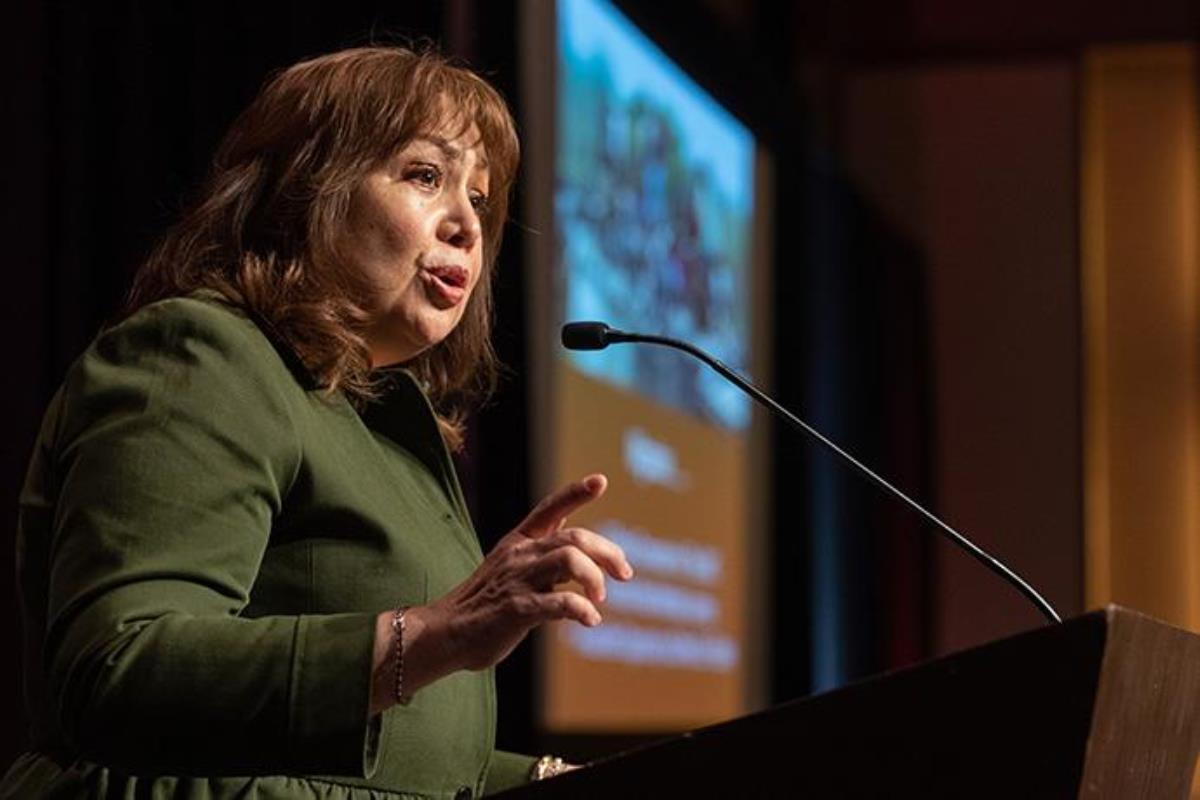
Leaders in the Western Jurisdiction announced March 9 that they had placed California-Nevada Conference Bishop Minerva Carcaño on leave from her episcopal duties as two complaints against her were under review. She has been suspended with pay and benefits since then.
While not naming the bishop, the Judicial Council said in Memorandum 1450 that a bishop has the right to appeal to the high court “only after” receiving an adverse decision at a church trial followed by an adverse decision at the jurisdictional committee on appeals.
The memorandum said that neither the Book of Discipline, the denomination’s law book, nor any of the church court’s earlier decisions “authorizes the Judicial Council to entertain an interlocutory appeal of a bishop.” An interlocutory appeal is a legal term for an appeal that takes place while other aspects of a case are still proceeding.
However, four of the nine participants in the Judicial Council’s deliberations disagreed with the majority. Judicial Council members the Rev. Kabamba Kiboko, the Rev. Dennis Blackwell, Beth Capen and Lidia N. Gulele filed a joint dissenting opinion, asserting that the Judicial Council does have jurisdiction in the case and that the bishop should be restored to her office.
“Fair process is a bedrock principle of the Church that must be present at every stage of a complaint proceeding,” the joint dissent said. “In this case, fair process has been violated. The Bishop’s rights have been violated. Therefore, we disagree with the majority opinion and believe that the Bishop is entitled to immediate reinstatement to her episcopal assignment.”
In a footnote, the majority’s decision also noted that the Western Jurisdiction had not yet met the fair-process requirement of setting up an Administrative Review Committee. The Book of Discipline in Paragraph 539 says each jurisdiction “shall establish” such a committee to ensure disciplinary procedures are followed whenever a bishop faces an involuntary action such as a leave of absence.
The Rev. Timothy Bruster, first clergy alternate, participated in this decision. The Rev. Luan-Vu Tran, who previously served under Carcaño when she was bishop of the California-Pacific Conference, recused himself and did not participate in any of the proceedings related to this decision.
Kent Fulton, first lay alternate sitting in for Deanell Tacha, also participated in this decision.
In addition to joining their colleagues in the joint dissent, Capen and Gulele filed a separate joint dissent. Carcaño’s continued suspension violates the Book of Discipline, the dissent said.
The Book of Discipline in Paragraph 413.3(a) allows for a jurisdiction’s college of bishops, in consultation with the jurisdictional committee on episcopacy, to suspend a bishop “when deemed appropriate to protect the well-being of the complainant, the Church and/or bishop.” However, Capen and Gulele noted, the Discipline says the suspension is “not to exceed 60 days.”
Their dissent also quoted the Book of Discipline’s Paragraph 523, which says: “Any bishop shall have the right of appeal to the Judicial Council.”
The dissent said the bishop is entitled to a fair-process hearing both before being placed on suspension “and particularly when the suspension extended beyond the 60-day maximum allowed by Discipline.”
The Judicial Council has sought to maintain the confidentiality of the complaint process throughout this appeal. The church court did not list the case on its docket. Before it began its deliberations, the church court held a rare closed-door oral hearing. The Judicial Council’s oral hearings are usually open to the public.
Neither the majority ruling nor the dissents offered any details on the complaints against Carcaño.
However, Carcaño’s suspension has received some very public pushback. MARCHA (Methodists Associated Representing the Cause of Hispanic/Latino Americans), the denomination’s Hispanic and Latino caucus, has urged the Western Jurisdiction College of Bishops to lift the suspension while the complaint process continues.
Since Carcaño’s suspension, retired Bishop Sally Dyck has served as the California-Nevada Conference’s interim bishop. Dyck recently announced that she plans to step down as interim bishop no later than Dec. 31.
In the coming week, the denomination’s five U.S. jurisdictions will each hold elections for new bishops and consider reassigning already active bishops. Bishops are set to take office or begin new assignments on Jan. 1. What that means for Carcaño remains to be seen.
At any time in the complaint process, the Book of Discipline encourages the people involved to work toward “a just resolution.”
The Discipline defines a just resolution as “one that focuses on repairing any harm to people and communities, achieving real accountability by making things right in so far as possible and bringing healing to all parties.”
Hahn is assistant news editor for UM News. Contact her at (615) 742-5470 or [email protected].To read more United Methodist news, subscribe to the free Daily or Friday Digests.


