
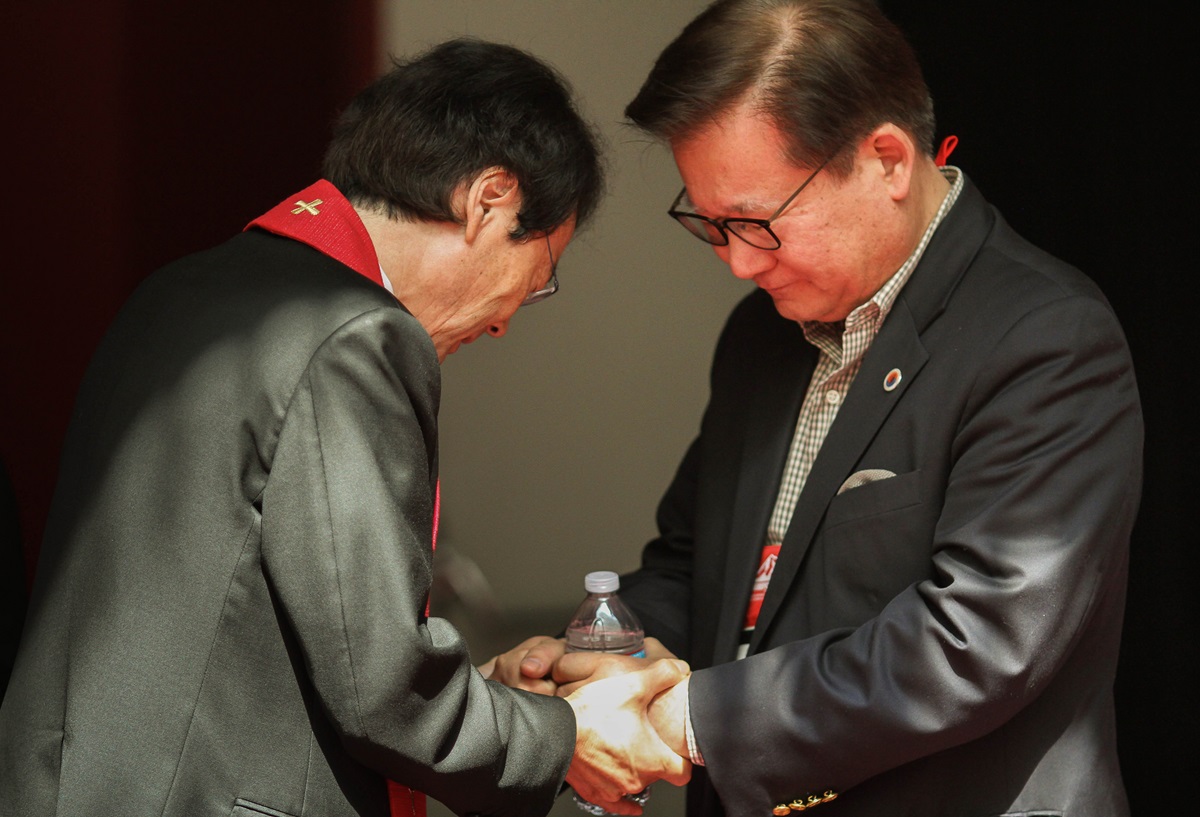
United Methodist bishops have adopted a “Covenant of Accountability,” in which they pledge to work for church unity and remain in community with each other despite differences in Christian conscience.
The covenant, the bishops stated, “is rooted in our consecration vows and … outlines how we intend to fulfill those vows and provide spiritual leadership prior to, during, and after General Conference.”
San Francisco Area Bishop Warner Brown Jr., who just completed his two-year term as Council of Bishops president, said he hopes United Methodists view the covenant as sincere.
“We are wrestling in conversation, and we have more work to do,” Brown told United Methodist News Service. “But we’re committed to serve this church with all our heart and faithfully.”
The covenant comes at a time when the bishops — as well as many of the United Methodists they lead — struggle with how the church should minister with gay and lesbian individuals.
Two weeks before General Conference, retired Bishop Melvin Talbert — for the second time — celebrated the union of two men in violation of church law. Meanwhile, African bishops, who lead a growing part of the church, publicly have urged church leaders to hold the line on church teachings regarding homosexuality.
The Book of Discipline, the church’s governing document approved by General Conference, has stated since 1972 that all individuals are of sacred worth but the practice of homosexuality “is incompatible with Christian teaching.” The book prohibits officiating at same-gender unions or ordaining “self-avowed practicing” gay clergy.
The Council of Bishops released the covenant after hours of closed-door meetings in the days leading up to the 2016 General Conference. In all council decision-making, retired bishops have voice but not vote on the final document.
The press release announcing the covenant noted that there might be a breach of the “Just Resolution” Talbert reached in a complaint after he previously officiated at a same-gender union.
However, as a matter of church governance, any complaint should be handled, not by the full council, but by the “appropriate College of Bishops,” the press release noted. In Talbert’s case, that is the Western Jurisdiction College of Bishops where he has membership.
“Appropriately, our (Book of) Discipline does not give us a role in that, and we need to honor fair process,” Brown said. “But if we said nothing, people would think we were not attentive. We are attentive, and within what is appropriate, we want to encourage the process to work.”
In the 2014 Just Resolution, Talbert agreed he was willing “to live according to the Book of Discipline.”
“I was willing to agree to that as long as people understood the Book of Discipline is more than gay marriages,” Talbert told UMNS. “The Discipline also talks about living by Christian conscience. That is what I am trying to do.”
At this point, Talbert said, he is not facing a complaint for his role in the April wedding of two men.
Where things stand
In the covenant, bishops vow to “Offer pastoral care to and with anyone,” and “Carry out our presidential duties in a manner that enables the work of the General Conference to be conducted in an orderly and non-disruptive manner.”
At previous General Conference gatherings, advocates for changing church law regarding gays and lesbians have interrupted proceedings with public demonstrations against what they see as discriminatory policies.
General Conference delegates late Tuesday included a slate of rules that, among other things, prohibits “verbal and non-verbal distractions” as delegates do their legislative work. It will be up to presiding officers to determine what constitutes distracting behavior. The role of presiding officer during plenaries rotates among active bishops. A silent demonstration in support of full inclusion of lesbian, gay, bisexual, transgender and queer or questioning did take place on May 14.
So far, petitions to remove the Book of Discipline’s prohibitions against same-gender marriage and the ordination of “self-avowed practicing” gay clergy have lost in legislative committees. However, some proposals may still go before the full General Conference plenary if there is enough support for adding them to the calendar.
Hopes for the church
West Virginia Area Bishop Sandra Steiner Ball said she hopes United Methodists will know the bishops are working toward unity and “are committed to hearing all voices in the church in a pastoral and caring way.”
Many church leaders expect the coming week of floor debate and votes to be challenging.
Dakotas-Minnesota Area Bishop Bruce R. Ough, the newly installed Council of Bishops president, said his prayer for General Conference is that “we would demonstrate to ourselves and the world that we are a community of grace — that we would show the grace to one another that Christ has shown to each of us.”
Hahn is a multimedia news reporter for United Methodist News Service. Contact her at (615) 742-5470 or [email protected].
Like what you're reading? Support the ministry of UM News! Your support ensures the latest denominational news, dynamic stories and informative articles will continue to connect our global community. Make a tax-deductible donation at ResourceUMC.org/GiveUMCom.


