
Key points:
- On U.S. Election Day, United Methodist bishops heard about the ongoing work of overcoming racism and tribalism.
- They heard from a fellow bishop and a Catholic theologian, who urged looking to both the Book of Ruth and the Epistle to the Ephesians for guidance.
- The Catholic theologian, Father Emmanuel Katongole, warned of what happens when “the blood of tribalism is deeper than the waters of baptism.”
If United Methodists want to combat racism and tribalism, they should follow the example of the early church in Ephesus.
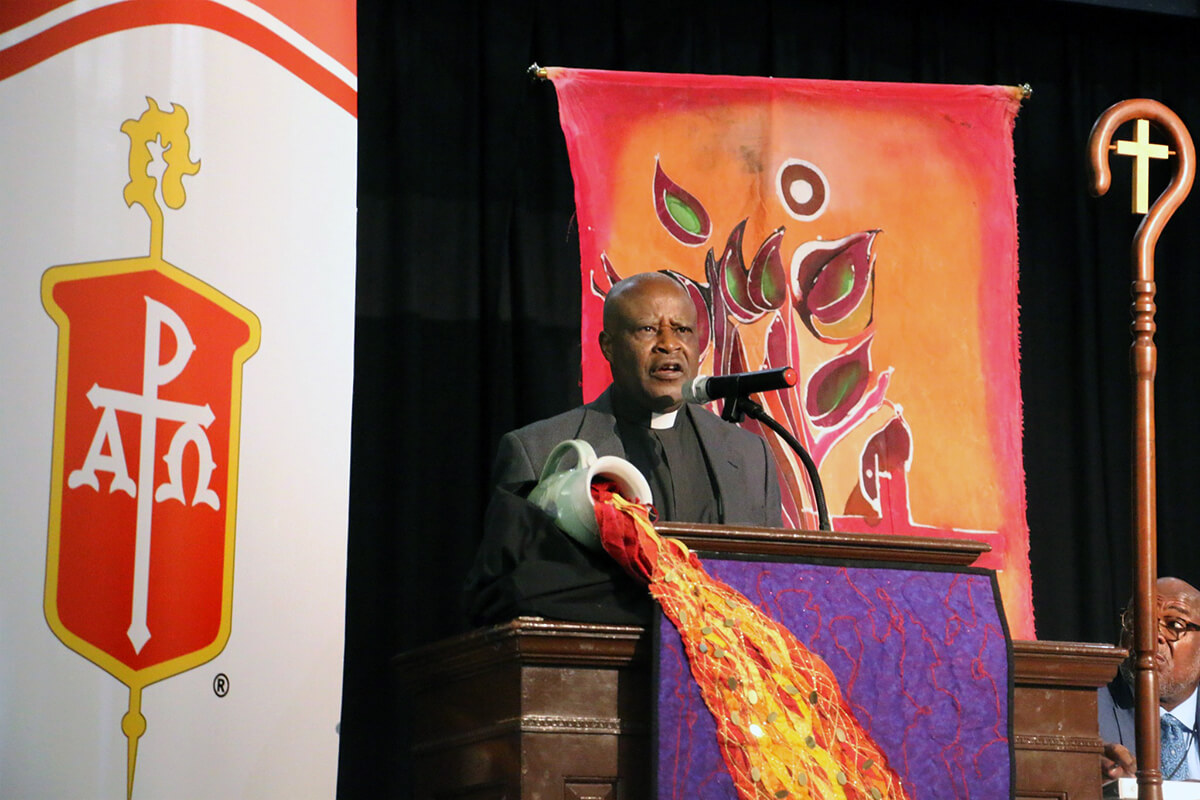
The United Methodist Council of Bishops heard that advice from Father Emmanuel Katongole, a Catholic priest and theologian who spoke to the bishops Nov. 5 about racism, tribalism and Christian identity.
In his letter to the Ephesians, Paul was writing to early Christians living in what is now Turkey and what was then a crucial city in the eastern Roman Empire. The letter praised the Ephesians of Jewish and Gentile heritage for overcoming internal tensions to successfully worship and eat together as one community in Christ.
“I want you to read again the letter to the Ephesians,” Katongole said. “And see the number of ways in which Paul says we are sharing of one hope, one Lord, one faith, one people — because we are all children of one God, the Father of all.”
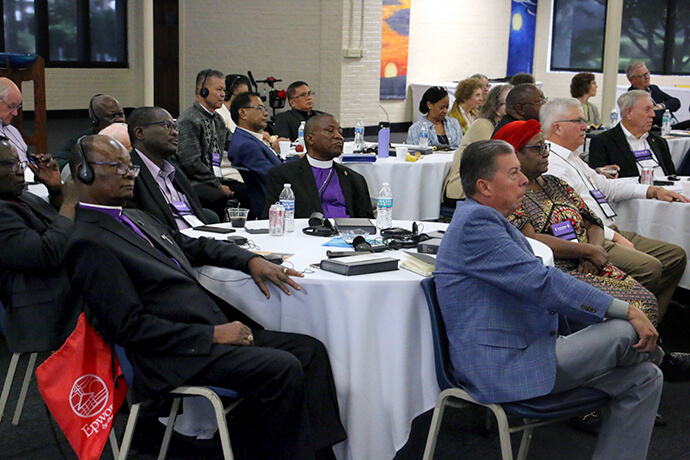
The bishops invited Katongole to address them as part of their anti-racism work. During the morning session, the bishops discussed efforts to confront racism, tribalism and colonialism, as well as the rise of authoritarianism around the globe.
They also heard a sermon by their colleague Bishop Daniel W. Schwerin, who touched on many of those concerns. Schwerin, who leads the Northern Illinois and Wisconsin conferences, called for people to form kinship across racial and ethnic lines — just as the Bible says Ruth and Naomi did across tribal lines.
Presentations to bishops
“What will define our Christianity is whether and how we love our neighbors,” he said. “We must choose between hostility and hospitality.”
Schwerin, preaching on U.S. Election Day, shared his concern about violent and hateful rhetoric during President-elect Trump’s campaign.
“I have walked the dank dungeons of Auschwitz, and I know the Ku Klux Klan is alive and well in my episcopal area, so let’s make it clear to this world that racism is incompatible with Christian teaching,” the bishop said to applause from his episcopal colleagues.
“And for United Methodists, fascism will be resisted while we have breath.”
In his presentation after worship, Katongole reminded the bishops that too often church attendance on Sunday doesn’t prevent Christians from committing atrocities later in the week.
Katongole, a native of Uganda, is the son of Rwandan immigrants — one Hutu and one Tutsi. His firsthand experience with the impact of violence, tribalism and division on the African continent eventually led him to help establish the Center for Reconciliation at United Methodist-related Duke Divinity School in Durham, North Carolina. He is now a professor of world religions and the world church at the University of Notre Dame near South Bend, Indiana.
Katongole recounted the irony that the 1994 Rwandan genocide — when Hutu militias slaughtered between 500,000 and 662,000 Tutsis — began two days after Easter Sunday.
“Many of the same Christians had participated in not only the two services of Holy Week, but in the Easter celebration of new life — Christ risen from the dead. They had sung together choruses of holy alleluias and celebrated that we were all born anew in the waters of baptism,” Katongole said. “On Tuesday, the killings started.”
During the height of the genocide, the late Pope John Paul II sent a representative to the predominantly Catholic country to try to make peace. In talking to the nation’s Christian leaders, the representative raised a question that still haunts Katongole.
He asked: “Do you mean to tell me that the blood of tribalism is deeper than the waters of baptism?”
Katongole offered the church in Ephesus as an example of how today’s Christians can ensure their shared identity in Christ is far stronger than any division.
The theologian noted that the church in Ephesus was dealing with the same debate seen throughout the early church over how Jewish and Gentile converts should interact. Some of the questions included whether Gentiles should be circumcised and whether Jewish and Gentile believers should eat together, even though they had different dietary practices and cultural heritages.
Paul, in prison, celebrates that the faithful in Ephesus remain in community together. “Paul realizes that it is in coming together that we become the body of Christ,” Katongole said.
In coming together, he said, this group also became something new needing a new name — not only Jewish nor Gentile but instead Christian.
Subscribe to our
e-newsletter
“God is determined to change us, to change who we are, to change who my people are,” the theologian said. “God is determined to do that — to create out of the many a new ‘we.’”
North Carolina Conference Bishop Connie Shelton got to know Katongole when they were both on Duke Divinity School’s faculty — she as director of field education.
She told her colleagues that what impressed her and her husband about Katongole was the Catholic theologian’s posture of serious joy.
“This concept, this serious joy, reflects his deep-rooted understanding of the complexities of the human experience,” she said, “recognizing the weight of suffering, the weight of injustice, and simultaneously witnessing to the hope toward renewal.”
Katongole shared his hope with the bishops of how coming together, even amid suffering, can truly transform people into a new Christian identity.
He said he saw a glimpse of what the church could be when Americans of multiple races came together in peaceful protests in 2020 after the murder of George Floyd. It was after Floyd’s death that United Methodists began their current efforts to dismantle racism.
Unfortunately, the moment of interracial solidarity in the U.S. proved only brief and “occasional,” Katongole said.
“I have a dream that is God’s dream, that we the people of God become that Ephesian space — that we come together in a manner that is not just occasional but becomes a culture that is who we are,” he said. “May this dream come true for you and for me.”
Hahn is assistant news editor for UM News. Contact her at (615) 742-5470 or [email protected].To read more United Methodist news, subscribe to the free Daily or Friday Digests.


