
Key points:
- Church leaders and scholars held a webinar exploring how Wesleyan theology shapes who United Methodists are around the globe.
- They also discussed how theology informs the denomination’s vision to “love boldly.”
- The webinar is the first in a series of three ahead of the bishop’s Leadership Gathering in October.
The Rev. Marian Royston sees hope for The United Methodist Church in what she calls “the mischief of the Holy Spirit.”
“If we look all around the connection, we see these little Holy Spirit-led sparks that are happening,” said Royston, who works with new and renewing churches in the North Alabama Conference. “It’s almost like we’re on the edge of a revival — if we’ll let it happen.”
Royston was among the United Methodist leaders and scholars from three continents who led a Jan. 24 webinar exploring the Wesleyan theology that undergirds the denomination’s vision to “love boldly.”
The webinar came the same week that United Methodists and other faith leaders from across the country showed their love for neighbor by traveling to the Minneapolis and St. Paul area on Jan. 23 for a day of prayer and protest.
Survey, webinar participation urged
In addition to watching the webinars, the denomination’s bishops are urging all United Methodists to participate in an online survey to help shape the Leadership Gathering’s outcomes.
“Two years ago, our denomination faced a crossroads. We carried deep divisions about identity, doctrine and mission,” said Bishop Ruben Saenz Jr., the co-convener of the Leadership Gathering’s design team.
“In this season of testing, the Council of Bishops asked a hope-filled question: What if we designed our future, not for the church, but with the church?”
The denomination-wide survey — in English, German, Korean, Spanish, French, Portuguese and Tagalog — asks United Methodists:
· What do you hope The United Methodist Church will prioritize?
· What do you envision for the denomination 50 years from now?
· What message do you want the Leadership Gathering to carry back to the whole denomination?
“The design team has made a binding commitment to weave the themes emerging from our survey responses and our webinar conversations into the October agenda in Calgary,” said Saenz, who also leads the Horizon Texas Conference. “When we gather, your voice will be in the room.”
The two other upcoming webinars are:
“Serve Joyfully” at 10-11:30 a.m. U.S. Eastern time Feb. 21, which examines Wesleyan approaches to mission.
“Lead Courageously” at 10-11:30 a.m. U.S. Eastern time March 21, which focuses on Wesleyan understandings of leadership and church life.
The hour-and-a-half webinar is the first of three discussing the denomination’s new vision statement in preparation for the Leadership Gathering that the United Methodist Council of Bishops has planned for Oct. 20-24 in Calgary in Alberta, Canada.
The next webinars, featuring different panelists, will focus on the Wesleyan teachings that inform the vision statement’s other components: “Serve joyfully” on Feb. 21 and “Lead courageously” on March 21.
Through the webinars and a survey, the bishops are inviting the whole denomination to engage in the Leadership Gathering’s work of shaping a more hope-filled future after a season of church disaffiliations.
Royston said she already has seen an example of how a post-disaffiliation denomination might look.
At historic St. Paul United Methodist Church in Birmingham, Alabama, where she is the first woman pastor, Royston said young adults have formed a Bible study and challenged the congregation to get more involved in community outreach. Late last year when the U.S. federal government suspended food assistance, the young adult group led the congregation in a food drive to help keep their neighbors from going hungry.
“I have this sincere hope that we will fan these little sparks into a flame, and that something big and beautiful and sustainable for the next generation will happen,” Royston said. “Because I have a lot of hope in the people who stayed, a lot of hope in the people who were cleaning up the rubble from the mess of COVID and disaffiliations.”
She added that she also has hope in the church leaders reevaluating United Methodist practices and conventions that may need to fall away.
“I just have a lot of hope in the people who are brave enough to follow the mischief of the Holy Spirit,” she said.
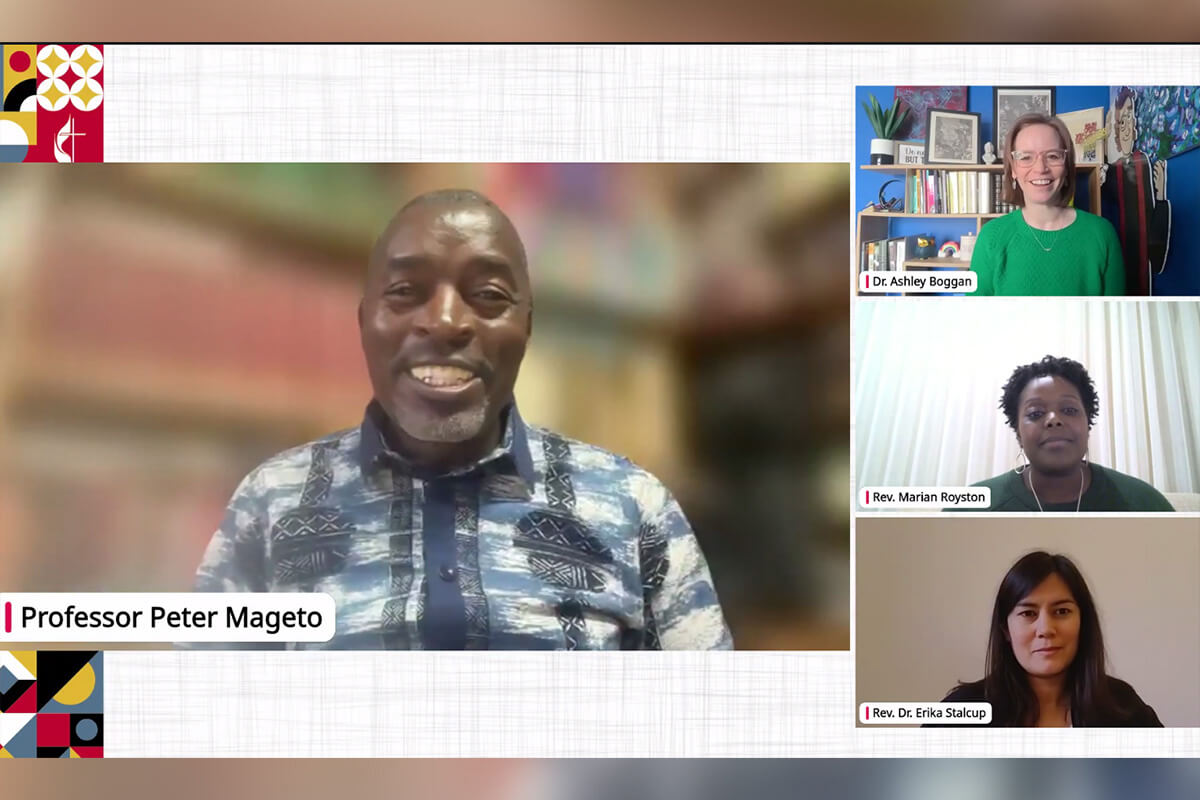
Ashley Boggan, the top executive of the United Methodist Commission on Archives and History, moderated the panel discussion that in addition to Royston included the Rev. Peter Mageto of Africa University and the Rev. Erika Stalcup of Switzerland.
At its heart, Mageto said, theology is a big word to describe the simple concept that God is speaking. Mageto is vice chancellor and professor at Africa University, the United Methodist pan-African university in Mutare, Zimbabwe.
He pointed out that the word combines the Greek terms for “God” and “word.”
“Theology, therefore, becomes God speaking in his word, and that word becomes active,” Mageto said. “Consequently, how we respond to God’s word then becomes now our conversation.”
He and his fellow panelists emphasized that the way United Methodists should respond to God’s love that they read about in Scripture is to share boldly that love with others in their contexts around the globe.
Stalcup, the United Methodist scholar in Switzerland, said Methodism’s founder, John Wesley, did not see his understanding of theology as distinctive from the shared beliefs of Christianity.
“John Wesley did not want Methodism to become an end in and of itself, but a means of living out our vocations as people who follow in Christ’s ways,” she said. Stalcup serves Village Mosaïque United Methodist Church in Lausanne, Switzerland; coordinates the Methodist e-Academy; and teaches Methodism and liturgy at Cliff College in the United Kingdom.
“So, I see that one distinctive aspect of Methodist theology is to resist being distinctive, or to put our Christian identity above our Methodist identity,” she added.
“And this is what makes Methodists good at ecumenism and interfaith relations, at working with people from other churches and other traditions, and it is also what allows Methodism to take root and to flourish in many different contexts because it honors the identities and needs of people where they are.”
Subscribe to our
e-newsletter
She added that “theology” is a verb — not a destination.
“It’s not a set of fixed understanding that we all need to arrive at and agree upon in order to call ourselves Methodist or Wesleyan or Christian, but it’s a journey that we embark upon together, and it’s something we do in community.”
Royston said she thinks loving boldly also involves being serious about being present in the world without worrying about being respectable.
She said her hope is “that we will be OK with rolling up our sleeves and getting our hands dirty and being present with our neighbors, no matter who they are, no matter what their story is.”
Mageto said he sees hope in the church growth taking place in the southern hemisphere. However, he added, hope is not a strategy. For hope to be meaningful, he said, there must be intentional discipline.
“The future of The United Methodist Church, literally, is determined by us,” he said. “God has given us the honor and the privilege to be the church, and in being the church, we shall then cultivate the church of the future.”
Hahn is assistant news editor for UM News. Contact her at (615) 742-5470 or [email protected]. To read more United Methodist news, subscribe to the free UM News Digest.


