
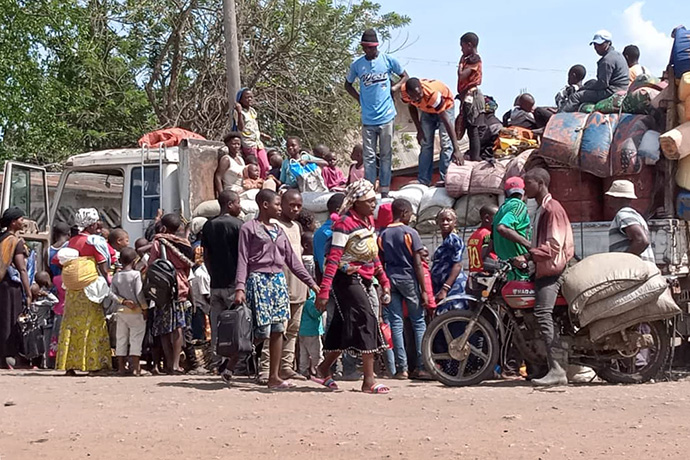
At least 25 civilians, including seven United Methodists from two families, were killed in the latest violence in this East Congo territory, according to the Beni District superintendent.
The large-scale attack on Dec. 31 in the villages of Eringeti and Mutwanga has been blamed on the Allied Democratic Forces, an armed rebel group that operates in Eastern Congo and Uganda, said the Rev. Dumas Balaganire.
“These repeated attacks in the region of Beni paralyze several economic and religious activities,” he said.
Henry Sinvazire, a Beni District lay leader and volunteer with the church’s disaster office in eastern Congo, said that Maurice Vahaven, a lay leader at Mutwanga United Methodist Church, died alongside most of his family while they were preparing to participate in the baptism of new believers at their home. Sinvazire said one of Vahaven’s adult children, Samuel Paluku Makia, a guitarist at the church, was able to escape unharmed.
Chantal Kavira, secretary for United Methodist Women at Mutwanga United Methodist Church, said two of her children died in the massacre. Both were members of the church’s chorus. She said her children were killed by the ADF while they were getting ready to go sing at the baptism of the other young people.
“It is a loss for my church, but I have the hope that one day we will meet in the kingdom of heaven,” she said.
Pastor Mukunge Shabantu of Mutwanga United Methodist Church said he mourns the losses from the two United Methodist families from his church.
Balaganire and Sinvazire said the attacks forced many villagers to flee their homes, and food insecurity has become a concern.
“We are overwhelmed by the displaced who are all concentrated in the city of Beni,” Balaganire said.
Sinvazire added, “(I) fear the worst of famine and the contamination of COVID-19 following this craze of the displaced.”
According to an October report from the United Nations refugee agency, UNHCR, there are 5.5 million people internally displaced in the Democratic Republic of Congo, one of the largest displaced populations around the world and the largest in Africa.
Jean Tshomba, coordinator of the United Methodist Committee on Relief's disaster management office in eastern Congo, said he is troubled by the violence, as well as the situation facing survivors who were forced from their homes.
He said he plans to appeal to UMCOR for help for those who have been displaced by the insecurity in the region.
Bishop Gabriel Yemba Unda offered his condolences to the bereaved families and called on the country's authorities to restore peace.
“I invite everyone to show solidarity with families who are displaced and to strictly respect the barrier measures because — apart from this insecurity — we cannot neglect the COVID-19, which is still with us,” he said.
There have been nearly 20,000 confirmed COVID-19 cases and more than 600 deaths in Congo, according to data from Johns Hopkins University.
In Unda’s role as national moderator of the Churches of Christ in Congo, an ecumenical council comprising 74 member denominations, he attended meetings in November led by Congo President Félix Tshisekedi Tshilombo.
“I met the president of the DRCongo, and I explained to him all of these problems of the Allied Democratic Forces in Beni, and I hope that with the help of the Lord, we will one day have lasting peace in the region,” Unda said.
Kituka Lolonga is a communicator in the Kivu Conference.
News media contact: Vicki Brown at (615) 742-5470 or [email protected]. To read more United Methodist news, subscribe to the free Daily or Weekly Digests.
Like what you're reading? Support the ministry of UM News! Your support ensures the latest denominational news, dynamic stories and informative articles will continue to connect our global community. Make a tax-deductible donation at ResourceUMC.org/GiveUMCom.


