
Key points:
- United Methodists at the Peace Conference joined in a Hands Off! protest in nearby Waynesville, North Carolina.
- The event was one of more than 1,200 such nonviolent rallies across the United States protesting the Trump administration’s impact on government services and human rights.
- Western North Carolina Conference Bishop Ken Carter was among those in attendance. “There are policies that do real harm to real people,” he said.
Peace and justice go hand in hand.
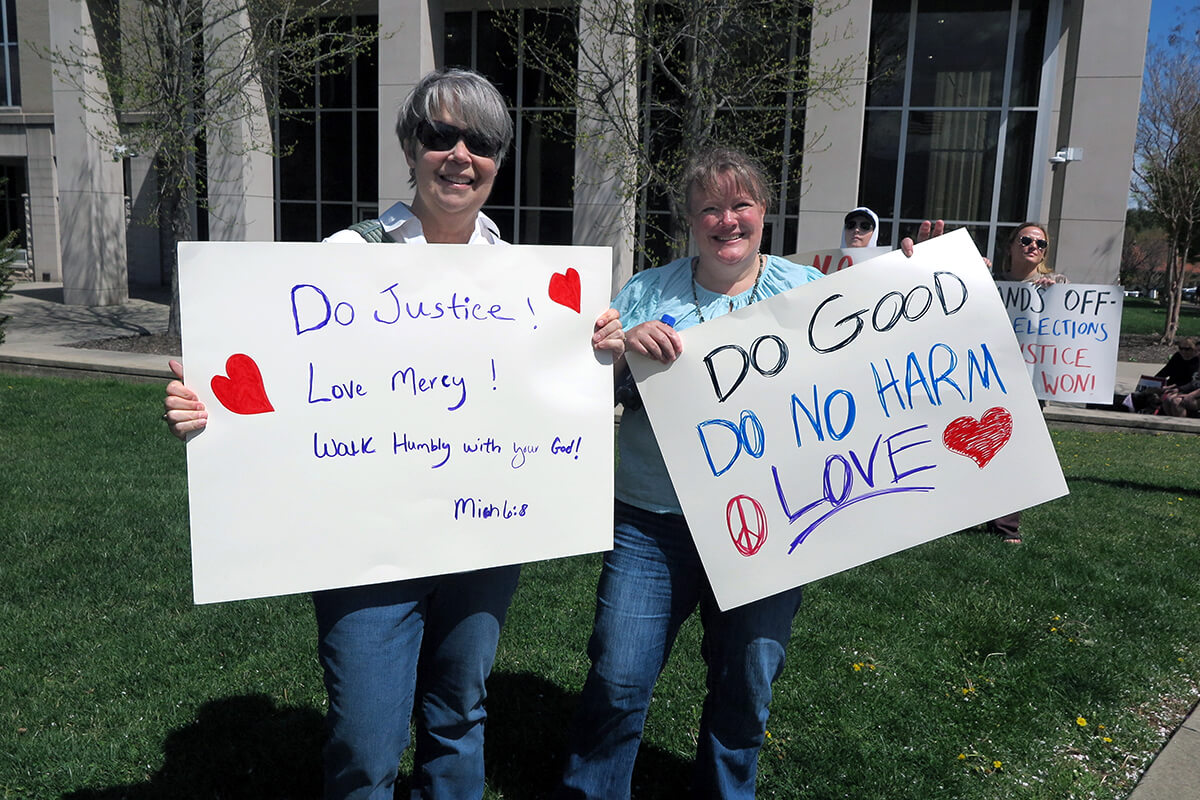
To pursue both, a number of United Methodists at the April 4-6 Peace Conference joined in a nearby rally to tell the Trump administration to take its hands off government services.
The protest outside the courthouse in Waynesville, the seat of rural Haywood County, was among more than 1,200 Hands Off! demonstrations organized April 5 in all 50 states.
Demonstrators across the U.S. voiced anger over the administration’s moves to fire hundreds of thousands of federal workers, effectively shut down entire agencies, close Social Security offices, deport immigrants, target transgender people and cut funding for health programs such as medical research, Medicaid and veterans’ care.
The Waynesville event drew some 1,000 people to a town with a population under 11,000. Rally-goers represented a cross-section of people — veterans, nurses, teachers, office workers and pastors. Some of those in attendance had brought their children with them.
Among those at the protest was Western North Carolina Conference Bishop Ken Carter. “There’s so much at stake for the community in terms of children and nutrition and young people’s education and older adults,” he said.
He distinguished between policy objections and partisanship. “To me, this is not anti-person, but it is saying that there are policies that do real harm to real people,” he said. “It’s just encouraging. Mountain people care about each other, and they are resilient. And that’s what you see here.”
Whenever drivers passing by the rally registered disapproval by revving their motors or flashing hand gestures, the protesters would respond in good Southern fashion: shouting “Bless your heart.”
Carter had been one of the organizers of the Peace Conference at Lake Junaluska — planned long before the April 5 protests.
The Rev. Beth Crissman, the conference director, told those gathered that the Waynesville protest from 12:30 to 1:30 p.m. just happened to coincide with the day’s lunch break. She encouraged conference participants to carpool to the nonviolent rally if they wanted to join in.
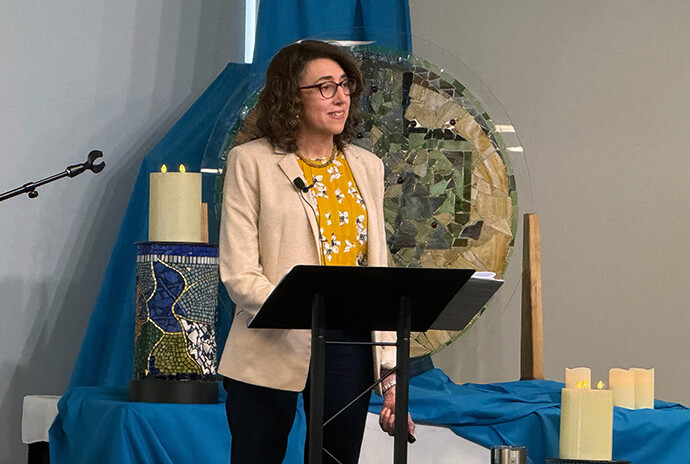
Among those addressing the rally was Kristen Wall, a native daughter of Haywood County, who also spoke and led workshops at the Peace Conference.
Until the night of March 28, she worked at the U.S. Institute of Peace, which is currently being dismantled by Elon Musk’s Department of Government Efficiency. The independent nonprofit was established by the U.S. Congress in the 1980s to provide research, policy analysis and training in international peace efforts and conflict resolution.
Wall noted that the Institute of Peace’s entire annual budget of $50 million is significantly smaller than just one of Musk’s SpaceX contracts, which average $212 million per launch. Among the organization’s now-cancelled projects were monitoring human-rights abuses and protecting journalists in Afghanistan and deterring extremist recruitment in Nigeria and Kenya.
Subscribe to our
e-newsletter
“I want us in this country to pursue peace and democracy and to support it — not just for some, but for all,” she said to applause from the crowd. “We cannot work for our own enrichment, satisfied in a private kingdom of safety and comfort, surrounded by a sea of deprivation. Our humanity is large enough for all of us.”
Meeting Wall at the Peace Conference helped bring home the reality of what’s happening to federal workers to the Rev. Cole Altizer, pastor of Bryson City United Methodist Church in North Carolina.
“But you know with all the programs that we have in Bryson City, they’re all going to be affected by many of these cuts,” he said. “Our work is to be with the people in the margins. This is how I do that today.”
John and Erika Lusk, members of University United Methodist Church in Chapel Hill, North Carolina, also joined in the rally.
“I’m not particularly progressive. You don’t have to be progressive to have an opinion about this,” John Lusk said. He wore a green T-shirt displaying the Wesleyan quadrilateral for illuminating the Christian faith of Scripture, Tradition, Reason and Experience.
“You can just be, like, the middle of the road and say, ‘You know what? This is just wrong.’ There’s lots and lots of progressive Methodists and lots and lots of conservative Methodists, and The United Methodist Church itself sort of stands astride this fracture line in politics right now. That’s why it’s important for us to speak up.”
His wife, Erika, said if not for the Peace Conference, she likely would have attended the rally in D.C. or in Raleigh, North Carolina.
“But I’m glad we’re able to be here at this gathering and be a part of it,” she said. “I just think one of the things that’s been a reoccurring theme this weekend is we need to be outside of our churches, not just in our church on Sunday mornings. We need to be bringing the word by speaking out against what’s wrong and standing up for the least of these.”
The Rev. Rhonda Grant Jordan, director of peace building and outreach ministries for the North Carolina Conference, said so many concerns drew her to the rally, including the effort to eliminate the Department of Education and threats to Medicaid.
“I have to be here because, as a Christian, as a follower of Jesus Christ, I am concerned about the least of my brothers and sisters. I’m concerned about them no matter who they are. And it’s my responsibility as a Christian, as a minister, to do anything I can to support God’s people … Jesus tells us to care about each other.”
A number of signs at the rally proclaimed Christ’s call to love our neighbors. That message was also shared throughout the Peace Conference, including at its closing worship the day after the Hands Off! rallies.
“Justice alone cannot fix injustice. Hearts must be transformed and love should empower all Christians to struggle for the self-affirmation that is intrinsic to the struggle for justice,” preached Bishop Robin Dease in the closing sermon. Dease is bishop of both the North Georgia and South Georgia conferences.
“Justice without love is just merely self-righteousness, and love without justice can become nothing but mere sentimentality,” she said. “Peacemakers are people who breathe grace. … They draw on the goodness and power of Jesus Christ, and then they bring Christ’s love and mercy, forgiveness, strength and wisdom to the conflicts of daily living.”
Return to main story, Building peace in a dangerously polarized US


