

Key points:
- A United Methodist Peace Conference drew some 200 clergy and laity to discuss breaking down national divisions.
- Participants heard about the dangers of Christian nationalism and polarization in the U.S.
- Pursuing peace does not mean ignoring past hostilities or staying silent in the face of current injustices, participants also were told.
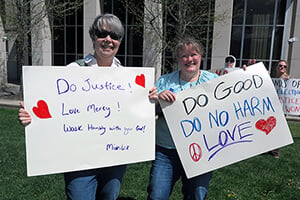
- Some of the conference participants joined a nearby Hands Off! rally that drew a cross-section of people to protest the dismantling of federal government services.
One thing Americans of all political stripes can agree on is that the people of the United States are deeply divided. In fact, “polarization” was dictionary Merriam-Webster’s choice for its 2024 word of the year.
All too frequently, Christianity has contributed to this polarization — erecting barriers between Americans and fueling mistrust. Yet, Christians in general — and United Methodists specifically — also can heal the fractures and help those most likely to be hurt by the nation’s brokenness.
That was the overall message of the Peace Conference on April 4-6 at Lake Junaluska Conference and Retreat Center. Some 200 clergy and laity, including college students, attended the gathering.
The event’s theme drew from Ephesians 2:14: “For Christ is our peace … and he has broken down the dividing walls, which is the hostility between us.”
Bishop Kennetha Bigham-Tsai, who leads the Iowa Conference and co-leads the Illinois Great Rivers Conference, expanded on that theme during opening worship.
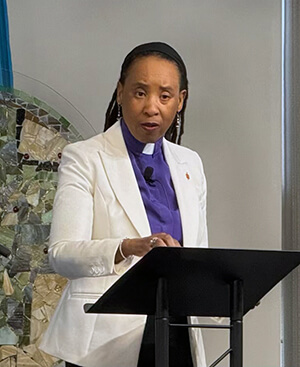
“Friends, today we are in deep peril because of walls,” she preached.
“All around us, people are building walls — walls to keep immigrants out, walls to keep people of color in their place, walls to hem in the LGBTQ community, walls to shut out the poor. These walls are being built through restrictions on health care, through layoffs and attacks on funding, through violent and dehumanizing speech. These walls are being built through fear.”
However, she said, Christ shows another way. Jesus broke down walls throughout his earthly ministry — healing on the Sabbath and eating with tax collectors. He also spoke up for the oppressed and marginalized.
Christ demonstrated, the bishop stressed, that peacemaking does not mean keeping silent or accommodating injustice.
Bigham-Tsai and other speakers at the conference were addressing an audience mostly from a region still reeling from the fallout of church divisions. From 2019 to 2023, more than 7,600 U.S. congregations left The United Methodist Church — prompted largely by conflict over LGBTQ inclusion. About half of those disaffiliations were in the Southeastern Jurisdiction.
Those disaffiliations as well as current U.S. political strife played a role in this year’s revamp of the Peace Conference, said the Rev. Beth Crissman, the conference’s director. Crissman is a district superintendent and director of peace building ministries in the Western North Carolina Conference.
Lake Junaluska first hosted a Peace Conference in 2009. The gathering, organized by longtime peace activists, was both interfaith in nature and focused on the wars then raging in Iraq and Afghanistan. The Peace Conference continued annually through 2019, which the original organizers saw as a good endpoint.
Now the circumstances have changed, Crissman said, but the need to foster peace has not. So, she and other leaders in the Western North Carolina and neighboring North Carolina conferences got to work designing a new conference.
The intent, she told United Methodist News, is “to reclaim our call as ambassadors for peace, particularly in our highly polarized political environment, which also impacts our churches as we have seen even within our own denomination.”
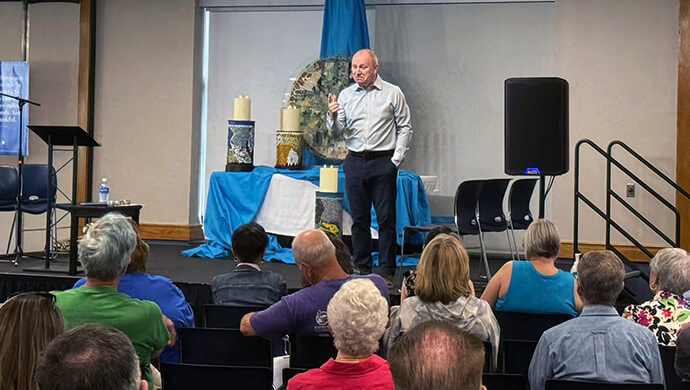
The Rev. Jonathan Marlowe, co-senior pastor of Mount Zion United Methodist Church in Cornelius, North Carolina, attended the first conference as well as the most recent one. “This Peace Conference is more holistic in terms of bringing in aspects of racism that were not much talked about at that earlier one,” he said.
Plans underway for next year
As a bishop, Bigham-Tsai told those gathered that she will pastor all people, but not the walls they erect to hold others back.
“I am not the pastor of anyone’s racism. I am not the pastor of anyone’s misogyny. I will not pastor anyone’s homophobia or hatred and disrespect toward immigrants,” she said.
Instead, she said she looks for the divine within everyone she meets: “I will pastor and seek to grow the Christ within you — the God that I know is in all of us. And I will do that by challenging you to love across barriers of difference and to break down walls.”
Polarization erodes democracy and makes violence more likely, said Kristen Wall. She has experience addressing global conflicts for think tanks and the U.S. Institute of Peace, now being dismantled by the Trump administration.
“When there is significant polarization, it’s harder to communicate and coordinate to solve shared problems. Grievances accumulate, creating an opening for political leaders who exploit feelings of abandonment or frustration through wedge issues,” Wall said.
“Partisan gain becomes more important than playing by the rules. This breaks down an interest in sharing power, which is the bedrock of a democratic system.”
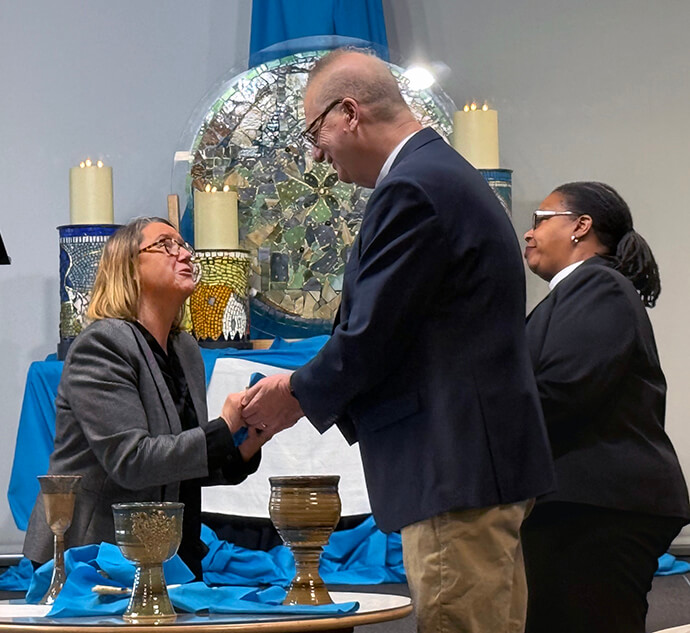
Anyone familiar with U.S. history will know such disunion is not unprecedented in a nation still struggling with the legacy of enslaving Black people and brutalizing Native Americans, said Derrick Scott III. He is a longtime campus minister and co-lay leader of the Florida Conference.
In Luke 4, Scott said, Jesus was confronting historic hostilities when he preached good news to the poor and ended up angering everyone in the synagogue.
“One of the things I think is happening in Luke 4 is the recognition that if we bypass history, if we don’t confront the historic hostility, we cannot have unity,” said Scott, a history major.
Rallying against government overreach
He urged his audience not to get too caught up in comparing one group’s suffering with another. Such comparisons without acknowledging people’s different stories, he said, can lead to “the kind of cheap solidarity that runs away when privilege is threatened.”
The Rev. Ismael Ruiz-Millán, the North Carolina Conference’s executive director of connectional ministries, was inspired by Scott’s talk. He cautioned white people not to rush to relieve their guilt about the sin of racism by silencing people of color. He said he has often seen white people interrupt a lament by calling for prayer around the person sharing their pain.
“We need to be careful of using means of grace as a means of oppression, as a weapon to silence the lament of the oppressed,” he said.
The Rev. Gary Mason — a Methodist minister known to many United Methodists — talked about the threat of Christian nationalism. He spoke from experience in working to end Northern Ireland’s 30-year-long civil war known as the Troubles. About a decade ago, Mason heard a quote from a Japanese scholar on Shinto nationalism that he thinks applies to both his homeland and the U.S.
“An incomprehensible act becomes comprehensible when told in conjunction with religion,” he recounted. “It’s that ‘God-is-on-our-side’ mentality.”
Addressing toxic religion, he said, will require United Methodists to take their ministry outside church walls. He also suggested United Methodists be willing to talk to men with guns in their hands, including Proud Boys and One Percenters. He stressed that engagement is not endorsement, but relationships are key to changing hearts and minds.
“I would say to all of you that even if you feel that America may be in despair, don’t give up,” Mason said. “The oxygen of hope is one of the most essential mechanisms the Christian church can actually bring.”
Hahn is assistant news editor for UM News. Contact her at (615) 742-5470 or [email protected]. To read more United Methodist news, subscribe to the free UM News Digest.


