

Foday Kamara, 17, and Abdul Conteh, 26, find nothing glamorous about mining for diamonds in a muddy field.
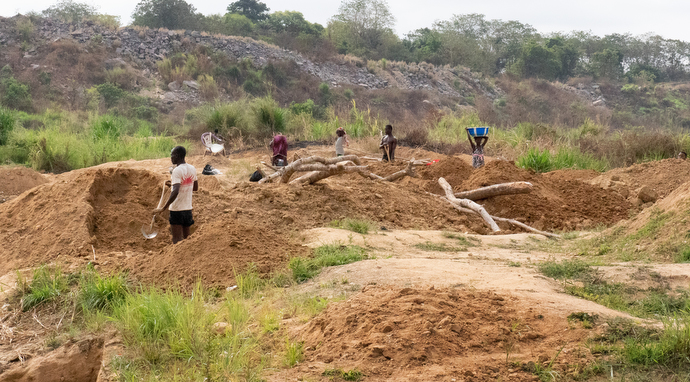
Kamara and Conteh used shovels to move a large mound of dirt, hoping to complete the work soon so they could start moving the dirt to yet another spot. The sweat on their bent backs glistened in the hot sun.
The two young men work for a group of artisanal diamond miners not employed by a mining company. For their labor, they will earn $2 a day.
“It buys books, shoes, clothing,” Conteh said.
Kamara added, “Young people suffer a lot to make a living.”
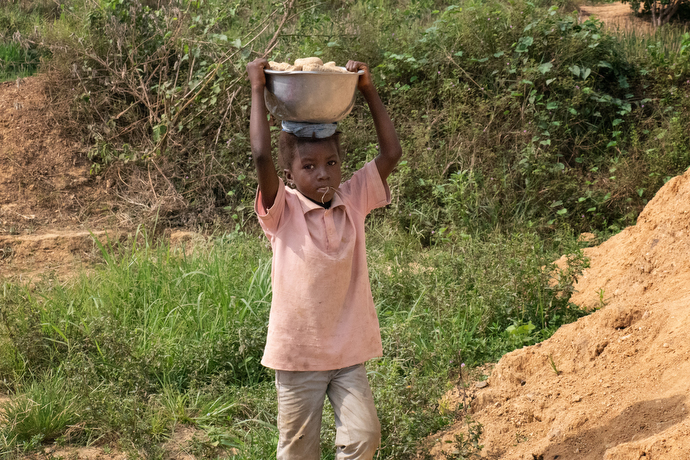
Working beside them were Mariah Kargbo and her children, who were breaking up rocks into smaller pieces. The family will sell those to people looking for materials for their yards or gardens. The children carried large tin pans full of the rocks on their heads back to their roadside stand.
 Mining in Sierra Leone started in the 1920s and is seen as one of the key factors for instability in the country, according to Wikipedia. The main production areas for diamonds are around drainage areas of rivers in the Kono, Kenema and Bo Districts. The Sierra Leone civil war was largely fueled by illicit diamond trading.
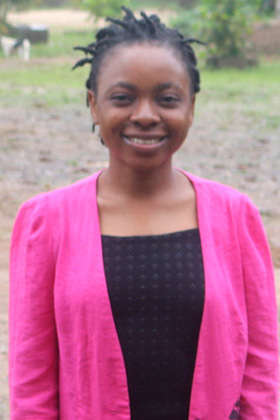 Adama Borway, a student at Koidu Secondary School, sees diamonds as a barrier to education.
“Young boys go to the diamond sites,” she explained. “They mine diamonds and when they get diamonds, they sell them, get a lot of money and forget about school. Some young girls, too, go around the mining sites every day and forget about education.”
Borway said people believe in silver and gold more than education.
“Kono is a community where our parents grew up believing in diamonds because the land is endowed with diamonds,” she said in an interview with United Methodist News. “So the people believe diamonds is the only way to make it in life.”
She said many school-age children are at the mining sites when they should be studying to take the West Africa Senior School Certification Examinations.
Men also use diamonds to lure young girls into relationships, she said. “Our generation is changing that story, but it is an uphill fight.”
 Koidu Holdings, a multi-national diamond mining company, provided support to the United Methodist Girls Primary School after the mining company wanted to mine where its old school building was located. The school was relocated to a remote part of the city in a safe, rural location, Borway said.
The company now provides a bus to transport children to the new location, she said.
However, Kai Jimmy — principal of the school Borway attends, Koidu Secondary — said the company is not providing transportation to the new location for the teachers at the primary school.
Borway said her inspiration for a better life comes from her family. “I had a single mother … she died before I could finish my education. I need to make someone proud who is in heaven,” she said.
She is also inspired by the fact that several of the professors in Sierra Leone came from Kono.
 “I was shocked because one would think given all these diamond distractions, Kono people would be at the bottom of the education index. But we have more educated people — that’s an inspiration.”
Borway, who is the president of the Children’s Forum Network, a national group that advocates in the interest of children around the country, dreams of becoming a medical doctor.
She took her high school exit exams in August and is now awaiting results. She is 100% positive she will pass.
Gilbert is a United Methodist News reporter in Nashville, Tenn. Jusu is director of communications for The United Methodist Church in Sierra Leone. Contact Gilbert at 615-742-5470 or [email protected]. To read more United Methodist news, subscribe to the free Daily or Weekly Digests.
Kamara and Conteh used shovels to move a large mound of dirt, hoping to complete the work soon so they could start moving the dirt to yet another spot. The sweat on their bent backs glistened in the hot sun.
The two young men work for a group of artisanal diamond miners not employed by a mining company. For their labor, they will earn $2 a day.
“It buys books, shoes, clothing,” Conteh said.
Kamara added, “Young people suffer a lot to make a living.”
Working beside them were Mariah Kargbo and her children, who were breaking up rocks into smaller pieces. The family will sell those to people looking for materials for their yards or gardens. The children carried large tin pans full of the rocks on their heads back to their roadside stand.
Kaday Kargbo, 5, carries a load of rocks to his family’s roadside stand in Kono. The family breaks down the larger rocks from an artisanal diamond mining operation to sell to people who need them for their yards or gardens. Photo by Kathy L. Gilbert, UM News.
Adama Borway
Photo by Phileas Jusu, UM News.
Photo by Phileas Jusu, UM News.
“Young boys go to the diamond sites,” she explained. “They mine diamonds and when they get diamonds, they sell them, get a lot of money and forget about school. Some young girls, too, go around the mining sites every day and forget about education.”
Borway said people believe in silver and gold more than education.
“Kono is a community where our parents grew up believing in diamonds because the land is endowed with diamonds,” she said in an interview with United Methodist News. “So the people believe diamonds is the only way to make it in life.”
She said many school-age children are at the mining sites when they should be studying to take the West Africa Senior School Certification Examinations.
Men also use diamonds to lure young girls into relationships, she said. “Our generation is changing that story, but it is an uphill fight.”
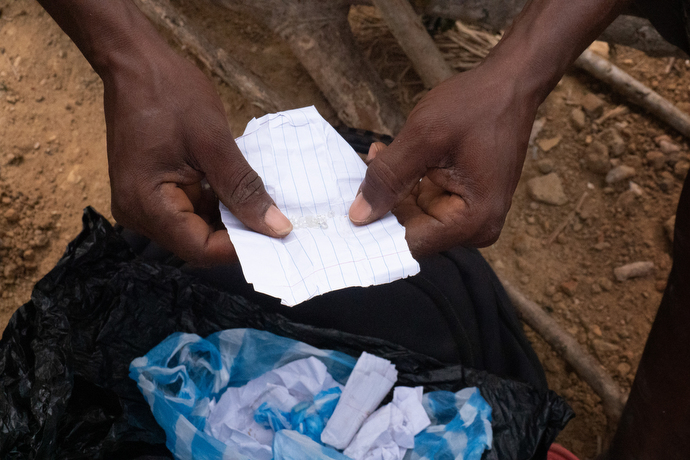
The owner of an artisanal diamond mine in Kono unwraps a small parcel of diamonds. He employs local people to work in his operation. Photo by Kathy L. Gilbert, UM News.
The company now provides a bus to transport children to the new location, she said.
However, Kai Jimmy — principal of the school Borway attends, Koidu Secondary — said the company is not providing transportation to the new location for the teachers at the primary school.
Borway said her inspiration for a better life comes from her family. “I had a single mother … she died before I could finish my education. I need to make someone proud who is in heaven,” she said.
She is also inspired by the fact that several of the professors in Sierra Leone came from Kono.
People work in an artisanal diamond mine around a drainage area of a river in Kono. Photo by Kathy L. Gilbert, UM News.
Borway, who is the president of the Children’s Forum Network, a national group that advocates in the interest of children around the country, dreams of becoming a medical doctor.
She took her high school exit exams in August and is now awaiting results. She is 100% positive she will pass.
Gilbert is a United Methodist News reporter in Nashville, Tenn. Jusu is director of communications for The United Methodist Church in Sierra Leone. Contact Gilbert at 615-742-5470 or [email protected]. To read more United Methodist news, subscribe to the free Daily or Weekly Digests.
Like what you're reading? Support the ministry of UM News! Your support ensures the latest denominational news, dynamic stories and informative articles will continue to connect our global community. Make a tax-deductible donation at ResourceUMC.org/GiveUMCom.


