
Key points:
- When congregations and seminaries present themselves through the lens of political ideology, they squander a sacred gift: the church’s capacity to hold us together.
- Garrett-Evangelical Theological Seminary has launched the Garrett Collective as a way to help the church lead the way in building community across differences.
- The church’s calling is not to mirror a fractured society but to practice a different way of being together — one that envisions reconciliation as a lived reality.
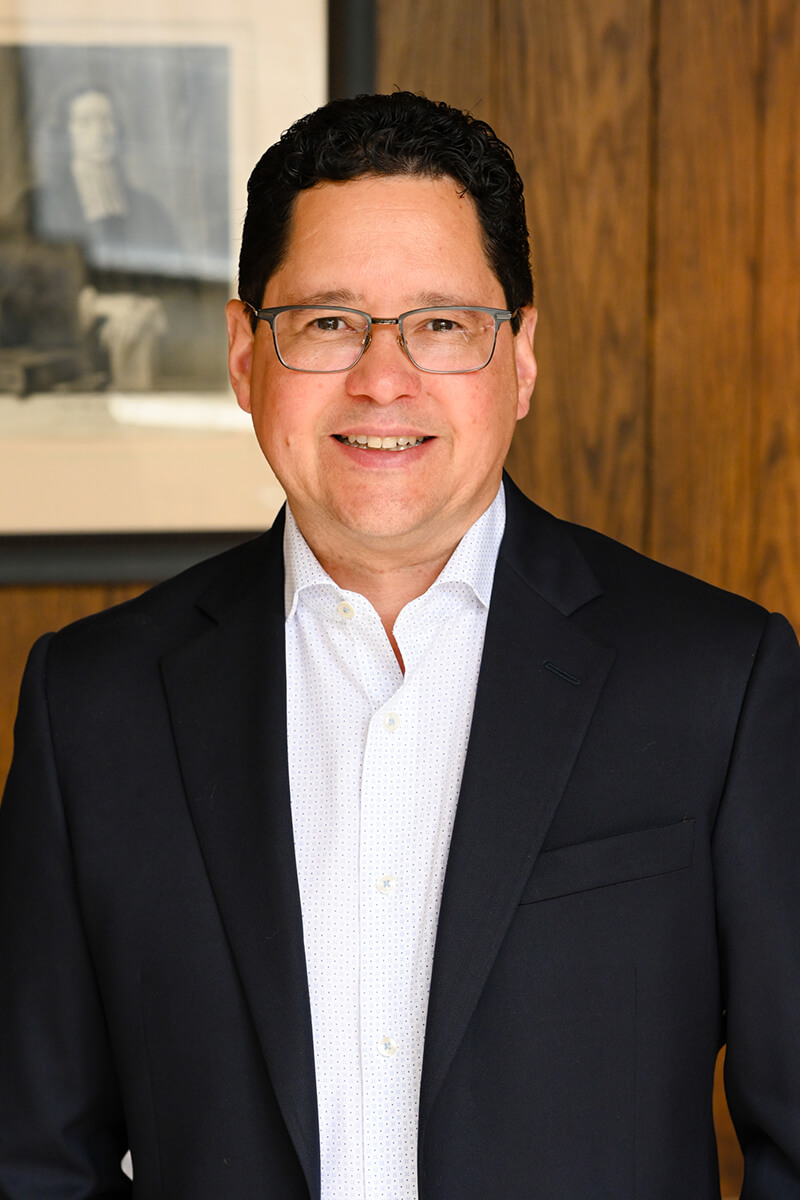
Photo by Brian McConkey Photography, courtesy of the Rev. Dr. Viera.
Commentaries
Not long ago, I sat with a pastor who described the moment her congregation split.
It wasn’t over doctrine or misconduct. It was over a yard sign. One family displayed it; another demanded its removal. Within weeks, relationships built over decades had shattered.
“We used to disagree about things that mattered,” she told me. “Now we can’t even disagree. We just leave.”
Political polarization has come home to roost in our churches. This observation may sound self-evident to anyone with passing familiarity with the modern Christian landscape, but we don’t sufficiently wrestle with what it portends — for our United Methodist denomination, for the broader church, and for the communities we serve.
When congregations and seminaries begin presenting themselves through the lens of political ideology, they betray the shared humanity to which Jesus calls us. Worse, they squander a sacred gift: the church’s unique capacity to hold us together when everything else tears us apart.
It was certainly within my living memory that people across the political spectrum worshipped side by side at their local parish. I don’t mean to paint an idyllic picture — sometimes that was hard. It demanded we move through discomfort, that we treasure the values and purposes we did share even when other convictions diverged. But people were willing to do that difficult work.
Enter most churches today and you’ll still see some version of this, but increasingly ideological affinity has become a surer predictor of people’s ecclesial home than denominational loyalty or even spiritual longing. A progressive Methodist who moves to a community with a conservative Methodist congregation is more likely to join the progressive Presbyterian church down the street. A conservative Baptist may well join the conservative Methodist community in their new town rather than the Baptist church that hangs a progressive flag outside its doors.
Churches and seminaries have observed this trend and reacted accordingly. A plethora of culturally coded words have arisen through which faith-based institutions quickly reveal their ideological leanings to attract like-minded seekers. If I offer the choice between a “diverse, justice-centered community” and a “Bible-believing church,” you likely already know which skews progressive and which conservative — even though both phrases are true for communities across the theological spectrum.
Schools like Garrett-Evangelical Theological Seminary, where I serve as president, are not exempt from these pressures. Marketers are quick to help us segment which students are most likely to attend based on political ideology and to craft language designed to reach them. The polarization that primes people to think of themselves first and foremost through a political lens has colonized our institutions, only deepening the pattern.
The first problem with this approach is that it explicitly rejects our calling. Jesus didn’t say, “Go and make disciples of the people who share your politics!” Christ’s call is universal — an invitation to weave belonging even and perhaps especially among people with whom fellowship isn’t always easy.
This is what The United Methodist Church represents at our best: a connectional body that honors our differences while simultaneously yoking us together to enact God’s desire for a thriving church and a healed world. When we reject that call because our differences feel too difficult to reconcile, we eliminate the chance for mutual transformation. The muscles required to build connection across disagreement begin to atrophy, and we tolerate less and less difference until we interact only with people who reflect ourselves.
Subscribe to our
e-newsletter
If those muscles can wither, however, they can also be strengthened. Our culture is beset by forces — from establishment politics to digital algorithms — with vested interest in pushing toward ever-more extreme polarization. The church must recognize its wondrous inheritance as one of the only remaining institutions whose identity and flourishing demand we push back against this unraveling.
From our elders to Gen Z, people openly lament how the past 30 years have driven wedges between themselves and their neighbors. They are tired. They hunger for something different. Let the church open our doors wide and begin the messy, difficult work of serving as repairers of the breach.
What might that repair require? In my own writing and research, I’ve come to believe it demands three disciplines: a clarified sense of identity that knows what we believe and why; spiritual humility that remains genuinely open to learning from those who see the world differently; and collaborative practice that binds us together through shared work for the common good.
These disciplines don’t develop through occasional dialogue or polite coexistence. They are forged in the slow, patient labor of studying together, praying together and acting together — even when we disagree about much else.
Garrett-Evangelical Theological Seminary has launched the Garrett Collective as one way our community is trying to live out that call. The Collective is a beautiful online platform housing an abundance of shared resources — prayers, liturgies, Bible studies and more.
But the true power of the Collective lies ahead. Through micro-courses and learning cohorts, we will bring learners together across wide geographic distances — and across the theological spectrum — to grow in faith together. A Christian from New York City can learn alongside a Christian in Idaho from a Christian in rural India.
Users will also create their own content, expanding the available resources. The Collective is launching in Spanish and English, with additional languages to follow. Materials can be downloaded for use offline, so learners can bring them to parts of the world with intermittent internet access. Over time, learners will build a content library reflecting humanity’s wondrous diversity — and a community that invites us into the difficult work of mutual transformation.
I’m overjoyed by how the Collective will feed The United Methodist Church precisely where we need sustenance. Pastors often tell me about the increasing leadership burden they shoulder, many now working bivocationally. A library of resources, vetted by Garrett professors and partners, will lighten that weight.
When I travel internationally to visit Methodist partners, I hear about the difficulty obtaining high-quality theological materials, particularly in languages other than English. The Collective intends to nourish the church in the United States but also in Africa, India, the Philippines and Latin America — exactly where Methodism is growing fastest. We can do this with integrity because our faculty hail from these places and remain connected to their communities of origin.
And I regularly hear from laypeople who want seminary-quality education without committing to formal enrollment. The Collective will let them study alongside pastors, seminarians and other laity, engaging materials drawn from a Garrett classroom. I wholeheartedly invite anyone to join this learning community, that we might practice more expansive ways of being church together.
There is a future beyond our present divide, and the church’s relevance will be significantly determined by the role we play in shaping it. Will we let our sanctuaries continue splitting along the same fault lines that fracture the world outside our doors? Or can we root ourselves in a gospel that calls us to relationship even across deep disagreement?
The church’s calling is not to mirror a fractured society but to practice a different way of being together — one that bears witness to reconciliation as a lived reality rather than a distant ideal.
That road begins with courage: a willingness to abandon the culturally coded signifiers that promise welcome but yield only division; a commitment to rebuild the connectional muscles we have lost; and the creation of new spaces where the Holy Spirit can move freely among people who might otherwise never meet.
The world is watching to see whether Christians can do what we proclaim — whether we can love across the chasms that defeat everyone else. The Garrett Collective is our small attempt to answer that call. We hope you’ll join us.
Viera is president of Garrett Seminary. A Methodist minister and educational theorist, his work explores how people can learn and build constructive coalitions across difference.
News media contact: Julie Dwyer, news editor, [email protected]. To read more United Methodist news, subscribe to the free UM News Digest.


