
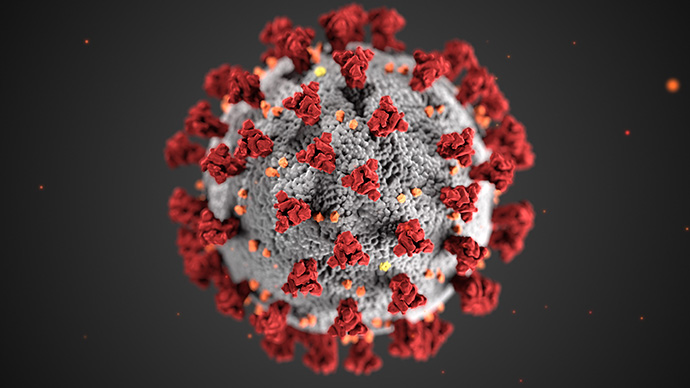
Church leaders say some of the responses to the coronavirus pandemic might help point the way to the future. Virus illustration courtesy of the Centers for Disease Control and Prevention.
“The other day I said to one of my colleagues, ‘That is such a pre-coronavirus perspective,’” said Bishop Sally Dyck, resident bishop of the Chicago area. “I hope we apply a post-coronavirus perspective that life is fragile and life is random.
“We’re not in control,” she said. “We have wanted to control the church. We have wanted to control God. We have wanted to control each other. And controlling is a pre-coronavirus perspective.”
More than 37,000 people in the U.S. have died of COVID-19 since Jan. 21, according to the Centers for Disease Control and Prevention. More than 720,000 cases have been reported as of April 19.
Technology has played the most visible role for the church in addressing the pandemic.
First United Methodist Church of Miami brought on a new staff member to help with virtual ministry. The Rev. Audrey Warren, senior pastor, said they’ll keep that person on staff post-coronavirus.
“We look to expand into that world, especially because in Miami we’re such a transient city,” Warren said. “People come into our church for three or four years, and then they move, and sometimes they have a hard time finding a new church.”
The Miami church has experienced success with moving small groups online, and also set up a prayer chain group that is doing well.
Warren visualizes a virtual church with members around the globe, with perhaps an annual homecoming service hosted at the Miami sanctuary.
In a timely coincidence, Warren is publishing a book in August through Abingdon Press about the need to put United Methodist resources more into people than property. Co-written with Bishop Kenneth Carter of the Florida Conference, the book is titled “Fresh Expressions of People over Property: Scripture, Stories and Strategies to Help People of Faith Reimagine their Space.”
“The last chapter of the book focuses on this pandemic a little bit, and how it furthermore emphasizes how possibly our funding might be more directed toward people than property,” Warren said.
Subscribe to our
e-newsletter
Like what you're reading and want to see more? Sign up for our free daily and weekly digests of important news and events in the life of The United Methodist Church.
Such concepts could be a tough sell to many churches.
Cornerstone United Methodist Church in New Orleans hosts Bible studies using Facebook and has started a telephone prayer line for church members who aren’t as technically savvy, said the Rev. Johnathan Carlton Richardson, senior pastor.
“Cornerstone luckily was sort of prepared for (online services and meetings),” he said.
Although the structure for online services was already in place when the pandemic happened, the culture of the city may not be conducive in the long term to a concept like virtual church.
“New Orleans has a very hospitable culture,” Richardson said. “It’s pressing against that very welcoming, socializing culture which makes New Orleans the international city that it is.”
Bishop Cynthia Fierro Harvey, resident bishop of the Louisiana Area, said Easter 2020 was the first time in some 60 years that she did not physically attend a church service.
“But I’ve been in more worship services than ever, with this technology on Sunday morning,” Harvey said. “There are some people doing livestream, there are people who prerecorded worship and then played it on Facebook at the appointed hour.”
Comparing COVID-19 with 9/11 and World War II, Harvey said there might not be a path back to where the church was before the pandemic.
“Perhaps our playbook that we have now will become irrelevant,” she said. “I believe that we have a different kind of future in front of us. We have to now begin to imagine what that might look like.”
The online world is far from perfect, Harvey said.
“Yes, there’s buffering,” she said. “The lighting is not always great. But they are connecting in ways I think are making a huge difference to people. We’re preaching the Gospel. So we’re back to long before, when we gathered on street corners. These are our new street corners.”
If more church connections are moving to the virtual world, finances might become an issue, she said.
“Unfortunately, this is a huge problem financially for our churches when you’re not meeting,” Harvey said. “Although some churches say giving has continued, I would imagine at some point that that’s not going to be so.”
Patterson is a reporter for UM News, both based in Nashville, Tennessee. Contact him at 615-742-5470 or [email protected]. To read more United Methodist news, subscribe to the free daily or weekly digests.
Like what you're reading? Support the ministry of UM News! Your support ensures the latest denominational news, dynamic stories and informative articles will continue to connect our global community. Make a tax-deductible donation at ResourceUMC.org/GiveUMCom.


