

Key points:
- As the U.S. marks its 250th year, a regional gathering explored American and Methodist history, past racial oppression and current social challenges.
- Speakers reckoned with the racial legacies of slavery, segregation and exploitation of Native American land and Black lives.
- The meeting’s second day featured a tour of Revolutionary War sites, including one of the state’s oldest Methodist churches, which was used to care for wounded soldiers.
Just before The United Methodist Church celebrated Heritage Sunday on May 24, denominational historians and archivists learned about the earliest history of both American Methodism and its host nation, which is celebrating its birth 250 years ago. That past includes still-present struggles with racism in both church and state.
The Greater New Jersey Conference Commission on Archives and History welcomed over 50 attendees from nine conferences to the 2026 meeting of the Northeastern Jurisdiction Commission on Archives and History on May 12-14, at historic Pennington United Methodist Church, established in 1774.
On the first day, they heard a trio of speeches on the theme “Striving to End the Sin of Racism in Church and State: Contemporary and Historical Methodist Perspectives.” They learned about past racial oppression, current social challenges and determined hopes for a redemptive future.
Bishop Cynthia Moore-Koikoi, who leads the Greater New Jersey and Eastern Pennsylvania conferences, Bishop Ernest Lyght, retired, and Rupert Hall, vice chairperson of Greater New Jersey’s Archives and History Commission, reckoned with racial legacies of slavery, segregation and exploitation of Native American land and Black lives.
Moore-Koikoi centered her message on Methodist values inherited from founder John Wesley and Jesus Christ’s mission, as asserted in Luke 4:18-19, “to bring good news to the poor, to proclaim release to the imprisoned, to proclaim recovery of sight to the blind (and) to set free those who are oppressed...”
She described as imprisoned and blind those who deny or distort history and those who claim racial, religious or national superiority, particularly those who profess Christian nationalism beliefs.
“Now is the time for us to listen to God and use the power and anointing of the Holy Spirit that has been given to us … to reset the social order,” she said.

She cited the Rev. Martin Luther King Jr.’s diagnosis of racism as “a deep-seated sickness that requires a profound spiritual awakening,” and his call to stand up for racial and economic justice in his 1965 speech “Remaining Awake Through a Great Revolution.”
“Are you ready to do some soul work?” she asked, calling on listeners to remain awake. “Are you ready for the soul force revolution to break out all across The United Methodist Church?”
She urged Northeastern Jurisdiction Archives and History leaders to “lead us, because you know what the Methodist movement was able to do when it was woke. You can remind us of who we have been and who God has been for us. As we remember, we will gain strength and courage, confidence and reassurance to do what God has called us to do in this present.”
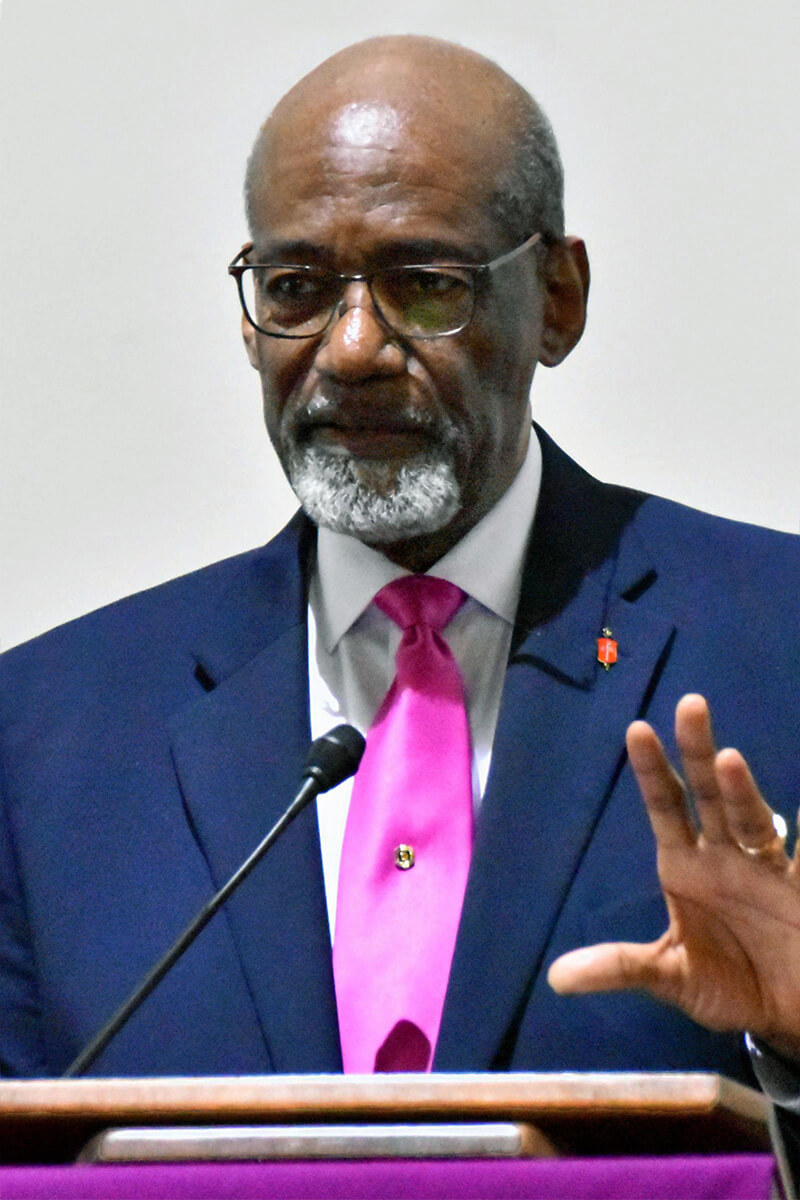
Bishop Lyght shared memories of the denomination’s former racial segregation. His clergy father served churches in the all-Black Delaware Conference, created in 1864, and the all-Black Central Jurisdiction, created in 1939 to segregate Black members when the North and South Methodist Episcopal churches merged to become the Methodist Church.
Many Black members remained loyal to the denomination, he recalled, while the painful legacy of segregation, lynching and discriminatory Jim Crow laws diminished gradually with racial integration. But, he said, Black clergy and churches still wrestle with the legacy of loss from social and economic inequities that mirror those of secular society.
Ordained in the new United Methodist Church in 1968, just as his father was retiring, Lyght served predominantly Black and predominantly white churches in New Jersey as a pastor and district superintendent, before he was elected a bishop in 1996. He described his cross-racial appointments as “sometimes rocky journeys.”
“Racism prevails in the hearts and minds of people, therefore dictating their actions,” explained the bishop, coauthor of three books that address race and racism in the church. “It is a struggle that must be engaged continually across all platforms in the church, the community and society.”
Following Lyght, Hall highlighted historical and ongoing economic injustice in America, emphasizing the intertwined nature of racism and capitalism.
“Race has been and is repeatedly used in this nation to advance economic systems that benefit some while oppressing others,” he said. “We gather here not merely to revisit the painful history, but to better understand the present and to help us shape a more just future.”
Hall is the founder and director of Hope for the City, a new urban outreach and empowerment ministry in Trenton, N.J., and formerly the pastor of Turning Point United Methodist Church in Trenton. He was elected May 19 by the Greater New Jersey Annual Conference as its Archives and History commission’s first Black chairperson.
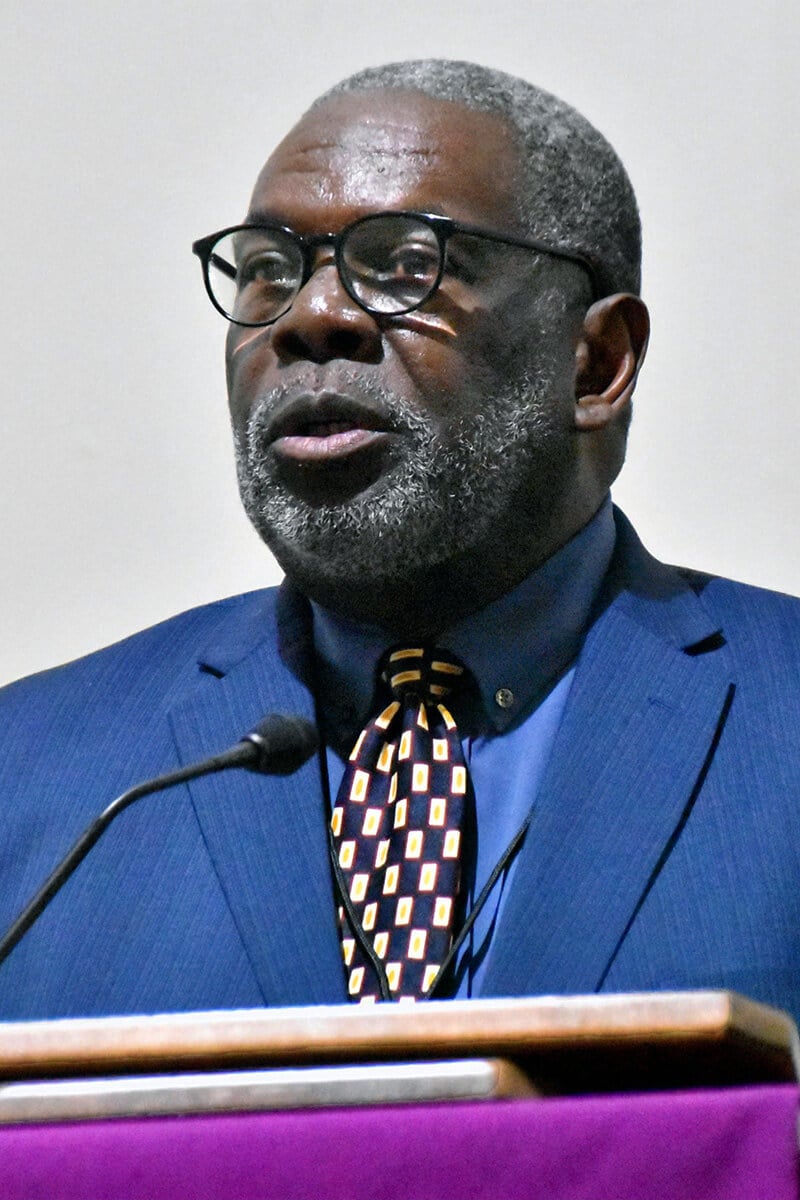
Describing economic justice as “not simply a political issue but a moral and spiritual issue,” he lamented European settlers’ taking of Indigenous peoples’ land to acquire property and wealth across the continent. He said broken treaties, land theft and forced removal of Native peoples were all rationalized by denigrating them as “uncivilized, inferior savages.”
Asking “what shall we do with this history of economic injustice?” Hall responded, “First and foremost, we cannot heal what we refuse to confront.
“We cannot merely preach about heaven while ignoring suffering on earth. We are called to justice and to mercy and to courage” he said.
“Despite all of America’s painful history, I still believe there is hope – hope when people come together across racial and economic lines; hope when churches become centers of justice and compassion; hope when communities organize for fairness and dignity; hope when young people refuse to inherit hatred. … As long as there are people willing to stand, willing to speak, willing to pray, willing to organize, willing to love, there is hope for America.”
Some meeting attendees noted with irony that while the United States celebrates 250 years since its 1776 rejection of Great Britain’s monarchy to establish a land of liberty, the federal government is demanding removal of historic references to slavery and racial oppression in public signs and exhibits.
Meanwhile, decades of progress and policies to increase racial diversity, equity and inclusion in American society are being overturned by federal mandates.
“What’s happening now nationally makes this event more significant and timely,” said the Rev. John Callanan, outgoing president of Greater New Jersey’s commission. “Trying to erase and whitewash our nation’s racial history, plus the absolute ignorance of perceiving DEI as something that diminishes us, is absolutely shameful.”
He lauded the commission’s efforts to increase its own diversity through the addition of several racial-ethnic members, including Hall, Cynthia Mosley (Nanticoke Lenni-Lenape) and Korean-American member Meekyung Kim.

Callanan and Mosley began the meeting with a land acknowledgment ceremony, reading and co-signing an official statement that recognizes “that our churches and facilities within the Greater New Jersey Conference stand on the unceded ancestral land of the Lenni-Lenape in Eastern Pennsylvania and New Jersey.”
Mosley is lay leader of St. John United Methodist Church in Bridgeton, N.J., the denomination’s fifth oldest Native American congregation and a recognized Historic Methodist Site. “Joining the commission is a way for us to share our history of racial oppression and the struggles and survival of American Indians,” she said.
The meeting’s second day featured a bus tour of important Revolutionary War sites in central New Jersey. They included Turning Point United Methodist Church, founded as First Methodist Church of Trenton in 1772. One of the state’s oldest Methodist churches, it was used to care for wounded soldiers. Today it hosts one of Trenton’s busiest food distribution ministries.
The tour group also visited key battle sites at Princeton and Monmouth and the place where General George Washington’s troops landed after secretly crossing the Delaware River through a harsh winter storm on Christmas night in 1776. From there they marched to Trenton to launch a successful, surprise attack on the British-Hessian garrison. It was a turning point in a war the Americans were losing until then.
Subscribe to our
e-newsletter
In addition, they heard the Rev. Kevin Newberg, director of Christian and Methodist Studies at Drew Theological School, recount the enthusiastic lay preaching and evangelism efforts of Captain Thomas Webb. The colorful British army officer helped establish some of the earliest Methodist societies and churches in the Northeast, including the John Street Church in New York City and Historic St. George’s Church in Philadelphia.
The Rev. Bonnie McCubbin, an archivist and director of Museums and Pilgrimage in the Baltimore-Washington Conference, found Newberg’s lecture on Webb’s busy life and unusual preaching style “especially informative and enlightening.”
She was also “grateful for Bishop Lyght’s honesty and willingness to share so personally about his experiences growing up in the racially segregated Delaware Conference.
“This was the first time many heard someone talk so candidly about the Central Jurisdiction,” she said. “I heard comments from people who didn’t know how challenging it was. This isn’t just Black history. It’s everyone’s history.”
McCubbin, the pastor of historic Old Otterbein United Methodist Church in Baltimore, recently highlighted racial experiences recalled by prominent Black United Methodists in her new book “I Love to Tell the Story: A Pilgrimage Towards Racial Justice in The United Methodist Church.”
“Our nation is looking forward to celebrating 250 years in July,” she said. “Yet, we sell ourselves short when we do not reckon with the past and wrestle with our own complicity in the racial divides that persist to this day.
“It can be painful to talk about the past. But if we don’t, we are cheating the present and future out of a true celebration where all people, no matter their skin color, heritage, socio-economic status, age, gender, sexuality or any other category that divides us, can claim freedom: freedom in the country and freedom in Christ.”
Coleman is a longtime communicator and part-time local pastor.
News media contact: Julie Dwyer, news editor, [email protected]. To read more United Methodist news, subscribe to the free UM News Digest.


