
United to End Racism
UMC Prayer Witness
Washington, DC
April 3, 2018
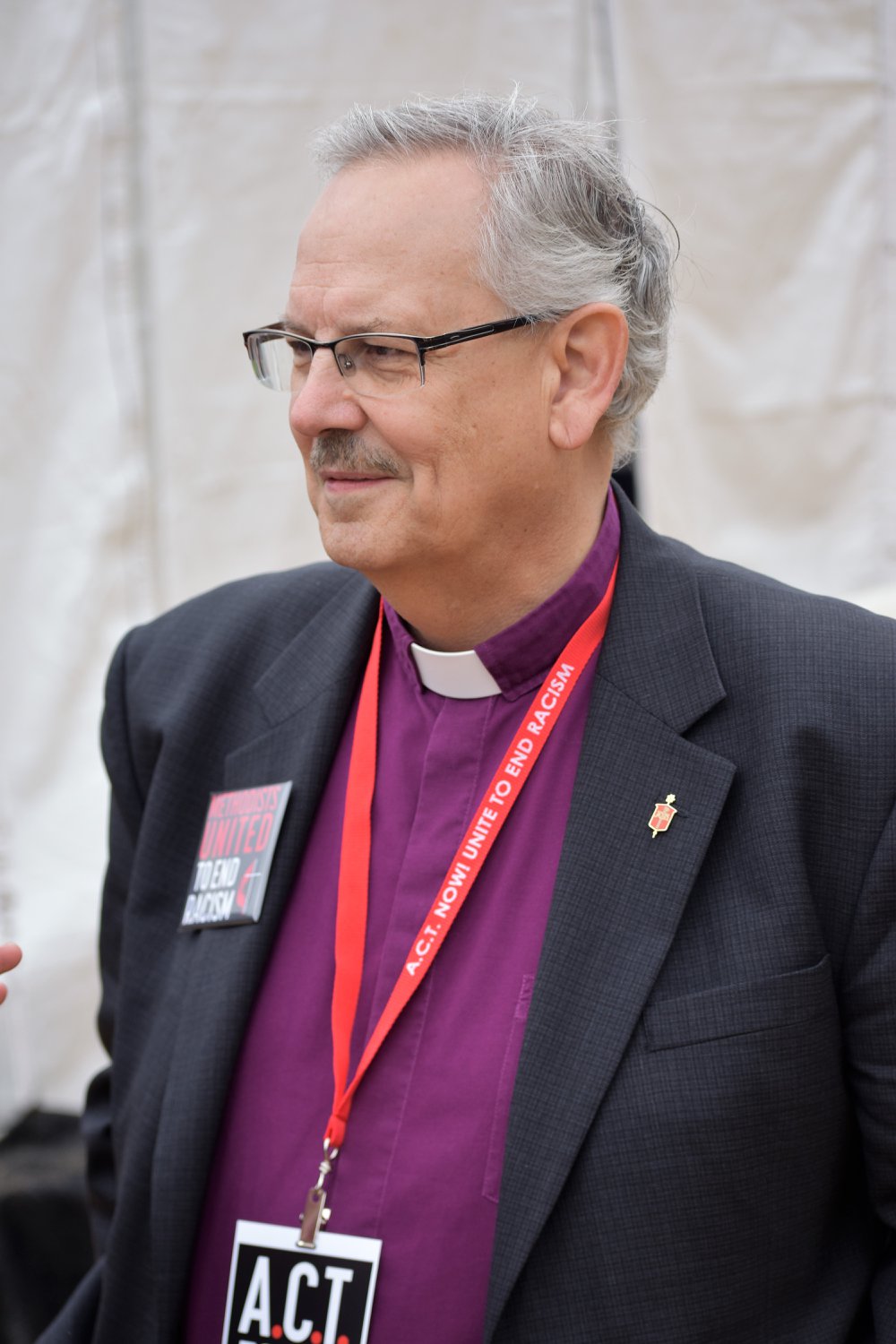
Statement by Bishop Bruce R. Ough
TO GO ON ANYHOW!
Grace and peace to you in the name and spirit of the Risen Christ. It is the Risen Christ who calls us here to embrace God’s vision of the beloved community and roll away the stones that entomb us in the sins of entrenched racism, collusive silence, pseudo reconciliation and delayed justice.
Thank you - thanks to each of you – for your presence today at this UMC Prayer Witness as the National Council of Churches launches its Truth and Racial Justice Initiative over these next three days. I am grateful for your commitment and your witness.
On behalf of the Council of Bishops, I also want to thank the National Council of Churches, the Board of Church and Society, the Commission on Religion and Race and the COB staff for their leadership in organizing this United Methodist Prayer Witness.
We have come to Washington, D. C. to commemorate the 50th anniversary of Dr. Martin Luther King Jr.’s assassination on April 4, 1968 at the Lorraine Motel in Memphis, Tennessee. The night before he was assassinated. King delivered his famous “I have been to the mountain top” speech to a crowd of striking sanitation workers. It was a stormy night, and Rev. King began his speech by thanking the audience for coming out and demonstrating, by their attendance that they were prepared “to go on anyhow.” TO GO ON ANYHOW!
It became the undertone, the undergirding, of his entire speech. He told the crowd that he did not know what would happen. The movement was in for trying time, but it didn’t matter because he had been to the mountain top and the people were prepared “to go on anyhow.”
I believe Dr. King was echoing this book written a year earlier titled, “Where Do We Go from Here: Chaos or Community?” That is the very question that has brought us to Washington fifty years later – Where do we go from here? And, friends, the only answer that will fulfill the gospel mandate and revive King’s civil rights legacy is: “to go on anyhow!” Say it with me – to go on anyhow. Yes, to go on anyhow!
Martin Luther King, Jr. wrote “Where Do We Go from Here?” in the midst of a nation deeply divided over race and racial inequality, deeply divided over the Vietnam War, deeply divided between poor and rich, deeply divided between political parties and over political inaction. The question ran strong and true – where do we go from here? And, the answer was “we go on anyhow!”
These divisions have only deepened in recent years, fueled by growing economic disparity, an increasingly crude political and personal rhetoric, the lack of a comprehensive immigration policy, the rise of white supremacy and hate groups, the resurgence of voter suppression and political gerrymandering, and unabated epidemic of gun violence. King’s haunting question continues to ring strong and true. And, our full-throated response is “to go on anyhow!”
One of my retired episcopal colleagues recently said to me that he has come to the conclusion that original sin is maintaining that my race or tribe or group that thinks and believes as I do is always correct and always superior, while other races or tribes or those who do not believe or think as I do are always wrong and always inferior. He has a strong argument. Racism may, in fact, be the original sin, or at least a variation of the original sin of making ourselves God and Lord over creation and Lord over others. Jesus’ entire life, ministry, witness, and even death and resurrection challenges this core sin. Dr. Martin Luther King, Jr. challenged this core sin. And, where do we go from here? Today, with one voice we day, “we go on anyhow!”
In his “Letter from Birmingham Jail,” King wrote: “We who engage in nonviolent direct action are not the creators of tension. We merely bring to the surface the hidden tension that is already alive … Like a boil that can never be cured so long as it is covered up, but must be opened with all of its ugliness … to the light of human conscience and the air of national opinion before it can be cured.” Friends, we are called to bring to the surface the hidden tension of bigotry, hate, xenophobia, institutionalized racism and lance these ugly boils. And, when our leaders or our fellow church members question our bringing such ugliness into the light of human conscience, our response is “we go on anyhow!”
Rev. Martin Luther King did not come preaching something new; he came shouting something we already knew, but failed to live. I quote Dr. King one last time: “You have said in your Declaration of Independence, ‘We hold these truths to be self-evident that all men are created equal. Are endowed with certain inalienable rights.’ And I insist that you either live by what you already know – or else be unfaithful to your own Constitution… It is time to take the thin paper and turn it into thick action.” We stand across from the Supreme Court Building and the U.S. Capitol Building and we bear witness today to the Court, our entire government, to the nation and to the entire world it is time to turn the thin paper into thick action for racial equality and justice. Where do we go from here? Our response is, “we go on anyhow!”
Psalm 41 begins with these words:
Happy are those who consider the poor; the Lord delivers them in the day of trouble.
The Lord protects them and keeps them alive; they are called happy in the land.
You do not give them up to the will of their enemies. (Psalm 41:1-2)
Dr. King did not give up on the poor, the weak, the disinherited, the exploited to their enemies. This is our challenge, our calling, our commitment, our reason for coming today to pursue truth and justice. Friends, where do we go from here? Always our response will be “we go on anyhow!” May it be so! Let us pray together.
Holy and gracious God, we bow before you grateful for the life and witness of your servant, Rev. Martin Luther King, Jr. As we gather these days to commemorate his death, we pray that the Holy Spirit will roll away the stones that entomb us within our own prejudices and paralyze us from seeking justice for all your beloved children. Let us not grow weary or disillusioned , so that we might be ready in this moment and in all circumstances of injustice to proclaim that, with the strength of your righteous, O God, we will go on anyhow. We pray this in the power and promise of the resurrected Christ. Amen.
Like what you're reading? Support the ministry of UM News! Your support ensures the latest denominational news, dynamic stories and informative articles will continue to connect our global community. Make a tax-deductible donation at ResourceUMC.org/GiveUMCom.


