

Key points:
- The United Methodist Committee on Relief said the changes will reduce costs while strengthening its disaster response ministry.
- Millions of relief supply kits have been assembled at Sager Brown and shipped to communities facing crisis across the United States and around the world.
- Throughout 2026, UMCOR will continue its work at the Sager Brown campus and host all scheduled mission experiences.
- UMCOR’s announcement said the relief agency looks forward to conversations about possible engagement with the local community.
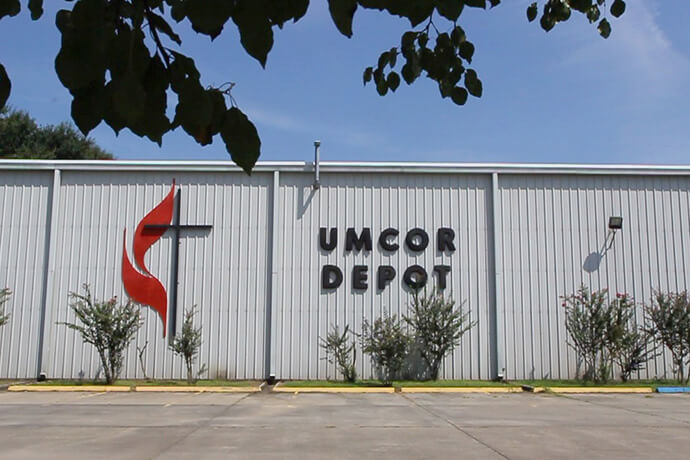
The United Methodist Committee on Relief has announced it will conclude operations at the Sager Brown Depot as it reimagines how disaster relief supplies are assembled, stored and deployed.
For nearly three decades, Sager Brown in Baldwin, Louisiana, has played a global role in disaster response. Millions of relief supply kits, often called flood buckets, have been assembled, prayed over and shipped to communities facing crisis across the United States and around the world.
In a Feb. 10 press release, UMCOR announced it will no longer operate the Sager Brown Depot, starting January 2027. Plans are to modernize the way the relief agency manages materials while reducing costs to strengthen its disaster response ministry. UMCOR will seek an experienced logistics partner and expand collaboration with affiliate warehouses across the country, the release said.
The relief agency will continue its work preparing and shipping relief supply kits at the Baldwin campus through the end of the year, in partnership with United Women in Faith and the Louisiana Conference. The depot will host all scheduled mission experiences.
“We will share updates as UMCOR’s plans evolve and look forward to conversations with the leadership of the Louisiana Conference as we explore possible engagement with the local community,” said Roland Fernandes, top executive of the United Methodist Board of Global Ministries and UMCOR, in the release.
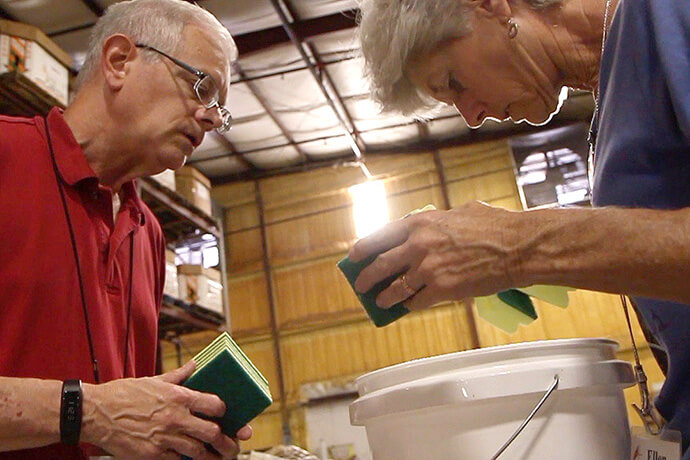
“As disasters increase in frequency throughout the United States, building a more distributed and agile network that draws on the expertise of partners is critical to UMCOR’s future disaster response efforts,” he said. “We know that this transition represents a significant shift for those involved with this ministry. UMCOR Sager Brown has been a cornerstone of our relief supply kit distribution for nearly 30 years, and we are grateful for the dedicated and faithful staff, volunteers, and donors who have sustained this ministry.”
For the Louisiana Conference, the news is both tender and hopeful.
“This is a moment filled with gratitude,” said Bishop Delores J. Williamston, who leads the Louisiana Conference. “UMCOR Sager Brown has been a place where faith met action. From Baldwin, Louisiana, love was packed into buckets and sent into the world. We give thanks for every life touched, every volunteer who served, and every prayer that traveled alongside those kits.”
She said the conference is grateful for the many people who made this ministry possible, the staff who showed up day after day, the volunteers who traveled long distances to serve people they would never meet, the churches and pastors in Louisiana who consistently answered the call to assemble relief kits, and the community of Baldwin and St. Mary Parish, who welcomed this work and walked alongside it for decades.
“The people of Baldwin have been gracious partners in ministry,” Williamston said. “This community supported Sager Brown, and Sager Brown supported this community. That relationship matters to us, and it will continue.”

Since the announcement, leaders across the conference have heard from clergy, churches, volunteers and community members who have expressed surprise, sadness and concern.
“Those reactions are understandable, and we want people to know that we hear them,” Williamston said. “This place holds deep meaning for many people, and it is right to pause, to grieve what is changing, and to give thanks for the ministry that has touched so many lives.”
According to UMCOR, the Sager Brown warehouse is approximately 48,000 square feet, a size that no longer aligns with its reimagined relief supply kit model. UMCOR also noted that the capital investments required to modernize the facility, including software systems, barcode scanning and logistics infrastructure, would be cost-prohibitive.
In addition, ongoing maintenance needs across the broader 25-acre campus, which includes multiple buildings requiring roofing, HVAC, and general upkeep, were cited as factors that made long-term operation unsustainable.
The Rev. Van Stinson, executive director of mission and ministry for the Louisiana Conference, said the ministry was never about one place or one program. “It was about people showing up for others, often in moments of deep need. That spirit of service and connection is something we carry forward.”
The story of Sager Brown long predates its role as a disaster response depot.
The property’s history stretches back to 1867, when it began as an orphanage and school for African American children in the aftermath of the Civil War.
Over generations, the land along Orphan’s Home Road served as a place of education, care, worship and community, shaped by the leadership and mission of United Methodist women.
After years of sitting vacant, the campus found a new purpose following Hurricane Andrew in 1992.
UMCOR used the site to stage disaster response efforts, and in 1996, the Sager Brown Depot officially opened as a hub for assembling and distributing relief supplies.
Since the mid-1990s, Baldwin has been known across the United Methodist connection as a place where service took shape through steady, faithful work.
Volunteers came from across the country and around the world to assemble relief supply kits that would be sent into communities facing crisis.
They asked for nothing in return, offering their time, their labor and their care, praying over each kit and trusting that God would meet people in moments of deep need.
“Those buckets carried more than supplies,” Stinson said. “They carried compassion. They carried dignity. They carried the prayers of thousands of volunteers who believed that even small acts, done together, could make a real difference.”
At the same time, UMCOR Sager Brown remained deeply connected to the Baldwin community.
Staff and volunteers worked alongside local residents through food distribution, housing rehabilitation projects and other efforts that supported families and older adults, including a thriving tutoring ministry.
Speaking about its impact in the Baldwin area and beyond, Bishop David Wilson, UMCOR board president, said the spirit of mission will continue.
“The UMCOR Sager Brown campus has been a place of vital mission and faithful service for many years and its impact extends far beyond the kits produced — it reflects a deep commitment to compassion, dignity and service in the name of Christ. As we move into this new phase, we honor that legacy and remain committed to ensuring that this spirit of mission continues to thrive.”
Subscribe to our
e-newsletter
For the Louisiana Conference, the change is a reminder of something long known in ministry: Models change, but the call does not.
“We know disasters in Louisiana,” Stinson said. “We know floods. We know hurricanes. And we know that the church must always be ready to respond. This moment invites us to build new models, connect our churches more deeply to their communities, and equip them to respond with grace and compassion.”
That commitment is rooted in the conference’s vision to build, connect and equip.
“Even as this chapter comes to a close, our calling remains clear,” Bishop Williamston said. “We will build new approaches to disaster response that meet today’s realities. We will connect congregations to neighbors in crisis. And we will equip churches to act quickly, faithfully and together.”
Conference leaders also want churches and members to know that conversations about what's next are ongoing.
“It is also important to clarify that the Louisiana Conference does not own the Sager Brown campus and is not the sole decision-maker regarding the future use of the site,” Stinson said. “The Louisiana Conference is actively working with United Women in Faith and Global Ministries to explore ways ministry can continue in Baldwin beyond this transition.”
In addition, plans are underway to honor and celebrate Sager Brown's legacy. Opportunities for celebration and reflection are being planned through the end of the year, with additional recognition anticipated at the 2026 Louisiana Annual Conference.
While the Sager Brown Depot model is changing, the heart of the work remains, Williamston said.
“We are thankful for what has been. And we are hopeful for what God is still calling us to do, and how we can and must respond when communities are in need. We will do so with bold love, a joyful spirit and with great courage.”
Rossnagel is director of communication strategies for the Louisiana Conference.
News media contact: Julie Dwyer at (615) 742-5470 or [email protected]. To read more United Methodist news, subscribe to the free UM News Digests.


