

Key points:
- United Methodist Men gathered African leaders for a historic meeting to share ideas, network and collaborate on a vision for men’s ministry on the continent.
- Conversations focused on how to conduct men’s ministry that aligns with The United Methodist Church’s new vision and offers a contextual approach to discipleship.
- “The idea was to encourage men to understand the significance of their calling and role as disciples of Jesus Christ,” said Bishop Nelson Kalombo Ngoy.
African lay and clergymen from across the continent gathered to share ideas about how to become better disciples of Jesus Christ during a historic first meeting with the Commission on United Methodist Men.
The inaugural gathering Dec. 9-11 at United Methodist-related Africa University brought together about 30 men from each of the denomination’s four African regional conferences to discuss issues affecting them and work to grow men’s ministry on the continent.
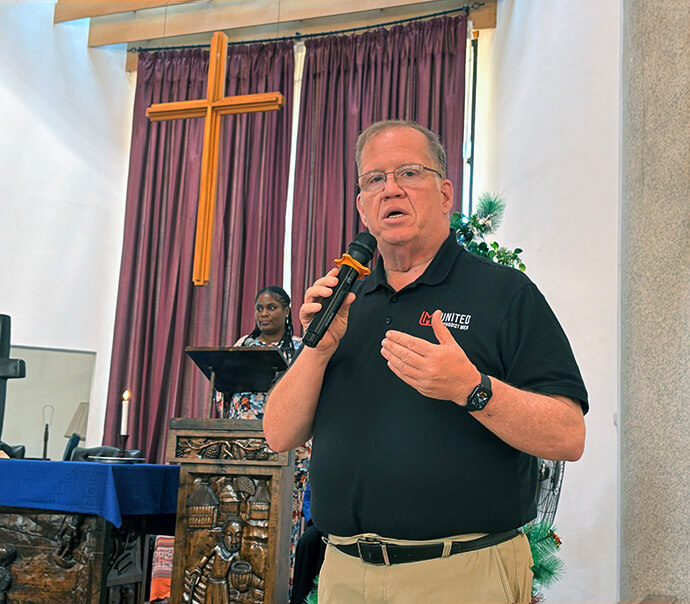
“Our conversations centered a lot around how to do men’s ministry in the context of African countries, and I also learned how they are doing ministry,” said the Rev. Rick Vance, top executive of United Methodist Men.
“I enjoyed the men’s excitement about the potential of new ministry in their episcopal area, heard of the challenges they face and the diversity of contexts they are doing ministry in as their areas are different,” he said.
Vance noted that there are some challenges and experiences shared by men in the U.S., Philippines and Africa.
“Ministry with and for men is happening in vibrant ways in Africa, and there is a deep desire about discipleship. I am taking back a lot of examples and ideas that will work throughout our connection,” he said.
Vance described the gathering as part of an intentional process to allow African men to create a ministry model appropriate for them.
“From an agency perspective, this is a new model and journey for GCUMM,” he said. “We are really embracing two things in The United Methodist Church: how to define the new vision and what that means in the context and the entire church.”
The denomination’s new vision calls on all members to “form disciples of Jesus Christ who, empowered by the Holy Spirit, love boldly, serve joyfully, and lead courageously in local communities and worldwide connections.”
Bishop Nelson Kalombo Ngoy of the Tanganyika Episcopal Area in Congo attended the meeting. He said the aim of United Methodist Men was not to bring a specific agenda to the continent of Africa, but to engage in a collaborative effort to connect and learn from the African view of doing ministry.
“I thought the purpose was humble and empowering. In my view, it decolonized the traditional concept of the old Christendom that America has all the answers,” he said.
“The main idea was to listen, empower and equip the United Methodist men on the continent of Africa because if men in Africa are transformed, the entire world will be transformed. Indeed, the idea was to encourage men to understand the significance of their calling and role as disciples of Jesus Christ within the body of Christ, so that they can be useful to advance the kingdom and to respond to the Christian mandate and mission to make disciples of Jesus Christ for the transformation of the world,” Ngoy said.
He said he offered participants a humble piece of advice.
“Pay attention to the critical contextualization. Even though we are all Africans, we are a diverse continent; each region has its specific challenges and opportunities for making disciples. I think a contextual approach is critical for fulfilling this missional mandate,” he said.
A major challenge is that men’s ministry has been historically ignored, Ngoy said. Men have engaged in ministry in their local churches, but they were often less affirmed and acknowledged.
“There has to be a paradigm shift in the theology. Men are often more vulnerable and marginalized than women according to many meeting participants,” Ngoy said.
The Tanganyika leader had a message for his African counterparts who were unable to attend.
“My advice to all my colleagues is to encourage, empower, support, affirm and recognize men and their calling because if men are equipped, The United Methodist Church will make a great impact and difference in the world.”


The Rev. Antonio Macilau Vilanculo of Mozambique said he learned that men’s problems are the same in many countries. It was his first time interacting with colleagues from across the continent.
Among the concerns expressed by attendees were marginalization in church activities, trauma from war in countries such as Congo, Sudan and South Sudan, and an inability to open up due to socialization and the belief that showing emotions is a sign of weakness.
“I bring with me the reality that as Methodist men, we are already shirking our responsibility to be the head of our families and communities. This is now the time for us to organize ourselves and begin men’s activities,” he said.
James H. Salley, Africa University president and chief executive officer of Africa University Tennessee Inc. and associate vice chancellor for institutional advancement, said the gathering gave men the opportunity to learn from other conferences.
“We learned that men need to talk more across conferences; the more they talk the better we can carry out the mission of the church,” said Salley, who is a lay member of the South Carolina Conference.
“It’s good to have men who graduated from AU back on campus in leadership across the continent. We thank them, especially Bishop Ngoy.”
Salley told UM News that his home South Carolina Conference probably has the largest regular gatherings of United Methodist men, with one event attracting over 1,100.
“I’ve heard gatherings of The UMC are for women,” he said. “It’s the first time that men have been invited to talk about how to get them involved in church. It’s something they have been looking for a long time, an opportunity to talk to other men and hear what’s happening in their episcopal areas.”
Salley urged the Zimbabwe men who are locally called “vabvuwi” (fishers of men) to give lessons to their counterparts to help develop their ministries.
Vabvuwi have a variety of programs, including medical outreach where they provide free medical consultation and treatment, spiritual conventions and income-generating projects. The men have purchased vehicles and founded two schools: Nyadire Secondary in Zimbabwe West in 1977 and Clare Secondary in Zimbabwe East in 2005.
“This is the start of a new movement, better late than never. The excitement and enthusiasm of these men may surpass U.S. standards,” Salley said.


Wehnam Dabale of Nigeria is Africa University’s director of alumni, externalization and church relations. He said the inaugural, continent-wide gathering of United Methodist Men in Africa is a commendable initiative.
“It powerfully reaffirms The United Methodist Church’s deep commitment to the welfare and inclusion of all its members, with particular focus on engaging men.
“Convening at Africa University, a shining example of The UMC’s legacy in Zimbabwe, underscores a commitment to nurturing a purposeful, collaborative and transformative men’s ministry dedicated to making disciples for the world,” he said.
Christopher Mukumire, Zimbabwe West Conference men’s chairperson, said the meeting was fruitful.
“We managed to connect with our counterparts in Africa and we have learned quite a lot about what other men are doing. We are very happy and from now we will be inviting other episcopal areas to attend our conventions, conferences and other events, so we can continue cascading information from other regions to our districts and circuits.”
Herbert Rusawo, men’s secretary for the Zimbabwe East Conference, said it was his first big meeting and he found it eye-opening.
Subscribe to our
e-newsletter
“At this forum, we were trying to strengthen and empower the men’s ministry, build relationships and share notes from different regions,” he said.
Steven Scheid, director of the Center for Scouting Ministries for United Methodist Men, attended the meeting to discover how African men can connect with youth on the continent. Scouting is present in 156 countries in the world, with over 40 of them in Africa.
“Conversations narrowed on how the men can connect with youth. It is time for men to be engaged with the younger generation,” Scheid said.
“The participants were very excited about Scouting but also nervous. Some fear dressing youth in uniform as it reminds them of war. So they are comfortable in the neckerchief, which is a safer symbol of the movement,” he said.
Retired Bishop James E. Swanson Sr., who serves as a mentor/consultant for United Methodist Men, said his role was to listen to attendees and hear their hopes, dreams, fears and concerns and discern ways the agency can support them.
“I was surprised by commonalities with the U.S. Participants approached the gathering with fear that they wouldn’t be heard or taken seriously,” Swanson said.
“Africans portray a happy-go-lucky image and celebrate while they are hurting,” he said. “How do you help men to release the hurt and anger? The church doesn’t know the men are hurting. This meeting has given me hope. I am so excited.”
Bishop L. Jonathan Holston, who leads the North Alabama and Alabama-West Florida conferences, is president of United Methodist Men and Africa University Tennessee Inc. He said the meeting was the start of a movement that will make a difference.
“We are not a denomination that is separate; we are one church. We do know in all of these areas we are all seeking to make disciples, and when our areas are transformed, the whole world is transformed,” Holston said.
In his sendoff reflections, Africa University’s Dabale encouraged participants to remain hopeful.
“The Holy Spirit will be with us. It will move everyone in their own village, language, context, situation. I hope we will gather again to celebrate this humble beginning.”
Chikwanah is a UM News correspondent based in Harare, Zimbabwe.
News media contact: Julie Dwyer at [email protected]. To read more United Methodist news, subscribe to the free UM News Digest.


