
Key points:
- The United Methodist Church in Romania runs a hotel that hosts a variety of ministries. They helped two Ukrainian women begin a sewing business on site.
- The women said their work is a helpful distraction from the bad memories of fleeing the war.
- They sew “everything you need” for babies, from blankets and linens for cribs to toys and hanging baskets.
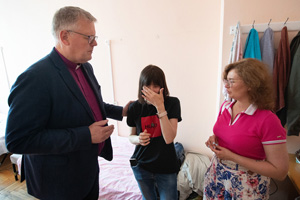
Editor’s Note: In late May, a team from United Methodist News, the United Methodist Committee on Relief and the United Methodist Board of Global Ministries visited church refugee ministries in the Czech Republic, Hungary, Romania and western Ukraine to share stories of the United Methodist presence in the wake of such tragedy and ongoing need. UM News has agreed to use first names only for some of those interviewed to protect their safety.
Living on a higher floor of her apartment building in Odesa, Ukraine, Maria had a front-row seat when Russia invaded her country on Feb. 24.
“When the war started, I saw everything from there — very loud, very bright, very scary,” she said.
How to help
To donate, please give to UMCOR’s International Disaster Response and Recovery fund, Advance #982450, or UMCOR Global Migration, Advance # 3022144.
By the next day, she knew it was time to flee. Her husband, a sailor at sea, urged her to go to Slovenia but, she said, “I was tired; it was night. I opened the map and found the nearest city, and it was Cluj.”
Cluj-Napoca, that “nearest” city, is still a 10-hour drive from Odesa, so she arrived in Romania late at night with her two children, mother-in-law and a small dog, seeking a hotel that allowed pets. She found a vacancy at the Hotel Hanul Fullton, a hotel and ministry center run by The United Methodist Church in Romania.
“In the morning, Rares (Calugar, church superintendent) came and said we can stay a while,” Maria said.
She was the first refugee to arrive in the city, so Calugar asked if she knew of others who needed help. Her first call was to her friend Daryna, who needed to leave her town of Kryvyi Rih. Daryna’s daughter has a metabolic condition requiring special medicine that she could no longer find in Ukraine.
“When the shock was behind us, we thought about what we want to do,” Maria said.
Back in Odesa, she’d been a professional seamstress. Daryna, who taught high school economics, had begun sewing for extra cash during COVID. A business idea was born.
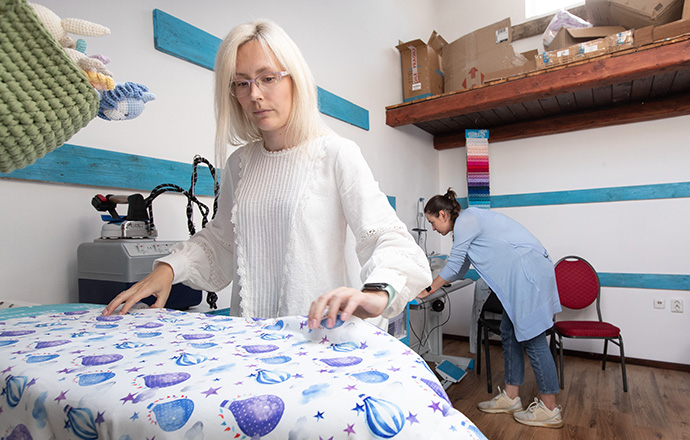
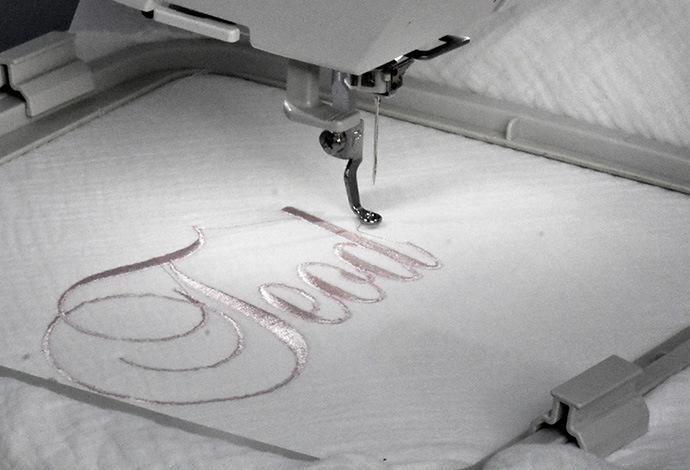
Calugar found them a workspace at the hotel and bought them a sewing machine. Through some complex arrangements, Maria was able to have her embroidering machine delivered from Odesa.
“It was a lot of people traveling car by car, different people,” she said. “It’s very expensive and the main machine that we needed to sew.”
They sew “everything you need” for babies, from blankets and linens for cribs to toys and hanging baskets. For now, they work for donations but hope to turn it into a business.
Maria said the work also is a helpful distraction.
“When you do something like sewing, you don’t think about bad memories,” she said, noting that her daughter still becomes scared and tries to hide when she hears a plane.
All of their children are attending school in Cluj-Napoca. Due to having a special-needs child, Daryna’s husband is exempt from Ukraine’s compulsory military service and was able to come with her. A former information technology manager, he’s currently working at a supermarket, but Daryna said he’s learning Romanian in order to find a better job.
“That’s why we plan for the long term: how to create jobs and integrate people into the community,” Calugar said. “Our resources will not last forever and some of these people have nowhere to return, so they will be here.”
Daryna said that every day they think about going back, but it’s not safe. “My parents and in-laws are still there. Our hearts are in Ukraine. Until the war ends, we will be at another place.”
Maria said she and her family feel safe now.
“My daughter has new friends here, both Romanian and Ukrainian, and now she thinks about this like it’s a new journey,” she said. “But when I put her to bed, she asks, ‘How is my room and my toys back home?’”
For now, both Daryna and Maria said Cluj-Napoca and the Hotel Hanul Fullton are home, and they are grateful for the hospitality they’ve been shown.
“I don’t know what we’d do if Maria hadn’t found this hotel and Rares,” Daryna said.
Maria said she can’t take the credit.
“Maybe this hotel found us. It was destiny or God; I don’t know.”
Butler is a multimedia producer/editor for United Methodist News. Contact him at (615) 742-5470 or [email protected]. To read more United Methodist news, subscribe to the free Daily or Weekly Digests.
Watch video