
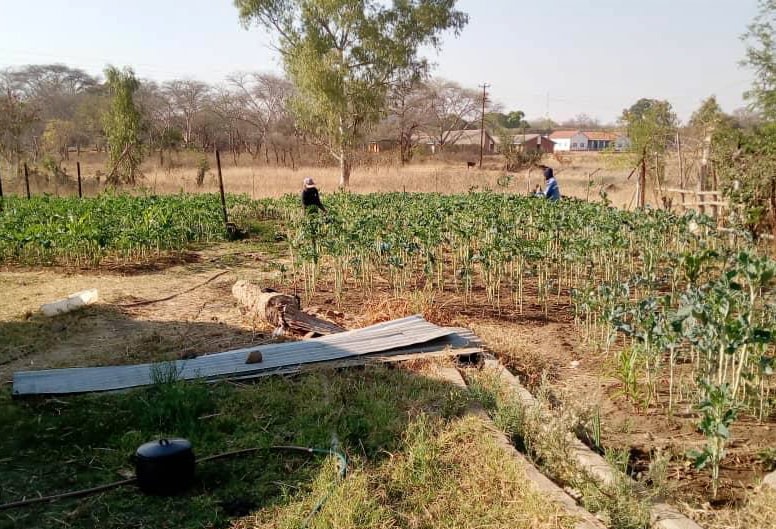
Workers tend to vegetables planted at the Nyadire Mission farm in Nyadire, Zimbabwe. The farm was among six United Methodist properties evaluated during a land audit by the Zimbabwe Episcopal Area. Photo by Chenayi Kumuterera, UM News.
The United Methodist Church in Zimbabwe is taking its first steps toward utilizing church land to develop large-scale farming projects.
In June, the Zimbabwe Episcopal Area embarked on a land audit to look for opportunities to make agriculture profitable for the church.
The audit is the result of a call made in January at a United Methodist agricultural summit to develop church land in Africa into commercial enterprises.
Auditor Kudakwashe Mutyavaviri said the results show the vast potential that farmland could bring to the church if utilized.
Receiving the report was an important day for the episcopal area, Bishop Eben K. Nhiwatiwa said. “We have been moving to try and upgrade our farms … I can assure you, change is coming. Change we embrace.”
The audit covered six land parcels The United Methodist Church owns across the country. The church has an additional 10 properties that will be audited after the first sites are developed.
According to the report, the church’s farm in Murewa is seriously underused.
Of the 5,018 cleared hectares of land (more than 12 thousand acres), only 982 hectares are being used due to a lack of resources.
Justice Chakanaka Nyakunu, a farmer who works at the church’s Mutambara Mission, said he talked with local farmers in the area who showed interest in commercializing their farming activities.
“We have the passion and the skill to go commercial. You can see where our effort has taken us. We have cleared the potential arable land, which we are not utilizing now due to a lack of resources,” said Nyakunu, who has a bachelor’s degree in agriculture from Africa University.
“My main challenge is seasonal change. During summer and winter, I face water challenges. It is of paramount importance that we have an irrigation scheme so that we can embark on commercial agriculture,” he said.
The Rev. Alan Masimba Gurupira, administrative assistant to the bishop, said the United Methodist Board of Global Ministries, emphasized the importance of land audits as a first step toward change. The agency organized the agricultural summit earlier this year in Johannesburg.
“The land audit is critical in that it gives a variety of answers to questions that are key for any serious agricultural venture to take place,” Gurupira said.
“The Zimbabwe Episcopal Area has got great potential to develop its existing farms. Given the needed financial and human capital, all should be geared to change the face of the episcopal area in support of its mission programs,” he said.
Auditor Mutyavaviri, director at SkyArt Investments, said The United Methodist Church’s vast land can change the church’s income level.
“Zimbabwe was once dubbed the breadbasket of Africa, and starting with (United Methodist Church) farms, we will be moving towards restoring this historic moment in our nation, provided we utilize the land” through commercial productivity, he said.
He urged the church to capitalize on the land audit.
“Look at the shortfalls and address them, look at the available opportunities and leverage on them to start something new in The United Methodist Church and in Zimbabwe at large.”
He noted that most of the audited farms lie in Region 2 and 3, which means they receive higher rainfall and are suitable for intensive farming.
“(The church) should start to act as soon as possible, look for partners, especially in financing the possible projects, or mere donors, so that they can start the production process and transform the nation,” he said.

Bishop Eben K. Nhiwatiwa receives a land audit report from auditor Kudakwashe Mutyavaviri. The Zimbabwe Episcopal Area ordered the land audit in June to look for opportunities to utilize church land for large-scale farming projects. Photo by Chenayi Kumuterera, UM News.
Gurupira said that now that the first land audit is done, the Zimbabwe Episcopal Area can look to the future.
“Farming season is just around the corner and we are going to make it a point that our farm managers, especially at Nyadire Mission and Mutambara Mission farms, are going to be working out a program (regarding) which (crops) we are going to plant this season,” he said.
The mission farms are among the six parcels audited in the recent report. The properties, it noted, need to begin farming proper crops and acquire additional funding and equipment to move toward commercialization.
Gurupira said the church intends to bring together United Methodist farmers in the region who are doing well to visit the church’s farms and share their expertise.
“We are going to work hard to till the land and sell our produces,” Gurupira said.
Kumuterera is a communicator with the Zimbabwe West Conference.
News media contact: Vicki Brown at (615) 742-5470 or [email protected]. To read more United Methodist news, subscribe to the free Daily or Weekly Digests.
Like what you're reading? Support the ministry of UM News! Your support ensures the latest denominational news, dynamic stories and informative articles will continue to connect our global community. Make a tax-deductible donation at ResourceUMC.org/GiveUMCom.


