
Africa University students are adapting to online classes following the March 24 government directive to close all schools, colleges and universities to curb the spread of the coronavirus.
The move is part of a three-week nationwide lockdown. There have been seven recorded COVID 19 cases in the country and one death, according to Reuters.
Online instruction began March 30 for the more than 2,500 students from across the African continent enrolled at the United Methodist university.
Stephene Chikozho, director for advancement and public affairs, said all departments will be conducting their lessons via the internet.
“Despite the scourge of COVID-19, classes will continue as if the students were on campus,” Chikozho said.
He said university leaders allowed a few days for students to reach their respective homes before implementing the online classes.
“The university ensured students downloaded all the big files before they left campus as data is very expensive in some countries,” Chikozho said.
Internet connectivity is a challenge that comes with online education, but the university is aiming to continue with normal lectures during the time students are away from campus. The government has not indicated when institutions will reopen.
No internet issues have been reported to date, according to the Students Representative Council, but the university plans to work with students to find solutions if problems arise.
The Rev. Peter Mageto, AU deputy vice chancellor, said there were only four weeks left in the first semester when the university closed.
“We had completed 80 percent of the curriculum, so it will be easy to complete the rest online,” he said. “We are excited and the students are happy as they will be able to complete their work for the semester.”
Africa University was the first tertiary institution to be approved to conduct online learning by the Zimbabwe Council for Higher Education. The online programs started in November 2017.
The Rev. David Bishau, director of the Institute of Theology and Religious Studies, said online classes already had commenced in his department.
“We are using various applications including Zoom (for meetings), WhatsApp messaging service and emails,” he said.
“I have created a file for the institute and I am pre-recording and uploading lectures on YouTube,” Bishau said.
The Institute of Theology and Religious Studies has over 130 students.
Chikozho said while the university closed in line with the government directive, some international students remained on campus because they could not afford to return home or their home countries had enforced a lockdown and closed their borders and airports.
“We have communicated with the bishops of international students on scholarships for them to assist with fares for their return home,” he said.
Fiston Okito, the AU Students Representative Council vice president and a final-year divinity student, is one of the students who remained on campus.
“I am a student leader. For me, there is no way I can go and leave the international students who are here because some of them do not have money to travel and there are others whose home countries have closed their borders,” he said.
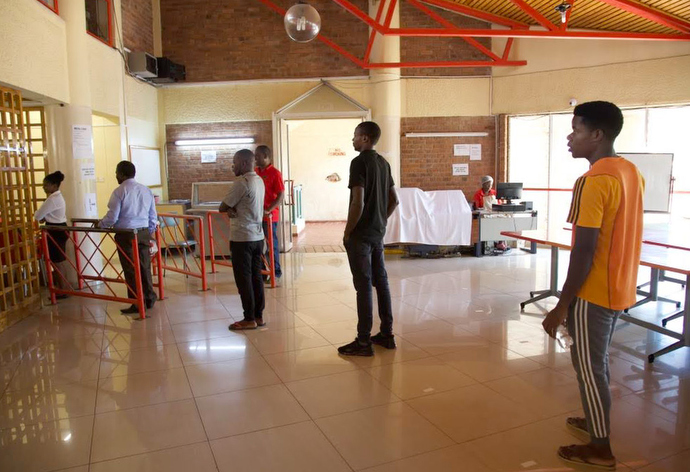
Africa University has introduced stringent measures to ensure everyone on campus is safe. People entering and exiting the campus are getting their temperatures checked at the main gate, while handwashing facilities and sanitizers have been strategically placed around the university.
“We have taken social distancing seriously and more than half of the staff are working from home,” Chikozho said.
“Students remaining on campus are not sharing; we have one person per room,” he said.
Chikozho said the AU dining hall has changed serving and seating arrangements and meal times have been extended to three hours so those on campus do not all have to be served at the same time. The dining hall staff also has been provided with personal protective equipment such as masks and gloves.
Chikwanah is a communicator of the Zimbabwe East Conference.
News media contact: Vicki Brown at (615) 742-5470 or [email protected]. To read more United Methodist news, subscribe to the free Daily or Weekly Digests.
Like what you're reading? Support the ministry of UM News! Your support ensures the latest denominational news, dynamic stories and informative articles will continue to connect our global community. Make a tax-deductible donation at ResourceUMC.org/GiveUMCom.


