
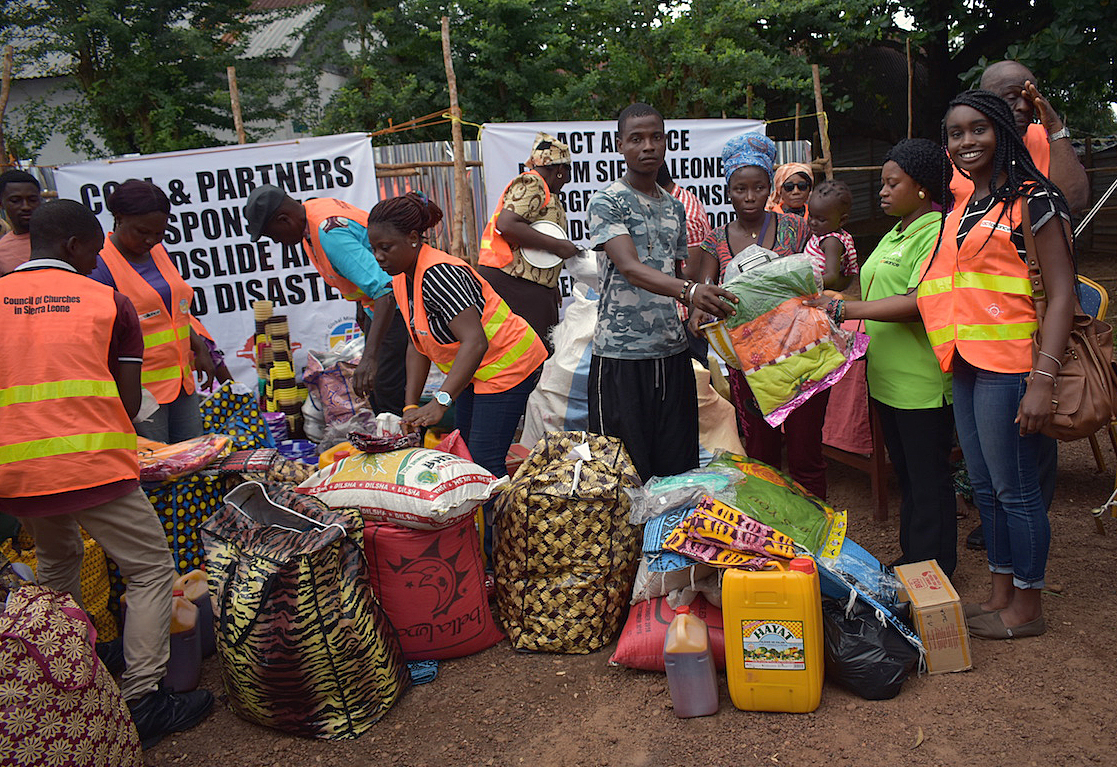
One month into the disaster response for people affected by the twin disasters of flooding and the mudslide, the Council of Churches in Sierra Leone views environmental care and education as the long-term plan for churches.
The council distributed about $82,000 worth of food, bowls, blankets and other relief items to the disaster victims from Pentagon and Kamayama who have now been relocated to Juba — a community near the Sierra Leone Armed Forces Military Barracks in western Freetown.
United Methodist Bishop John Yambasu, president of the council, said the distribution was a way for churches to be in solidarity with the mudslide survivors.
“It was done in the hope to alleviate the suffering of the people who were affected by the disaster,” the bishop explained. “Some people were well placed and all of a sudden they lost everything. That (distribution) was meant to put food on their table even if for a day or two because the loss on their part was enormous.”
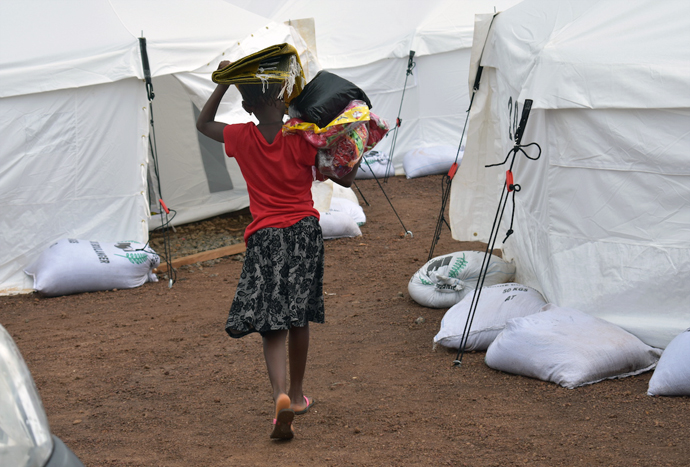
A disaster-displaced girl returns to her tent after collecting relief items distributed by the Council of Churches in Sierra Leone at a new relocation camp in Juba. Photo by Phileas Jusu, UMNS.
Ebun James Dekam, the council’s top executive, said she is happy religious organizations are helping provide some hope to the survivors.
“But the task at hand is so big — the prevention. How do we engage government?” she asked. “How do we use our pulpit to tell these people — the landowners, the tenants who are either in our church or in our mosque — that they must quit the places they are staying at because government has said it is disaster prone?”
Another issue is convincing people to stop cutting down trees and “to go out there and plant trees” despite the fact that firewood or charcoal is a primary source of energy,” she said.
Dekam said the challenges of climate change and environmental degradation need the long-term engagement of the church and cited the creation story in Genesis.
“So it is time for Sierra Leoneans to go back to Genesis. God will hold us accountable for caring for earth and the sanity of life,” she added.
The preliminary findings of a rapid disaster assessment led by the World Bank were reported Aug. 25 to Sierra Leone President Ernest Koroma. That report states that the loss of forest and spread of urbanization brought more challenges for sustainability of the environment. The report said 60 percent of the forest north of Freetown has been lost over four decades, contributing to the $30 million in damages to Freetown from the Aug. 14 flooding and mudslide.
how to help
Donate to the International Disaster Response Advance #982450. Money from this fund is used to respond to disasters around the world.
Those affected by the disaster will stay at the new camp for the next three months before they are moved to permanent homes. The government’s Ministry of Information and Communication said three construction companies have opted to build 52 affordable houses for flood and mudslide survivors at a site recommended by government. The homes will be the first of the many more affordable housing the government hopes to construct for the long term.
The council is providing counseling and psychosocial support for two of the affected communities at Pentagon and Kamayama. That service will continue even after the emergency response ends, Dekam said.
“The grieving period is going to be much longer. With trauma situations sometimes, the person is in a state of denial saying ‘No, no, no, this can’t be true,’” she noted. “And that is why we stationed our pastors at the centers.”
Two pastors will continue to be on hand at the camps, holding worship services in the morning, Dekam said. After services, the pastors are available in case survivors have further needs.
“Those who are not Christians are referred to their imams — Sierra Leoneans have that religious tolerance that makes room for such referrals. Our pastors were initially stationed there for a month. But I understand the camps will be running for three months; most likely we will walk the journey with them even when they go back home or after the camp might have closed,” she said.
When helping distribute relief items to the mudslide survivors, Dekam said she wondered what would be next.
“In 2015, we were at the National Stadium and served the flood victims and government at the time promised relocating them,” she recalled. “Today, you go to bay (the area hit hardest by that flood) and you’ll think it did not happen.”
She’s now worked with victims of four disasters and said she’s learned to be patient with survivors.
“At times, they’re a bit aggressive and they throw the items back at you like they’re fighting back that pent-up emotion in them. Others come tearfully and you can see that they are in that shock state still. Some of their stories would want to make you cry. They just receive the things and then they go — it’s a bundle of mixed feelings,” she said.
Lois Kamara, an Oxfam social worker at the new camp, told UMNS that the bowls, plates, spoons and cups distributed by the council were needed, since survivors have been using rubber bottles to drink tea.
“The cotton dresses for the women make them feel dignified once again,” Kamara said.
Jusu is director of communications for The United Methodist Church in Sierra Leone.
News media contact: Vicki Brown at (615) 742-5470 or [email protected]. To read more United Methodist news, subscribe to the free Daily or Weekly Digests.
Like what you're reading? Support the ministry of UM News! Your support ensures the latest denominational news, dynamic stories and informative articles will continue to connect our global community. Make a tax-deductible donation at ResourceUMC.org/GiveUMCom.


