
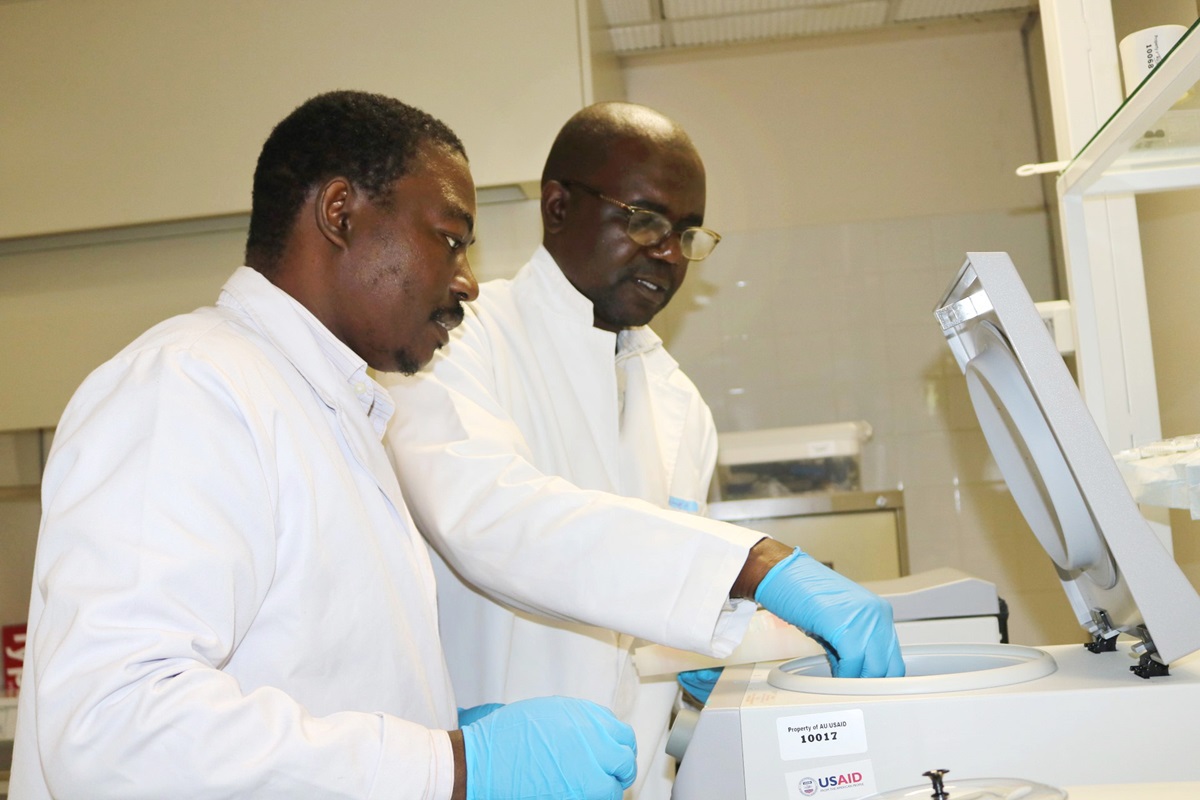
Africa University is engaged in groundbreaking research to combat malaria in partnership with the U.S. Agency for International Development, the Zimbabwe government Ministry of Health and Child Care and other organizations.
The work to study mosquitos that cause malaria is part of a broader effort by the
U.S. President's Malaria Initiative, a project of USAID and the Centers for Disease Control and Prevention to increase the capacity of mosquito monitoring and research throughout Zimbabwe, said Stephanie Funk, USAID/Zimbabwe mission director. Launched in 2005, the goal of the initiative was to reduce malaria-related mortality by 50 percent across 15 high countries in sub-Saharan Africa.
“Africa University's lab and insectary, located in a part of the country with the highest cases of malaria, will help map malaria mosquitoes throughout the country, monitor and understand mechanisms for mosquito resistance to insecticides, and document mosquito biting and resting behaviors,” said Funk.
She said the U.S. initiative supports Zimbabwe’s national malaria program by providing bed nets, spraying to eliminate mosquitoes and assisting in diagnosis and treatment to combat malaria in 45 districts.
“This contributed to the reduction in malaria cases from 1.8 million in 2006 to 469,000 in 2017,” she said.
Sungano Mharakurwa, a professor at Africa University, said that until 2015, malaria was the leading cause of death in Zimbabwe, even surpassing HIV/AIDS. “But thanks to increased interventions and renewed determination to eradicate the disease, the problem has been greatly reduced,” he said.
LEARN MORE OR DONATE
To learn more about Africa University or donate to the United Methodist school, visit the Africa University Development office site.
The United Methodist university is located in the Mutasa District, one of the districts that contributes to more than half of the malaria cases in the country, he explained, adding that the university’s College of Health, Agriculture and Natural Sciences “is committed to solving national problems for the positive transformation of Mutasa, Zimbabwe and beyond.”
Until three years ago, the annual global malaria death toll was 2 million — mostly children in Africa — with 500 million suffering from the disease every year, Mharakurwa said.
Cases were recorded mostly in Africa, south of the Sahara, though other regions, such as Asia and the Pacific also were affected. During that time, malaria was affecting 101 countries but with progress through eradication of the disease that number has been reduced to 91 nations.
In 2011, there were massive efforts to spray homes with insecticides and also distribute insecticide-treated mosquito nets, but, surprisingly, the number of malaria cases increased, he said.
The Southern Africa International Centre of Excellence for Malaria Research — which Africa University is affiliated with — then captured and identified the mosquito that was transmitting malaria. “It was Anopheles funestus, a vector that was believed to have been wiped out during the time the country used DDT for spraying, and people had forgotten about it,” he said.
It was discovered that the Anopheles funestus was resistant to the synthetic pyrethroid insecticides then used for both residual spraying in households and treating mosquito nets.
This led to the increase in malaria cases despite the efforts to combat the disease.
“The Ministry of Health then changed the malaria policy in 2014, resulting in the introduction of a different class of chemicals for spraying,” Mharakurwa explained.
The university now provides the government with reference material and live mosquito specimens and is in the final stages of establishing a national referencing insectary for research.
“We established a molecular surveillance facility which feeds technical data to the Ministry of Health and Child Care and is used to guide malaria control,” said Mharakurwa.
The university provides the government with reference material and live mosquito specimens and is in the final stages of establishing a national referencing insectary for research.
Currently, the government’s malaria control program personnel submit suspected malaria-transmitting mosquitoes to the university, which dissects and analyzes the specimen in its laboratories.
The Southern Africa International Centre of Excellence for Malaria Research operates in Zimbabwe and Zambia, including on the border with the Democratic Republic of Congo.
“We are now working on more versatile personal protection and researching on effective natural methods traditionally used to fight the disease,” Mharakurwa said. “We want to get to zero cases of malaria in Mutasa and neighboring districts. Many diseases are spread by mosquitoes so our work is set to expand to other areas.”
Mharakurwa said the research will benefit other countries besides Zimbabwe. “The methods and research findings are shared across the Southern Africa region and beyond.”
He cited other diseases transmitted by mosquitoes as filariasis (including elephantiasis), yellow fever, Rift Valley Fever, Zika fever and chikungunya (a viral disease endemic in East Africa and Asia).
Mharakurwa, a childhood malaria survivor, is passionate about finding a lasting solution to the disease, which has also affected some members of his family and robbed him of his maternal grandmother.
“I was once treated for malaria at Mutare Provincial Hospital in the 1970s, and my eldest son fell ill last year. These are sobering personal experiences that are a stark reminder of the duty to battle against malaria,” he said.
Chikwanah is a communicator of the Zimbabwe East Annual Conference.
News media contact: Vicki Brown, news editor, [email protected] or 615-742-5469.
Like what you're reading? Support the ministry of UM News! Your support ensures the latest denominational news, dynamic stories and informative articles will continue to connect our global community. Make a tax-deductible donation at ResourceUMC.org/GiveUMCom.


