
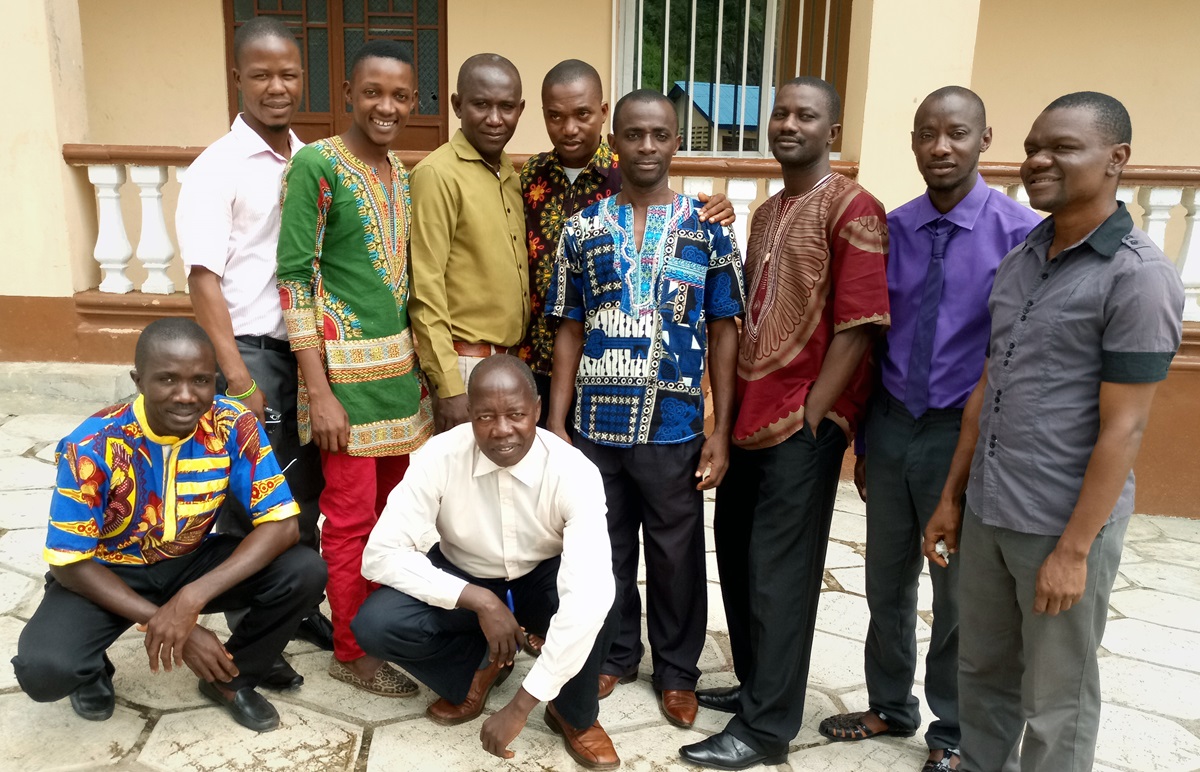
After a year’s delay, United Methodist University in Sierra Leone is up and running. Orientation has been completed and students have started classes in earnest as they grapple with both the academic and social challenges.
Located at Leicester Peak — the highest peak on the Freetown Peninsula overlooking Freetown — the new one-building School of Theology provides a serene atmosphere for learning. The paved compound is far from the hustle and bustle of the city, and the elevation offers cooler temperatures in a country known for its humid weather year-round.
The United Methodist University in Sierra Leone was initially proposed to start with four faculties — nursing, theology, development studies and agriculture. The other faculties will be integrated as they become ready. Furnishing and equipping of the newly constructed School of Nursing in the southern city of Bo is underway.
First year Bachelor of Theology student Steven Senesie, a United Methodist pastor, was impressed with the classroom environment after a week of lectures.
“All the lecturers for the nine modules for the first semester have shown up, given us course outlines and are effectively teaching us every day,” he said.
Senesie, who was pastor in charge at Valunia United Methodist Church in Mongere in the south before becoming a student, has been to other universities around the country, but he said the classroom at the new university is better equipped than any he has seen before. There’s even an overhead projector, he said, that records the day’s lessons so that students can play them back if they have difficulties or want to refresh what they’ve learned.
Roy Christian Tarawally is a graduate of Ernest Bai Koroma University in Makeni in the north where he was assistant pastor at First United Methodist Church. He is impressed with the knowledge base of the tutors. The least qualified of them, he said, holds a double master’s degree.
There are nine students pursuing Bachelor of Theology degrees; four diploma students in theology; and 18 certificate students in chaplaincy. The diploma and degree students are all on scholarships, while the chaplains in training are supported by their respective United Methodist schools.
Asked whether they signed a bond before enrollment to serve The United Methodist Church upon graduation, Senesie said there was no need since all 13 of them are United Methodist pastors.
“We have been serving the church all these years; we will continue to serve the church even after graduation,” he said.
Students are facing a few challenges at the new university. Almost all of them come from the provinces and were expecting to stay on campus. However, there is no lodging facility and the compound is far from where many of them stay in town.
While Tarawally is grateful for the opportunity to attend the school, he said transportation is an issue. He lives in the far eastern part of the city and the college is on a steep hilltop in the west. He has to wake up early to catch a bus and changes several public transports before he gets to the college campus — a situation he has yet to adapt to. He worries that he will be late to class and face suspension.
“I have to wake up at 6 a.m. and hurry because my classes start at 9 a.m. and we have been told … that coming late three times is equal to one absence; four absences is equal to suspension. I don’t want to be suspended,” he said.
Senesie said the food situation also is a concern.
“We are very much comfortable; the atmosphere is conducive; the compound is very neat, but there is no cafeteria system that exists in other tertiary institutions and there is no nearby restaurant,” he said.
The Rev. Joseph Moiba teaches undergraduate students in Introduction to the Old Testament and Psychological Counseling. He said that after his first week interacting with the students, he finds them to be committed, polite and eager to learn. He also was impressed with their timeliness.
“Today, I was here at 10 minutes to nine for a nine o’clock class. They were all present. They also have the eagerness to always ask questions. I think they will be great students,” he said.
Moiba, who also is chaplain and director of research, further commends the learning environment.
“We count ourselves as probably the most lucky in Freetown when compared to other learning institutions. This place is so ideal for learning and teaching because it is very cool and the atmosphere here at Leicester Peak encourages us to concentrate. I really appreciate and I’m thankful to God that we have this type of environment, which is unique.”
Looking forward, he wants to see the chapel built and more buildings added, including hostels for adjunct lecturers. He expects minor challenges, such as water storage in the building, to be resolved quickly.
United Methodist University in Sierra Leone is the brainchild of Bishop John Yambasu who envisions it to be a “center of excellence with a focus on the production of individuals with moral integrity and the ability to positively transform lives in society.”
After the first couple of weeks, Moiba finds himself sharing in Yambasu’s dream.
Jusu is director of communications for The United Methodist Church in Sierra Leone.
News media contact: Vicki Brown at (615) 742 5470 or [email protected].
Like what you're reading? Support the ministry of UM News! Your support ensures the latest denominational news, dynamic stories and informative articles will continue to connect our global community. Make a tax-deductible donation at ResourceUMC.org/GiveUMCom.


