

Key points:
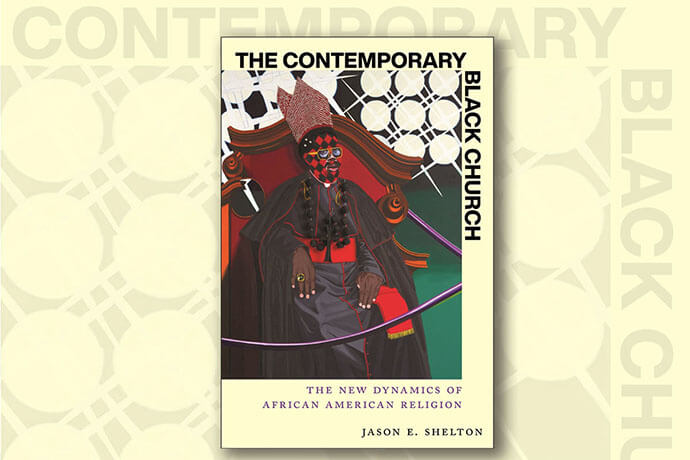
- In his book “The Contemporary Black Church: The New Dynamics of African American Religion,” Jason E. Shelton reveals what his research on the Black church has uncovered.
- One step that would improve engagement with the Black church would be to modernize services, music and outreach.
- Shelton’s research also sheds light on how Black Christians voted in the last presidential election.
When Jason E. Shelton brought his grandmother from Cleveland, Ohio, to his Texas church four years ago, he had to prepare her for the experience.
“I had to warn my grandma, ‘This isn’t the service you’re used to back home. It’s not going to feel Methodist when you walk in. But the spirit of the tradition is here.’”
Shelton’s church, The Village United Methodist Church in the Dallas suburbs, is an offshoot of a more traditional United Methodist church. It was planned as a community that would share a “modern” approach. While that may unsettle some, it appears to be working there.
“When she got here, she enjoyed it,” Shelton said. “We had remixed the faith a little bit … to put a more contemporary, hip hop feel onto it.”
In his new book, “The Contemporary Black Church: The New Dynamics of African American Religion,” Shelton argues that modernization can help United Methodism rebound from years of declining membership the U.S. He also uncovered some trends that might have affected the last presidential election.
Shelton, a sociologist and director of the Center for African American Studies at the University of Texas at Arlington, said that discrimination and assimilation are simultaneously being experienced in this era by Black families.
“For so long, scholars did not believe that (assimilation) applied to us as African Americans. And there are still a lot of scholars who say there’s still so much racial discrimination in America, that Blacks are systematically left out,” Shelton said. “I’m not going to fight that argument, but what I am going to say is that two things can be true at the same time. Racial discrimination can still be a part of American life, but also African Americans can be assimilating into American life.”
The Village was founded because Black people in Dallas started making their way into the middle class and moving to the suburbs. Some of them were members of St. Luke United Methodist Church in Dallas, a large, traditional Black church.
“Since the late 1990s, fewer African Americans are attending what we would describe as historically Black churches,” Shelton said. Many are choosing to move to nondenominational churches rather than stay United Methodist.
“They’re moving to historically white evangelical churches as well,” Shelton said. “It’s an interesting story of how African Americans are slowly moving into the mainstream of American life in terms of faith.”
Many young Black people these days grew up with Barack Obama as their president. They’ve learned about the civil rights movement, but it’s not something they experienced themselves.
Subscribe to our
e-newsletter
“You’re seeing the benefits of the civil rights movement kick in. So, now you’ve got a generation of young African Americans whose grandparents have passed on, and they don’t know what Grandma and Grandpa or Great Grandma and Grandpa dealt with in the deep South at the point in which they weren’t alive,” Shelton said.
“More and more African Americans are making it to the middle class.”
While traditionally, the pastor was likely the most learned person in a Black community, now many middle-class Black people are educated as well as or better than their pastor, Shelton said. And that can be a problem.
“As they move up in the modern world, they want to be in a room where people are educated as well,” he said. “Now you do have a college degree, and you question what that (pastor) knows.”
Shelton’s research also sheds light on how Black Christians voted in the last presidential election.
“Black nondenominational Protestants are twice as likely to vote for a Republican presidential candidate as compared to Black Baptists and Methodists,” Shelton said.
“The Black Methodist tradition has always been looked at (among African Americans) as upper class, the bourgeois,” he said. “Very well-educated and kind of snobby.”
Black nondenominational Protestants are doing well financially, most of them better than those who are part of The United Methodist Church and other denominations, research showed. They are more likely to live in the suburbs.
President-elect Donald Trump’s team likely took note of this trend and acted on it.
“He went to Detroit and showed up at an African American nondenominational church,” Shelton said. “That tells me he knows something.”
Black men who have left church altogether are very socially conservative, Shelton said.
“What we’re seeing here is that social conservativism among our African Americans (who don’t attend church), mostly men, and they’re saying, ‘No, I don’t want to vote for a woman for president.’”
Read more: Young Black church thrives with ‘contemporary feel’
Patterson is a UM News reporter in Nashville, Tennessee. Contact him at 615-742-5470 or [email protected]. To read more United Methodist news, subscribe to the free UM News Digests.


