
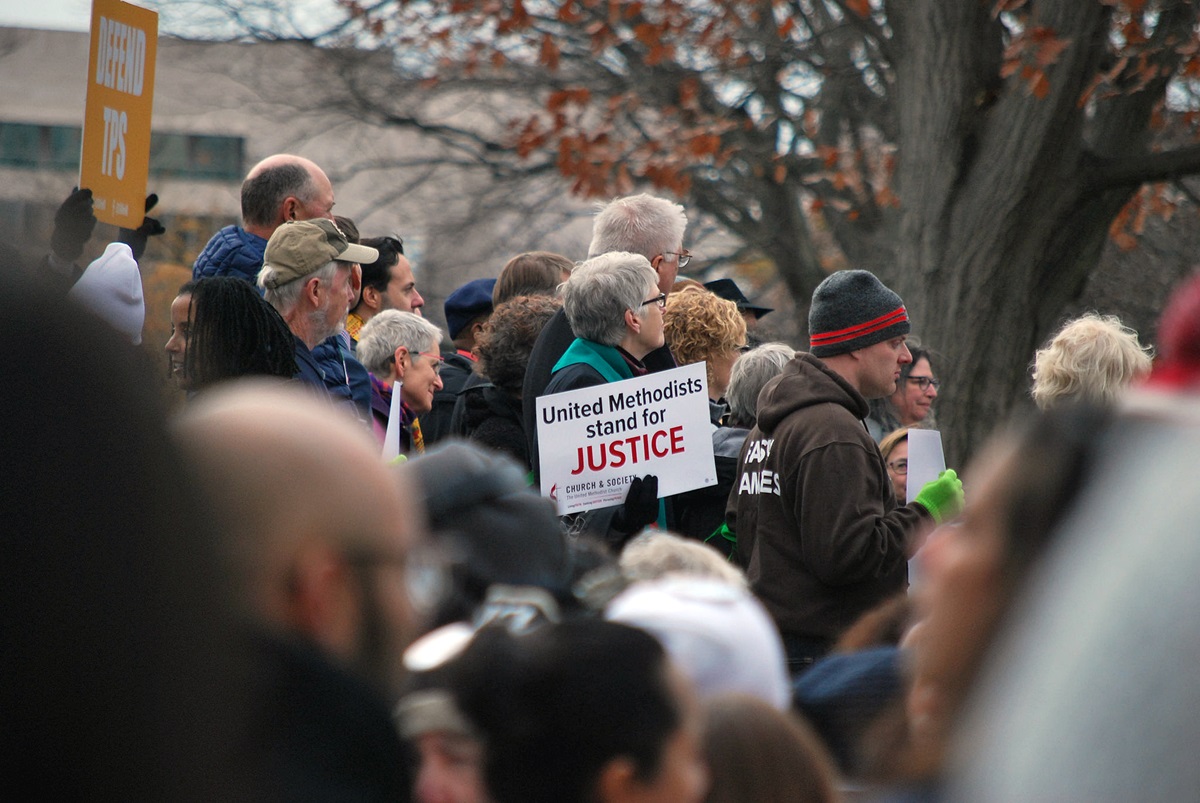
United Methodists were among hundreds arrested on the steps of the U.S. Capitol as they demonstrated in support of the DREAM Act.
Some 2,000 young immigrants and their supporters converged on Washington on Dec. 6 to rally congressional support for legislation that would protect the immigrants — commonly known as “Dreamers” — from deportation. Altogether, some 11,000 participated in marches for the DREAM Act around the country as part of the day of action.
Around 200 DREAM Act supporters — including six United Methodists, a mix of clergy and laity — were arrested for refusing to move from the Capitol steps in an act of civil disobedience. Also joining in the sit-in were U.S. Reps. Luis Gutierrez, D-Illinois, and Judy Chu, D-California. Rally organizers arranged with U.S. Capitol Police ahead of time that those arrested would not go to jail but instead pay a $50 fee.
Rebecca Cole, the director of organizing for the denomination’s Board of Church and Society, was among those arrested.
“I see this as a critical moment to live out my faith,” she said. “If I can raise my voice through an act of nonviolent resistance like civil disobedience to encourage members of Congress to act on behalf of DACA recipients, I will.”
She and others demonstrators say time is running out for young immigrants who are part of the Deferred Action for Childhood Arrivals program. The program, created under President Obama in 2012, has allowed some 800,000 young immigrants who have grown up in the U.S. to attain temporary legal status. They have been able to attend college, get jobs, obtain driver’s licenses and even buy homes.
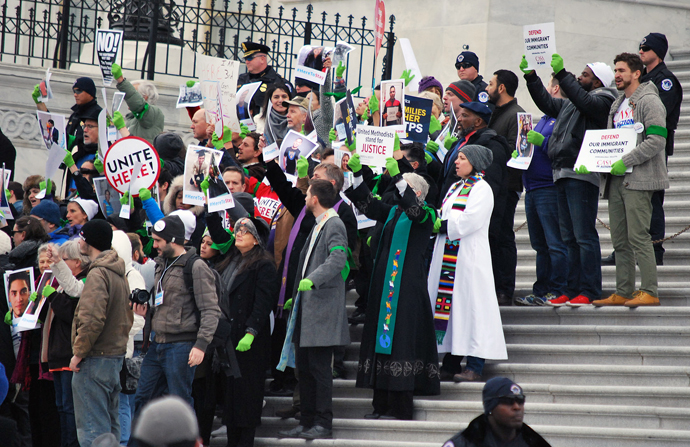
United Methodists are calling for the passage of a clean DREAM Act that offers a path to citizenship. The Trump administration announced in September that it is rescinding the protections for young immigrants under the Deferred Action for Childhood Arrivals. Photo by Tricia Bruckbauer, Church and Society.
The Trump administration announced earlier this year that it would end the program in March unless Congress acted. Currently, 690,000 immigrants are enrolled in the program.
Cole said the action was one of many United Methodists have taken on behalf of these immigrants — including meeting with and calling their congressional representatives.
The United Methodist Church’s Social Principles recognize the right of people to, with nonviolence, “resist or disobey laws that they deem to be unjust or that are discriminately enforced.”
Cole and others point out that obtaining the protected status takes hard work.
To qualify for DACA, recipients had to be under 31 as of June 15, 2012. They also had to come to the U.S. before reaching their 16th birthday and needed to be a high school graduate or have obtained an equivalent certificate.
DACA recipients have paid $495 and undergone an extensive criminal background checks to ensure they had a clean record. To remain DACA recipients, they have gone through the same process, including payments, every two years.
Polls show a substantial majority of U.S. voters support allowing these immigrants to stay in the U.S. According to a Politico/Morning Consult Poll, 68 percent of self-identified Trump voters want these immigrants to be able to stay.
United Methodist leaders have called for Congress to pass — and for President Trump to sign — a clean DREAM Act that provides a path to citizenship.
Melissa Bowe, program and advocacy manager for National Justice for Our Neighbors, has joined in those efforts and attended the Dec. 6 rally. She works with the United Methodist ministry that provides legal services for immigrants at clinics around the U.S.
On Dec. 5, she visited with members of Congress to advocate for DACA recipients and other immigrants with temporary protected status. The Trump administration rescinded that status for Haitians and Nicaraguans last month and plans by January to issue a ruling on an additional 200,000 from El Salvador with temporary protected status.
“It’s important to us because we know Dreamers and folks with temporary protected status and refugees are our neighbors,” Bowe said. “They make our communities better. We want to be on the right side of history and fight for an America we believe in, and that is an America that is welcoming, that honors and celebrates the richness immigrants bring to our country.”
Hahn is a multimedia news reporter for United Methodist News Service. Contact her at (615) 742-5470 or [email protected]. To read more United Methodist news, subscribe to the free Daily or Weekly Digests.
Like what you're reading? Support the ministry of UM News! Your support ensures the latest denominational news, dynamic stories and informative articles will continue to connect our global community. Make a tax-deductible donation at ResourceUMC.org/GiveUMCom.


