
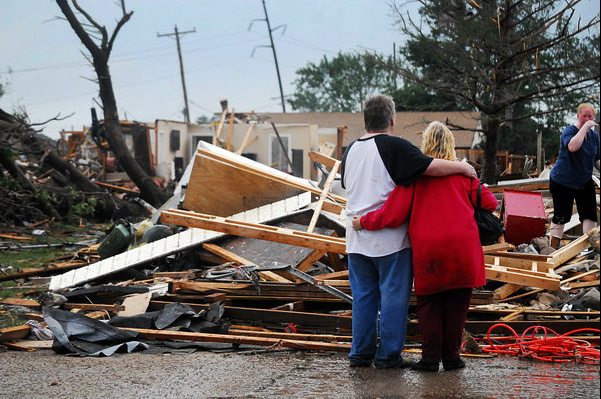
When word went out that McFarlin Memorial United Methodist Church was taking donations for disaster relief they never dreamed that in one day they would collect more than $100,000 without even a chance to pass the offering plate on Sunday.
The Rev. Linda Harker, pastor of McFarlin, said a family donated $50,000 and another couple matched that donation.
“When people come and share out of their generosity and abundance there are simply no words, only tears of gratitude,” she said. “Our phones have hardly stopped ringing with people wanting to help.”
Harker had just returned from a tour of the area with the local sheriff and she said the destruction is hard to describe. “It’s even hard to identify where you are because road signs are gone and you can’t even remember what used to be there.”
How disaster giving works
When both the United Methodist Committee on Relief and an annual conference ask for funds, United Methodists who want to help in a disaster might be uncertain where to send donations.
Conferences may set up their own funds to help with the immediate needs of housing, food, shelter and transportation. Conference fundraising is intended for raising money within the conference to meet immediate needs.
Giving to UMCOR through The Advance, the United Methodist official giving channel, ensures that 100 hundred percent of each donation goes directly to the need specified. UMCOR’s administrative costs are covered through a separate fund supported by One Great Hour of Sharing.
She said many electrical workers from all over the country are busy trying to reconnect electrical services in the heavy rain that has hit Moore intermittently since the tornado.
Harker said United Methodist Oklahoma City University has opened its dorms to about 200 displaced families and more than 200 first responders. She and other clergy have been visiting with the folks staying at the university.
“I visited with a young couple last night and they were just sharing their stories. The young woman said ‘You know I just wish the world could be this way all the time, it would be a place of peace.’ And I just thought, in the midst of all this, they had lost everything and yet she was seeing as the people came together that this was how the world could be. She said ‘Do you think that’s the way it’s supposed to be?’ and I said I’m sure that is the way God wants it.
“We are just one small part of the whole connection, there are many, many people doing lots of great things.”
How to give in response to disaster
*News media contact: Kathy Gilbert, Nashville, Tenn. (615) 742-5470 or [email protected]
Like what you're reading? Support the ministry of UM News! Your support ensures the latest denominational news, dynamic stories and informative articles will continue to connect our global community. Make a tax-deductible donation at ResourceUMC.org/GiveUMCom.


