
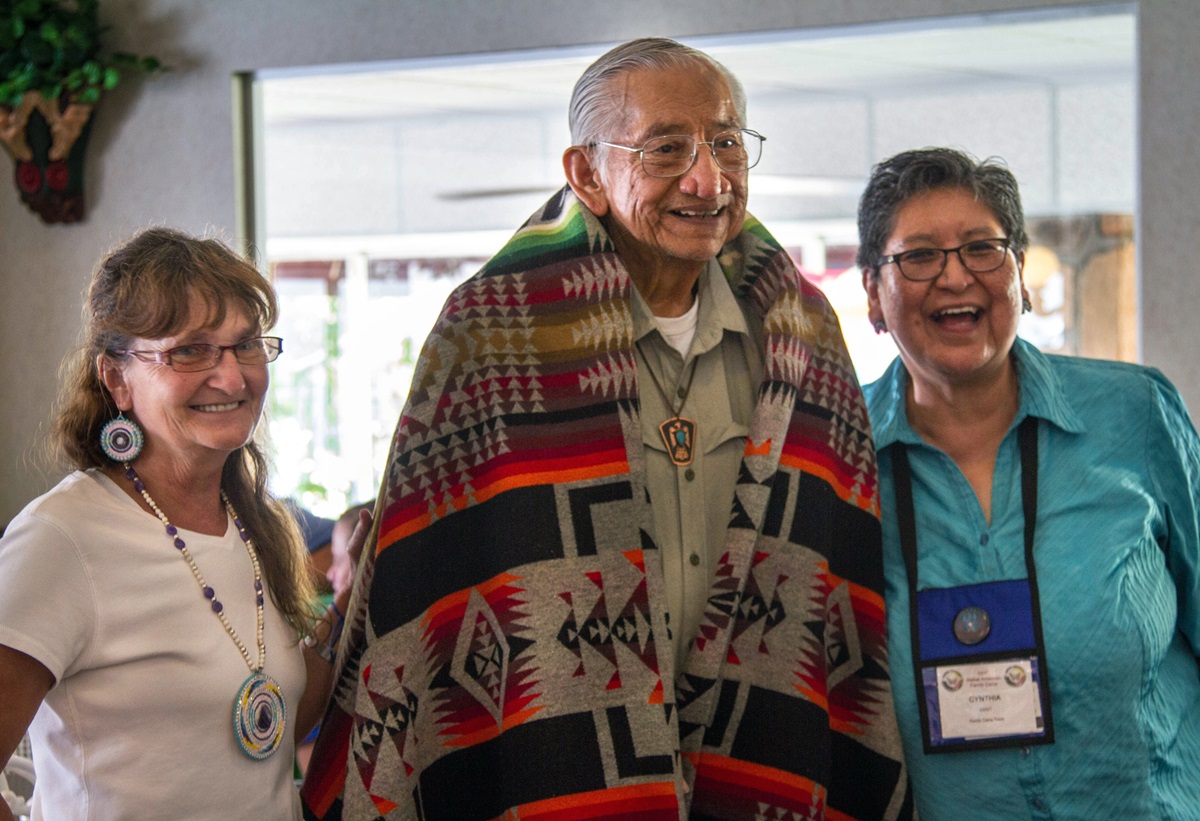
The Rev. Homer Noley, a member of the Choctaw Nation and founder of the National United Methodist Native American Center, was a trailblazer in Native American ministries in The United Methodist Church.
For nearly 40 years, Noley worked for the inclusion of Native Americans at all levels of the denomination. His book “First White Frost,” which documented the activities of Methodist missionaries with Native Americans from the 1600s to the modern day, continues to be a resource for churches.
Noley died March 2 at the home of his daughter, Lisa Noley, in Oklahoma City. He was 85.
“Among the many gifts of the Rev. Noley was his passion for the inclusion and recognition of what Native Americans have to offer to the whole church,” said the Rev. David Wilson, Oklahoma Indian Missionary Conference superintendent.
“The ‘First White Frost’ has been a great asset to the entire church and we use it very often in the classroom and in various circles across the church and outside the church. His research has been invaluable, and we are all much better because of his work.”
In “First White Frost,” Noley reflected on his experience as a Native United Methodist at the 1960 General Conference. “I felt like a dark spot in a sea of white faces,” he wrote.
Friends say the soft-spoken artist, musician and poet worked tirelessly to remind the church of the Native American presence.
Noley also co-wrote “A Native American Theology,” known as the first book to articulate a comprehensive and systemic Christian theology through a Native American point of view.
“Homer was held in high esteem by Native and non-Native theologians alike and beloved by his community,” said the Rev. Cynthia Abrams, director of Health and Wholeness at the United Methodist Board of Church and Society. “As a member of the Native American community, I know he will be sorely missed. As United Methodists, we can be proud that such a great man walked amongst us.”
Noley finished his career by serving as executive director of the National United Methodist Native American Center in Claremont, California. He retired in 1999.
Established in 1983, the center focused on strengthening the self-sufficiency and self-determination of Native American churches and Native Americans in ministry. The center’s programs made it possible for Native American pastors to obtain a seminary education, and the center hosted several important theological forums under Noley’s leadership.
“As the leader of NUMNAC, he explored ways of reaching Native Americans to have a relationship with Jesus, the Christ, and provided training for Native American pastors to meet the missional needs of our communities,” said the Rev. Alvin Deer, former director of the Native American International Caucus and retired pastor from the Oklahoma Indian Missionary Conference.
“The theological forums that Homer led touched many cutting-edge and unique ideas for innovative ministries among Native Americans,” he said.
Noley was an ordained a deacon in Oklahoma and appointed to attend school at Saint Paul School of Theology in 1961. He was ordained an elder in the Nebraska Conference in 1967.
His appointments included the Omaha City Mission Society in 1962; Wallace-Grainton charge in 1967; Nebraska Conference Native American Ministries in 1969; and a staff position at the United Methodist Board of Global Ministries in 1971.
Noley moved his membership to the Kansas East Conference where he served appointments as staff at Baker University in 1975; executive director of the International School of Native American Ministries in 1979; Parker-Beagle-Fontana charge in 1981; Waterville-Blue Rapids charge in 1984; Independence Grace Memoria-Sycamore charge in 1985; and executive director of the Native American center in 1991.
In addition, he worked in partnership with the denomination’s Native American Comprehensive Plan and the Native American International Caucus.
In August, 2017, the Native American International Caucus honored the life work of Noley during a celebration at its Native American Family Camp in Gore, Oklahoma. He encouraged his Native brothers and sisters then to continue to advocate for their rights with The United Methodist Church and to keep working with schools of theology.
“I’m grateful to see that you are still working, just as hard as we did in the early years,” Noley said at the event.
Anne Marshall, former chair of the Native American International Caucus, reflected on the commitment and legacy of her longtime friend.
“He always stressed to continue to tell the Native story to The United Methodist Church with authenticity and in truth and never give up.”
The Rev. Tweedy Sombrero Navarrete, pastor at Trinity United Methodist Church in Yuma, Arizona, visited Homer just days before he passed away and echoed those sentiments.
“Homer was a fighter and believed wholeheartedly in the work of Native people. His last words to Anne Marshall and I were to continue to tell the Native story. We will honor him by doing as he asked,” she said.
Noley’s funeral will be held at 10 a.m. March 10 at Mary Lee Clark United Methodist Church in Del City, Oklahoma, with burial at his hometown cemetery in Wilburton.
Underwood is a freelance writer and communication consultant with ties to the Oklahoma Indian Missionary Conference. She is a member of the Comanche Nation of Oklahoma.
News media contact: Vicki Brown at (615) 742-5470 or [email protected]. To read more United Methodist news, subscribe to the free Daily or Weekly Digests.
Like what you're reading? Support the ministry of UM News! Your support ensures the latest denominational news, dynamic stories and informative articles will continue to connect our global community. Make a tax-deductible donation at ResourceUMC.org/GiveUMCom.


