
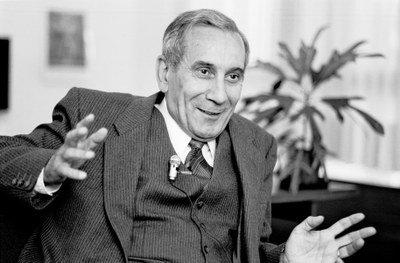
The Rev. Emilio Castro is being remembered by United Methodists as a church leader who combined faith with a commitment to justice during turbulent political times in Latin America and helped define the global ecumenical movement as top executive of the World Council of Churches from 1985-92.
A clergy member of the Methodist Church of Uruguay, Castro died April 6 in Montevideo at the age of 85.
He “is one of the role models not only for Christians in Latin America but for Methodists all over the world,” said Germany Area Bishop Rosemarie Wenner, who also serves as president of the United Methodist Council of Bishops.
“Dr. Castro’s work and example were instrumental in the education of my generation of missionaries and mission thinkers,” said Thomas Kemper, top executive of the United Methodist Board of Global Ministries and a former missionary in Brazil, in a statement. “He was one of the first international mission leaders to come from Latin America, and he will remain an inspiration for years to come.”
In her letter to the Rev. Oscar Bolioli, president of the Methodist Church in Uruguay, Wenner noted that more than 1,000 United Methodists who had gathered in Reutlingen, Germany, were remembering Castro’s ministry with guests from the church in Uruguay when “Emilio was called to his eternal home.
“We are blessed because we — through our growing partnership with the Methodist Church in Uruguay — had the chance to learn more about the witness and service of Emilio Castro for his mother church, his home country Uruguay and Latin America,” she wrote.
The Rev. Stephen J. Sidorak, Jr., top executive, Office of Christian Unity and Interreligious Relationships for the United Methodist Council of Bishops, called Castro “gracious, giving and gentle” and considered him an ecumenical mentor.
Castro had a practical wisdom but also “was one of the most spiritually grounded individuals I ever met,” Sidorak said. “I will cherish the many memories I have of him and our wide-ranging conversations on the nature and purpose of an ecumenical vocation.”
Born in Montevideo, on May 2, 1927, Castro began attending his neighborhood Methodist church when he was 9 years old. After his studies at the theological faculty in Buenos Aires, he served as a pastor in Uruguay and Bolivia in the 1950s and ‘60s before becoming involved in a provisional ecumenical group on Christian unity in Latin America in 1965.
In 1973, he joined the World Council of Churches as director of the Commission on World Mission and Evangelism.
Kemper, who previously led the mission work of The United Methodist Church in Germany, said Castro was instrumental in the framing the council’s 1982 statement on “Mission and Evangelism: An Ecumenical Affirmation,” setting the standard for its work on mission.
“It contained all the right points: refocusing conversion, recognizing the role of the poor in Christian life, and preparing Christians to live with and among adherents of other faiths,” Kemper noted.
He succeeded Philip Potter, another Methodist, as the fourth leader of the World Council of Churches from 1985-92. Challenges during that time included coping with the collapse of communism in Eastern Europe and its effect on churches and expanding the participation and representation of Orthodox churches within the council.
Castro never lost his optimism for the future of the ecumenical movement, said the Rev. Olav Fykse Tveit, now the WCC’s top executive.
“The first time I met him in 1992, he inspired the young ecumenist in me to be committed to the call to unity and justice. He appealed to my faith and to my heart with his words and his open and twinkling eyes,” Tveit remembered.
“Even in the last couple of years he kept on preaching and teaching in the Methodist way of bringing personal holiness and social holiness together,” Wenner noted in her letter to Methodists in Uruguay.
“We thank God for the life and the witness of Emilio Castro and we commit ourselves to be part of the Methodist movement which, by God’s grace, works for the unity of the church and for the transformation of the world.”
*Linda Bloom is a United Methodist News Service multimedia reporter based in New York. Follow her at http://twitter.com/umcscribe. Contact her at (646) 369-3759 or[email protected].
Like what you're reading? Support the ministry of UM News! Your support ensures the latest denominational news, dynamic stories and informative articles will continue to connect our global community. Make a tax-deductible donation at ResourceUMC.org/GiveUMCom.


