
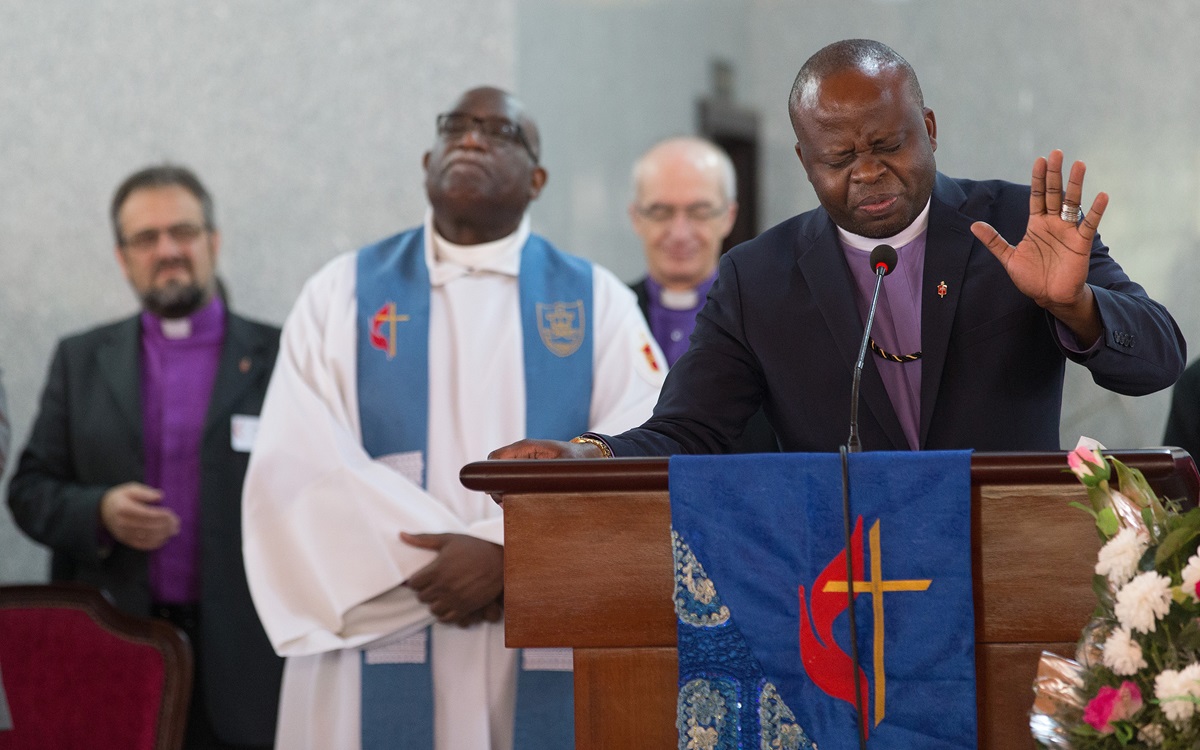
The United Methodist Church plans to have five new bishops in Africa starting in 2021. The question remains where to put them.
“You can say everywhere is underserved, in a sense,” said Bishop Gregory V. Palmer, who leads the Ohio West Area. “But there are some areas that are more underserved than others where we need to fan the flames.”
At a recent meeting in Côte d’Ivoire, Palmer and other members of the Standing Committee on Central Conference Matters outlined their criteria in determining the location of the five new episcopal areas. They also made clear: No decisions have been made at this point.
About the Standing Committee
The Standing Committee on Central Conference Matters has 43 members. It is the only denomination-wide body in which people who live outside the United States are the majority.
Its roster includes:
- 5 members from the Africa Central Conference
- 4 from the Congo Central Conference
- 4 from the West Africa Central Conference
- 3 members from each of the four remaining central conferences (Germany, Central and Southern Europe, Northern Europe and Eurasia, and the Philippines)
- 3 from each of the five U.S. jurisdictions
- 3 the United Methodist Board of Global Ministries, the denomination’s mission agency
The 2016 General Conference — the denomination’s top lawmaking body — approved legislation from the standing committee to increase the number of African bishops from 13 to 18.
Central conferences are seven church regions in Africa, Europe and the Philippines. There are currently three central conferences on the African continent.
The legislation calls on the standing committee to “implement a collaborative comprehensive plan on numbers and boundaries of central conferences and episcopal areas in Africa.”
It also specifies that 10 standing committee members form the Africa Comprehensive Plan subcommittee, none of them from the African continent. The legislation requires the subcommittee also hold consultations with African bishops and a person elected from each annual and provisional conference on the continent.
The subcommittee will make recommendations to the standing committee based on its findings. The standing committee, in turn, will use that information in making its recommendations to the 2020 General Conference, which has final say on the number of central conferences and the number of bishops each elects.
The standing committee, as a whole, will determine its recommendations in March 2019. The Africa College of Bishops recommended to the standing committee the creation of seven central conferences in Africa.
In the meantime, Lathem Postell of the North Georgia Conference listed the data the subcommittee is reviewing in where to add bishops. The Book of Discipline, the denomination’s policy book, dictates in paragraph 404 the criteria under consideration.
In order of priority, the criteria are:
- The number of charge conferences and number of active clergy
- Geographic size, including number of time zones and nations
- The number of annual conferences and the overall church membership
Postell said he and other members also are looking at missional potential of a given area.
“One way to do that is to see the change over time,” Postell said. “The trajectory is very important.”
The team also will look at the percentage of United Methodists compared to a nation’s population as a whole, he added. The African Comprehensive Plan members are using data reported to the denomination's General Council on Finance and Administration.
Still, he said, statistics will not be the only the driving factors the team will examine. The group also will consider information from a consultation last year with African church leaders in Harare, Zimbabwe and a second consultation this August in Freetown, Sierra Leone.
“What we plan to do is take the data we have — and the data we will acquire over time — to Freetown and have the African delegates who are there help us interpret this data,” Postell said.
Bishop Mande Muyombo, who leads the North Katanga Episcopal Area in the Democratic Republic of Congo, urged the subcommittee to examine qualitative as well as quantitative data.
“You may have the numbers, but you may not be vital,” the bishop cautioned.
Palmer assured Mande that the subcommittee would send questions ahead of the Sierra Leone consultation aimed at trying to get that missional perspective.
“We have raw data,” Palmer said. “Now we’re moving toward the stage of seeing what is the missional potential of particular areas, keeping in mind it is not possible to send a bishop everywhere we think the church could grow. The General Conference has put a cap of five.”
Hahn is a multimedia news reporter for United Methodist News Service. Contact her at (615) 742-5470 or [email protected]. To read more United Methodist news, subscribe to the free Daily or Weekly Digests.
Like what you're reading? Support the ministry of UM News! Your support ensures the latest denominational news, dynamic stories and informative articles will continue to connect our global community. Make a tax-deductible donation at ResourceUMC.org/GiveUMCom.


