

Key Points:
- Representatives of five United Methodist-related primary and secondary schools reported an average 44% of students (1,448 of a total 3,274) lack birth certificates.
- The church is working with local leaders and government departments to help students secure documents.
- Major challenges, said the Rev. Oswell Kaseke, include “lack of finances, broken families, deaths of parents, and parents without birth certificates and identity cards themselves, creating a vicious cycle.”
The Zimbabwe constitution declares that everyone has a right to citizenship documents. Many children, however, do not have birth certificates, and obtaining national identification cards is a challenge.
Representatives of five United Methodist-related primary and secondary schools reported an average 44% of students (1,448 of a total 3,274) lack birth certificates.
“The figures are worrying,” admitted the Rev. Munyaradzi Timire, education secretary, Zimbabwe East Conference. “In our system, the church’s approach is for the heads of schools to work with the registrar’s office and assist parents or guardians in acquiring the birth certificate.
“We encourage the church to write letters of reference, which guardians or parents can use as supporting documents for the registrar’s office to use. This will help process identification documents so that learners do not miss seating for examinations and enable them to attend sports competitions.”
The Rev. Oswell Kaseke, Harare Central District superintendent, said the church works closely with local leaders and government departments to facilitate the acquisition of the documents.
Subscribe to our
e-newsletter
“Headmasters write letters to the registrar’s department confirming that the child is a learner enrolled at our school,” Kaseke said. “The headmaster also raises awareness and sensitizes parents or guardians on the importance of these documents. Where the parents are not present for one reason or the other, the supporting structures — traditional and political leaders — will assist in the process.”
Major challenges, he said, include “lack of finances, broken families, deaths of parents, and parents without birth certificates and identity cards themselves, creating a vicious cycle.”
Learners from Nyamacheni Secondary School shared their stories.
“I do not have a birth certificate because my parents separated when I was very young,” said Fortunate Mapinda, 16. “I am now staying with my grandparents, who are very old.”
Tanatswa Nguwaya, 16, said his father lacks transportation money to enable him to process the birth certificate, “despite it having a lot of advantages in my education.”
Mollet Mujajati, 15, concurred. “I am staying with my parents,” Mujajati said, “but they do not have the money for me to travel to the registrar’s office.”
Fifteen-year-old Bright Chirasha said her parents are divorced. “I am staying with my mother, who does not have a birth certificate and identity card to enable me to process my birth certificate. This is beyond my control, but my wish is to have a birth certificate like other children.”
Thelma Munhori, 16, a Clare Secondary School student, said her situation is similar. Her father died and she is staying with her grandmother.
“She does not have money to take me to the registrar offices for my birth certificate.”
Bridget Chalosa, 16, a member of Gurure United Methodist Church in Mupambawashe Village, is a Form 4 student. After her parents divorced, her mother remarried and left her in the care of her grandparents.
“When my mother remarried, she never looked back on us. I did not manage to secure a birth certificate, which is a prerequisite for me to seat for the Ordinary Level examination.
“This issue is eating me day and night. What to do and where to go, I do not know. Whether I am going to write my Ordinary Level examination or not, only God knows.”
She continued, “Although I am bright in school, I am afraid I might fail to write the examinations, and my future will be doomed.”
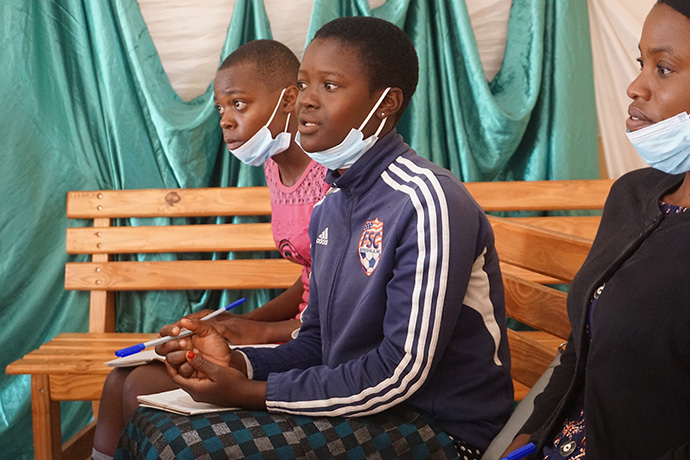
Tapfuma Tamanikwa, acting deputy headmaster at the church’s Dindi Secondary School, said, “we face these challenges annually, especially from orphans and other vulnerable children, despite the government putting in place modalities for easy acquisition of the birth certificate.
“Without a birth certificate, a child cannot participate in any sport activity competitively because most sports participation has age limits. The student cannot participate in a sporting event if the school cannot prove the age of that student,” Tamanikwa said.
“As a school, we sensitize and share with the guardians on the importance and effects of a birth certificate, or lack of it, on the child.”
Liberty Sithole, headmaster for United Methodist-related Mashambanhaka Primary, said the school does awareness campaigns during parents’ meetings.
“We also educate the learners about their rights to birth records and assist with affirmation letters to the registrar.”
The government has implemented several initiatives aimed at facilitating the registration process.
Charles Madamombe, headmaster of The United Methodist Church’s Muziti Primary School, noted that a recently conducted mobile registration program helped many to acquire registration certificates.
The Rev. Juliet Chirowa is connectional ministries director for the Makoni Buhera District and pastor-in-charge of Rusape Innercity Church.
She said her circuit, through Church and Society outreach programs, helped grandmother Mirriam Garape, 89, secure birth certificates for three children in her care: Owen, 16; Tapiwa, 13; and Darlington, 13.
Since their father’s death, the children have been struggling to acquire birth certificates so that they can proceed with their education.
“Through the frantic efforts of the church,” Chirowa said, “… there was joy for grandmother Garape and the children after they managed to acquire birth certificates for all grandchildren and a national identification card for Owen. This proved that, as a church, we can help the community in acquiring the important documents.”
Tendai Rebecca Gurupira serves as area coordinator for the church’s Ministry with Women, Children and Youth. “As a church,” she said, “we have a child-protection policy document in place that says every Zimbabwean has a right to birth records, which includes the birth certificate and the national identity card.
“I encourage everyone to continue helping children to acquire these important documents to enhance a bright future for them.”
Chingwe is a communicator for the Zimbabwe East Conference.
News media contact: Julie Dwyer at [email protected]. To read more United Methodist news, subscribe to the free Daily or Weekly Digests.


