
Editor’s note: Pam Carter left Haiti on Jan. 15, three days after the earthquake. She returned three months later. Here is her account of her April visit.
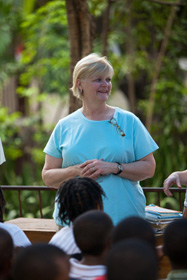
Pam Carter visiting with the children
who attend the College de Freres school. Photos courtesy of David Johnson, www.silentimages.org.
The joy I experience when I see Donnette, the director of the Methodist Guest House where I stayed during the earthquake, is nothing short of deeply wonderful. I wonder if she will remember me. Yet, as I make my way up to the patio by the dining room, I hear her call my name, "PAMMMMM!" We clasp our arms around one another like long-lost friends and hug. When you share such a tragic and frightening experience with someone, there is a bond, a connection.
We walk around the grounds of the school at the Methodist campus of the College de Freres next door to the Guest House. Immediately after the quake occurred, I heard the screams of the schoolchildren from the window of the Guest House office where I stood until the quake subsided. As I stroll along the campus on this day, we see how the basketball court once used for the enjoyment of the children has become a community of tents as those made homeless by the quake seek shelter. We meet a woman who is busy ironing clothes at the edges of the tent community. A smile spreads across her face as my friend shows her the picture she took of her. Grabbing the phone, she shows her friends the image, and they all laugh and joke.
Around the campus, we see clusters of students gathered under tarps. I hear a child say, "Hello," attempting her best effort at English with a Creole accent. And then she smiles. Her classmates laugh as I respond to her, "Hello, how are you?" Children are the same everywhere, it seems. The children's desks are lined up under the tarps, and their teachers stand before them in front of a blackboard. The classroom buildings that stood behind them suffered only minor damage and have already received some repairs, but the children will not re-enter their classrooms because they fear the building will fall on them when the next aftershock or earthquake comes. The secondary school needs more extensive repairs. But the director of the school perseveres, hoping she will be able to pay her teachers this month. Few students are able to make regular tuition payments. The look of worry is there behind her smile.

Schoolchildren from the College
de Freres enjoy skipping rope.
In the afternoon, we snake our way through the city in a minivan and see the destruction at the Presidential Palace. Even as the building is being dismantled, the beauty of the structure is apparent. Vendors line the sidewalk, hoping to sell a trinket of some sort. That seems to be expected for such a landmark. Right across the street, a large tent city looms with large numbers of the homeless working through the difficulties of life post Jan. 12. Children gather around us as we stop to make photographs. They play with sticks. Bits of rubbish have become their new toys.
Life returns to some kind of normal, but not normal. The fear remains, and the challenges are truly daunting. But I hear laughter, and I see joy. And I feel reconnected to what makes the Haitian people so truly remarkable—their resilience and perseverance in the face of such overwhelming odds. I am reminded again of how much they need our friendship. We meet briefly with the Rev. Gesner Paul, president of the Methodist Church of Haiti. He reminds us of the challenges his church faces. They will need many, many friends.
When I returned to the U.S. after the earthquake, someone asked me how Haiti could be "fixed" after this great disaster. I responded that in such a time of sorrow and devastating loss of life, I thought you would say to the bereaved not "How can I fix this?" but rather "My friend, I am so sorry for your loss. What can I do to help?"
Many here are asking that question: “What can we do to truly be helpful?”
*Pam Carter is Director of Senior Adult Ministries at Providence United Methodist Church, Charlotte, N.C. Providence United Methodist Church has been in mission in Haiti for decades.
Like what you're reading? Support the ministry of UM News! Your support ensures the latest denominational news, dynamic stories and informative articles will continue to connect our global community. Make a tax-deductible donation at ResourceUMC.org/GiveUMCom.


