

While other parts of The United Methodist Church’s global connection are pondering separation, Africa is “forging cooperation and unity to preserve the heritage of true Methodism,” said Simon Mafunda, a lay leader from the Zimbabwe East Conference.
Mafunda was among a delegation of 12 lay and clergy members from the Zimbabwe Episcopal Area who traveled to Congo to meet with church leaders from the South Congo Episcopal Area, which includes Zambia.
The two episcopal areas began a partnership in 2018 to exchange ministry ideas and strategies for church growth.
“These partnerships should quickly spread across Africa as we seek to take charge of key leadership in our global connection,” Mafunda said. “Africa must stick out as a true model that the world should emulate.”
During the delegation’s farewell dinner at Bouche Camp in Lubumbashi, South Congo Bishop Owan Kasap urged those in attendance to help the church stay unified.
“Africa needs to find its own resources for church growth, share ideas and experiences that motivate the desire to maintain the traditional ethos,” he continued. “We need to learn from each other as we walk side by side in this journey.”
The exchange visit took place on the heels of the denomination’s special General Conference in February, where a majority of delegates adopted legislation that maintains the policy that the practice of homosexuality is “incompatible with Christian teaching.” The approved Traditional Plan reinforces bans on same-gender weddings and “self-avowed practicing” gay clergy and strengthens penalties for violating those bans.
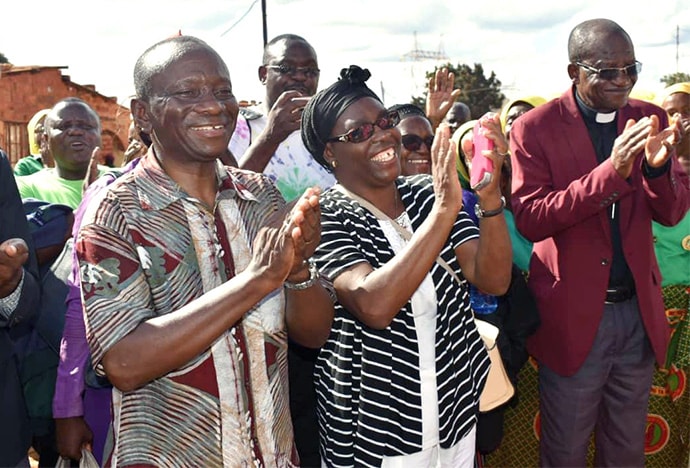
Members of the Zimbabwe Episcopal Area attend a worship service during a recent visit to South Congo. Photo by Chenayi Kumuterera, UM News.
“Let us as the African United Methodist Church unite to uphold our social, moral ethics and principles,” Kasap said.
He said unity in United Methodism is the most valuable asset for the development of the church in Africa.
“For us to succeed, we need to work together and forge partnerships right across the continent,” Mafunda said.
During the visit, church members from Zimbabwe learned about South Congo’s evangelism efforts and assisted with training programs.
In April and May of last year, a delegation from South Congo visited Zimbabwe, where they received training in church growth and administration and learned more about strategies for advancing the Gospel. The leadership program focused on finance and stewardship, as well as pastoral care, building projects, fundraising, health and education.
“We have exciting ideas popping up in our minds following our visit with South Congo lay leaders,” Mafunda said. “This is the beginning of a long-lasting and mutually benefiting relationship.”
He said his area will explore partnerships, particularly where it concerns laity training and empowerment. He said the first act of business will be to establish the Association of Annual Conference Lay Leaders of Africa, a social group where lay leaders can share information and empower each other on laity activities within the conferences.
“We hardly know each other as conference lay leaders and this should be the starting point. This will not be limited to South Congo but to all the central conferences of Africa with South Congo/Zimbabwe as the model,” Mafunda said.
He also noted South Congo’s rich resources and prospects for the future.
“South Congo can easily become a hub of agricultural activities and this can be initiated by utilizing church-owned land. This is something that we share in common as episcopal areas,” Mafunda said.
Kasap said plans for the partnership moving forward are to focus on capacity building, mentoring and the exchange of experiences in the management of church institutions.
The next exchange visit will be between the South Congo and North Katanga episcopal areas.
Professor Chipeng Kayemp François, South Congo Episcopal Area administrative assistant, was encouraged by the exchange of ideas and experiences during the visit.
“The unity between the Congo and Zimbabwe episcopal areas has opened a new direction in Africa that could later became a major development driver.”
South Congo Episcopal Area communicators John Kaumba, Mireille Womba and Irene Tsheleka contributed to this report.
News media contact: Vicki Brown, Nashville, Tennessee, (615) 742-5470 or [email protected]. To read more United Methodist news, subscribe to the free Daily or Weekly Digests.
Like what you're reading? Support the ministry of UM News! Your support ensures the latest denominational news, dynamic stories and informative articles will continue to connect our global community. Make a tax-deductible donation at ResourceUMC.org/GiveUMCom.


