
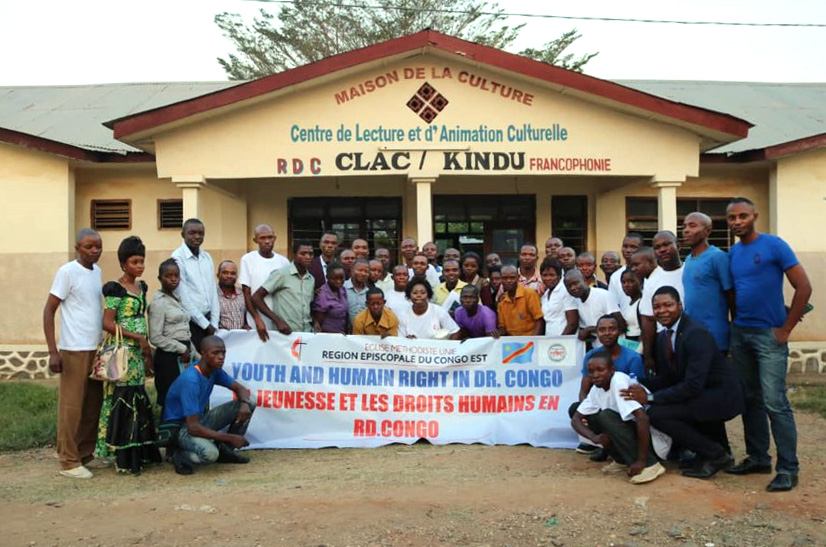
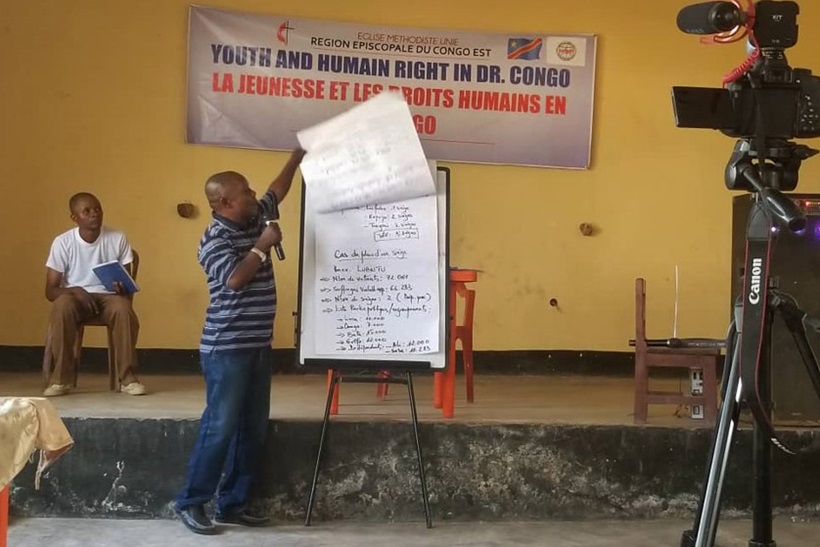
With funding from the United Methodist Board of Church and Society, United Methodist youth in the Democratic Republic of Congo are conducting civic education for other young people to help curb election violence.
During an election period, candidates often intimidate and manipulate young people, and fights sometimes break out between dissenting youth camps.
Presidential, legislative, provincial and local elections in the Congo are scheduled for Dec. 23. Elections should have occurred when incumbent President Joseph Kabila’s constitutionally mandated two-term limit expired in December 2016. The government’s failure to hold the elections led to countrywide protests.
The awareness-raising workshops teach the young people about human rights, especially how they should behave during the election period.
According to Germain Unda, vice president of the Federation of Young Protestants of Congo, the goal is to prepare young people to remain vigilant. He believes that by learning about human rights, young people will monitor their behavior.
“We are in a period of rising tensions,” Unda said. “With the experience of the past two elections, we must do a lot of civic education for young people to understand the issues.”
Raphael Upelele, coordinator of the National Human Rights Commission in Maniema Province, expressed appreciation for the United Methodist youth initiative, agreeing that young people must be guided to prevent violence during an election period.
Addressing a dozen young workshop participants from The United Methodist Church and the Church of Christ in Congo, Unda said, “During the election campaign, you must remain cautious and not give in to clientelism (a social order that depends upon relations of patronage; in particular, a political approach that emphasizes or exploits such relations) and manipulations of political actors. Above all, you need to listen attentively to the programs of action of each political party and each candidate so you can make a judicious choice.”
Muthomas Bushiri directs the bishop’s cabinet in the Eastern Congo Episcopal Area and is an officer of the Independent National Electoral Commission. During a civic education session, he explained the new electoral law affecting the legal threshold of representativity.
“The legal threshold of representativeness,” Bushiri explained, “is a corrective of the proportional system of the lists, by the grouping of the actors and political parties into large components. The threshold consists of a valid vote percentage determined by a legal standard that each list or independent candidate must meet in order to be admitted to the allocation of seats.”
He asserted that “teaching young people will help prevent violence during the election period. The United Methodist Church must play this role by teaching its youth and others about electoral citizenship.”
Kapas Yulu, a young United Methodist from the Kindu South Ecclesiastical District, believes the session he attended would be very useful during election campaigns.
“As we are informed about various innovations contained in the new electoral law,” he said, “it will be difficult for us to be manipulated by politicians in elections as was the case during past elections. As young Christians, we will be role models for other young people.
“Having had the chance to be sensitized,” he added, “we will pass on this message wherever we go, whether in our homes or at the university where we study. This is what we have always done to influence change in our community.”
Londe is a communicator for the East Congo Annual Conference.
News media contact: Vicki Brown, Nashville, Tennessee, (615) 742-5470 or [email protected].
To get more United Methodist news, subscribe to the free Daily or Weekly Digests.
Like what you're reading? Support the ministry of UM News! Your support ensures the latest denominational news, dynamic stories and informative articles will continue to connect our global community. Make a tax-deductible donation at ResourceUMC.org/GiveUMCom.


