

The Rev. Diane Dyson doesn’t wear a clergy collar. If she did, no one would see it these days because of everything else she has on.
Her work garb for 12-hour-plus shifts includes an N95 mask, face shield, protective cap, gloves and floor-length gown.
“I don’t want to whine but it’s hot and heavy,” Dyson said. “It’s nice to leave at the end of the day and get some fresh air.”
Dyson is a United Methodist deacon and registered nurse who since mid-March has been caring for COVID-19 patients at Hunterdon Medical Center in Flemington, New Jersey.
People well beyond the hospital are aware of her work, including Greater New Jersey Conference Bishop John Schol.
“Diane is the kind of person who rolls up her sleeves and does whatever it takes to serve people,” Schol said. “We’re blessed by the ministry of Diane and all the people who have really been on the front lines.”
Dyson’s biggest — and most worried — fan is her husband.
“You can see the fear and sadness,” said the Rev. Drew Dyson, a United Methodist elder, former district superintendent and current executive director of the Princeton (N.J.) Senior Resource Center. “The depth of care she has for her patients also bears an emotional toll.”
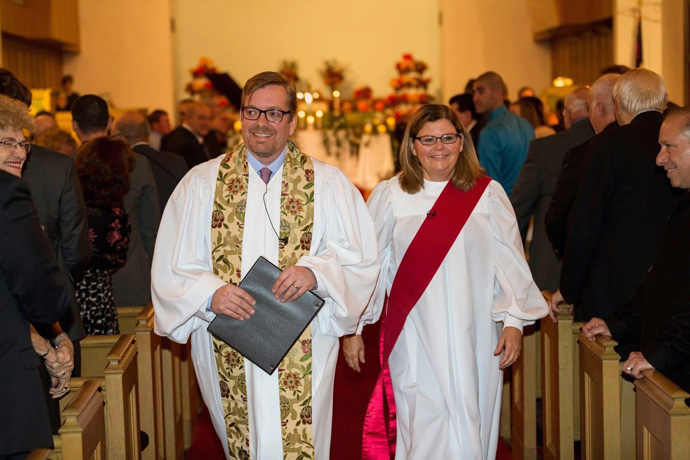
The Revs. Drew Dyson and Diane Dyson are a United Methodist clergy couple in the Greater New Jersey Conference. She’s a deacon whose main work is as a hospital nurse, and she’s lately been treating COVID-19 patients. He’s an elder who currently serves as executive director of a seniors’ resource center. Photo courtesy of Drew Dyson.
The Rev. Chris Barbieri, for example, is a chaplain at Floyd Medical Center in Rome, Georgia, and he’s been ministering to COVID-19 patients’ families and to hospital staff.
The Rev. Ken Kalungi, of the Uganda-South Conference, works with the nonprofit Harper Hill Global to translate into a range of African languages messages about handwashing, mask-wearing and other prevention measures.
At the Oregon Health Authority, the Rev. Danna Drum has lately been doing COVID-19 response, serving as liaison to local public health officials, federally recognized Native tribes and long-term care facilities.
“The pandemic just makes more visible the many equity and justice issues that exist in the world,” Drum said.
Deacon roles abound, but Diane Dyson is exceptional, possibly unique, as one directly caring for people deathly ill with the coronavirus.
She began as a registered nurse in 1985, and her husband notes that she volunteered to care for early AIDS patients when the epidemic was causing so much fear and ostracizing.
Well into her nursing career, Dyson felt a call to ministry as a deacon and attended Drew Theological School, earning an M.Div. degree. She studied to become a chaplain, but concluded her real calling was as a deacon and a nurse.
Support for health care workers
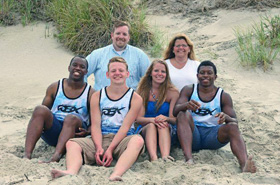
The Revs. Drew Dyson and Diane Dyson with their children (from left), Timothy, Jeremy, Allison and William. Photo courtesy of Drew Dyson.
Many governments and communities have found ways to salute health care workers during the COVID-19 pandemic. Individuals and families who want to offer support can find some practical ideas here.
The United Methodist Board of Higher Education and Ministry provides background information on the path to becoming a deacon in the denomination.
Discipleship Ministries, another denominational agency, offers certification in parish nursing.
The United Methodist Board of Higher Education and Ministry provides background information on the path to becoming a deacon in the denomination.
Discipleship Ministries, another denominational agency, offers certification in parish nursing.
“I think the deacon background has always helped me,” Dyson said. “It’s helped me to look at people more holistically, and I’d like to think it’s helped me to be a more patient and better listener.”
Dyson was working in a step-down unit at Hunterdon Medical Center when the coronavirus took hold in New Jersey.
After New York, New Jersey has had the most coronavirus cases in the U.S. Hunterdon County is one of New Jersey’s least populated counties but has still seen, as of last week, 729 cases and 47 deaths.
Dyson’s hospital began to get COVID-19 patients in ICU two months ago. The hospital created a separate area for other such patients, which is where Dyson now works.
She’s cared for people so sick that they eventually can’t breathe on their own and are moved to ICU and put on a ventilator. She’s also had patients getting weaned off of a ventilator.
Among her COVID-19 patients were a married couple. The husband was discharged, but soon was discovered dead at home by a neighbor, with blood clots a possible cause. Meanwhile, the wife was still in the hospital, battling the coronavirus.
“Trying to support people who are so sick and who have just lost someone — that’s very difficult,” Dyson said.
With the risk of infection preventing nearly all family visits to the hospital, she and other nurses have been crucial channels of information and connection.
“We’re doing conversations with the family and FaceTimes with the family on our phones, so they can see their loved ones,” Dyson said. “The hospital has let people come when it’s an end-of-life situation, so they can say goodbye. It’s hard. I know not all hospitals allow that.”
Drew Dyson posted on Facebook a prose poem tribute to his wife that begins and ends with “I watched my hero cry tonight,” and lays out in detail the emotional toll the pandemic has taken on her.
“This is a depth of suffering that she hasn’t experienced in all her time as a nurse, and she’s been a nurse for more than 30 years,” he said by phone.
The Dysons share the fear that she might get the coronavirus and spread it, including to family members. They have three college age children at home now, and the risk is increased because one of them has a job registering emergency room patients at Hunterdon Medical Center.
So the safety protocols continue at home.
“Early on, we set up a routine where you undress in the garage, you leave your dirty clothes and uniform there and go right to the shower,” Diane Dyson said. “Drew and I have been sleeping in separate rooms, just trying to play it safe.”
Subscribe to our
e-newsletter
Like what you're reading and want to see more? Sign up for our free daily and weekly digests of important news and events in the life of The United Methodist Church.
Combined with this good trend is the support Dyson has felt from community members and United Methodists.
Care packages have been sent to her and her colleagues from Girl Scout troops. Local restaurants bring meals by.
“Oh, my gosh, the cards,” Dyson said. “A church in particular, where Drew was youth pastor and associate pastor when our kids were little — I got a bunch of cards from them.”
Drew Dyson worries about the cumulative stress of health care workers in the pandemic. Diane Dyson owns up to having had her share of fear and sadness since March.
But she’s continued to feel gratitude that she’s able to be both deacon and nurse.
“That’s the great thing about deacons. You can be out in the world, fulfilling the call God has placed upon your heart.”
Hodges is a Dallas-based writer for United Methodist News. Contact him at 615-742-5470 or [email protected]. To read more United Methodist news, subscribe to the free Daily or Weekly Digests.
Like what you're reading? Support the ministry of UM News! Your support ensures the latest denominational news, dynamic stories and informative articles will continue to connect our global community. Make a tax-deductible donation at ResourceUMC.org/GiveUMCom.


