
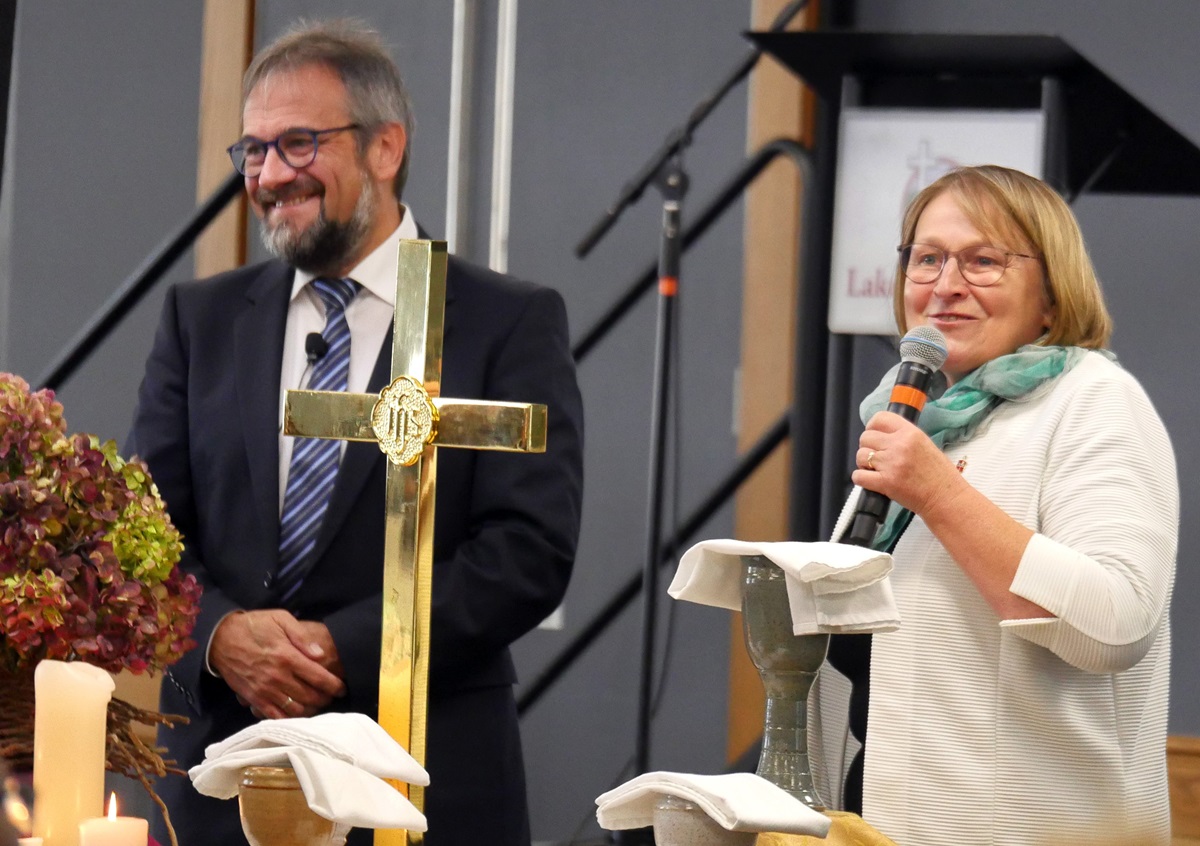
At the same meeting bishops celebrated the toppling of the Berlin Wall, they also agreed to work toward removing modern-day barriers to refugees seeking safety and freedom.
United Methodist bishops held a special service Nov. 5 to mark the 30th anniversary of the Berlin Wall’s fall and the peaceful revolution that led to reuniting East and West.
“People risked their lives to make change happen,” said retired Bishop Rosemarie Wenner of Germany. “The churches played a very important role.”
Wenner led the service alongside Bishops Harald Rückert, also of Germany, and Eduard Khegay of Eurasia. The three grew up on opposite sides of the Iron Curtain — Rückert and Wenner in what was then West Germany and Khegay in what was then the Soviet Union.
They testified to the role faith played in overcoming the divide between East and West.
In 1989, churches such as St. Nicholas Church in dowtown Leipzig provided a safe place for dissatisfied East Germans to pray and discern a better future. From the church, these Germans launched weekly nonviolent demonstrations that pressured politicians for freedom.
Rückert recounted how an East German hymn written a few months before the wall’s fall also became an anthem across Germany for change. He translated the hymn’s title: “Trust into the New Path in which God Will Lead You.”
Faith kept peaceful protesters going even amid fears they might face a bloody crackdown like that Chinese demonstrators had experienced earlier that year in Tiananmen Square.
Even with fervent prayers and personal courage, the wall’s end appeared to come almost by accident, Wenner said.
On Nov. 9, an East German government official called a press conference to announce citizens would receive one of their demands — freedom of travel.
A reporter asked when the change would take effect, Wenner said. The official’s response was none too certain: “I assume now.”
“So people just went to the checkpoints, and the soldiers were brave enough to open the gates,” Wenner recalled. “People were dancing in the streets of Berlin.”
Thus a barrier first erected in August 1961 began tumbling down on Nov. 9, 1989 — with more peaceful results than the collapse of Jericho’s wall in the Book of Joshua.
However, it doesn’t require stone or graffiti-covered concrete to set up powerful barriers between people.
During their meeting on Nov. 6, bishops also made plans to help remove modern-day roadblocks faced by refugees forced from their countries by war, violence or persecution.
“While there is an assumption that the United States receives the largest number of refugees, it is actually one of the countries today that is set to receive a very low number,” Bishop LaTrelle Easterling told her colleagues. She leads the Baltimore–Washington Conference and serves on the denomination’s Immigration Task Force.
In September, the U.S. State Department set the number of refugees taken in by the U.S. to no more than 18,000 in fiscal year 2020 — a historic low.
Help with Room in the Inn
To put that number in perspective, Germany reported taking in nearly 200,000 refugees in 2017 — down from a peak of 890,000 in 2015.
But even with the U.S. cap set so low, Easterling said, there is a risk the country will admit zero refugees next year.
Subscribe to our
e-newsletter
She pointed to an executive order President Trump signed that requires both state and local governments to give their “consent, in writing” for refugee resettlement in their localities.
According to Public Radio International, about 190 U.S. communities currently resettle refugees. Already some governors and mayors have stepped forward to offer consent.
However, the Christian refugee resettlement organization World Relief reported that the U.S. admitted no refugees in October. In the 30 years the organization has records, this is the first time the U.S. took in zero refugees for an entire month.
The Immigration Task Force recommended U.S. bishops take action by sending letters by Dec. 26 to their governors and city officials urging them to welcome refugees. The task force also asked that local churches likewise join the letter-writing campaign, which the group has named “Room in the Inn.”
The bishops raised their hands in support of the recommendation.
“We believe that there is room in the inn and what a wonderful way to celebrate the birth of the Christ child by doing this work,” said Bishop Minerva Carcaño, the task force’s chair and leader of the California-Nevada Conference.
At the 30th anniversary service, bishops spoke of their fears that walls — both literal and metaphorical — are rising once again.
“The joy, confidence and passion in God who wants walls that separate people to come down … is heavily challenged in these days,” Rückert said. “You hear ‘America First,’ ‘Russia First,’ ‘Germany First.’ The joy, confidence and passion in God to bring people together is even challenged in our United Methodist Church.”
However, he said, faith in God helped bring people together then and can overcome divides again.
“With God, we can leap over walls.”
Khegay, who leads United Methodists from Ukraine to Russia, echoed that sentiment in his Holy Communion supplication. The bishop prayed that God would break down the walls of prejudice and walls that separate families.
“Lord, we repent that we may have built walls in our minds and hearts,” Khegay prayed. “Help us, Lord, to build bridges — not walls.”
Hahn is a multimedia news reporter for United Methodist News. Contact her at (615) 742-5470 or [email protected]. To read more United Methodist news, subscribe to the free Daily or Weekly Digests.
Like what you're reading? Support the ministry of UM News! Your support ensures the latest denominational news, dynamic stories and informative articles will continue to connect our global community. Make a tax-deductible donation at ResourceUMC.org/GiveUMCom.


