
Key points
- The United Methodist Commission on the Status and Role of Women says it has a role to play in the complaint process involving Bishop Minerva Carcaño.
- The bishop has been suspended from episcopal duties for just over a year, while also receiving full pay and benefits.
- Western Jurisdiction leaders say the complaint process is moving forward.
- The goal of all involved is to reach a just resolution.
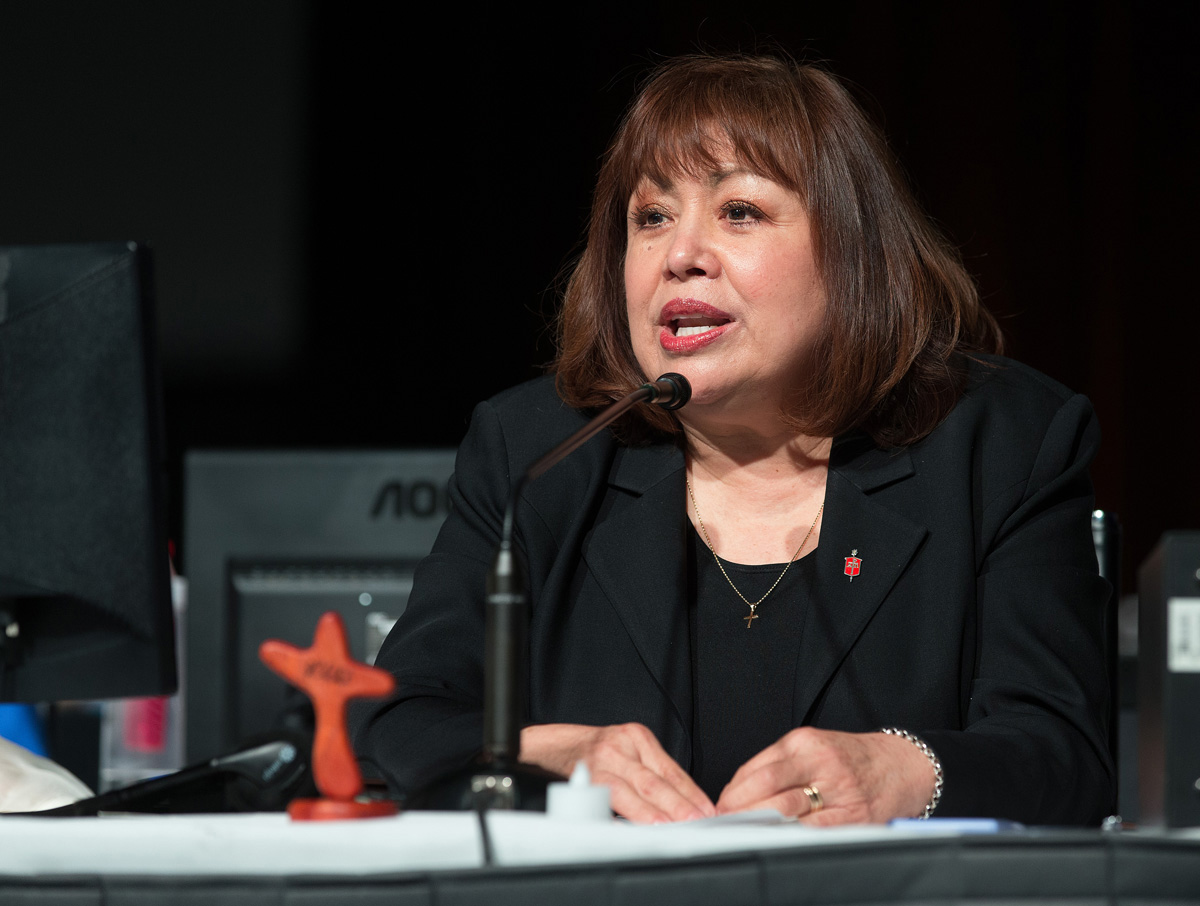
As the suspension of Bishop Minerva Carcaño crosses the one-year mark, a United Methodist agency is asking to serve as a monitor as the bishop’s case is being adjudicated.
“For God’s work of justice, reconciliation, and healing to be realized in the body of Christ, fair process in the life of the Church must be applied to all parties involved equally and in a timely manner,” said the statement by the board of the United Methodist Commission on the Status and Role of Women. “Justice delayed is in fact justice denied with the compounding of harm as the process is prolonged.”
Western Jurisdiction leaders placed Carcaño on leave on March 8 last year while complaints under church law against the bishop were under review. Carcaño faces three complaints, according to Western Jurisdiction leaders. No one has publicly disclosed the nature of the complaints.
Since then, Carcaño has been suspended from her episcopal duties while the church’s judicial process moves forward in the Western Jurisdiction where she is bishop.
She also has been receiving full pay and benefits. Meanwhile, retired Bishop Sally Dyck has served as interim episcopal leader of the California-Nevada Conference, the regional body where Carcaño has been assigned since 2016.
The suspension of a United Methodist bishop under complaint is not unprecedented, but such a move is extremely rare.
Both the length of Carcaño’s suspension and the lack of public details about the complaints have led to some confusion and worries about the denomination’s commitment to fair process.
Carcaño, the denomination’s first Latina bishop whom the Western Jurisdiction elected in 2004, is among The United Methodist Church’s more well-known episcopal leaders. She has gained national recognition in the U.S. and respect across the denomination for her advocacy work for migrants and U.S. immigration reform. She recently led the denomination’s Task Force on Immigration.
Her suspension also has received some very public pushback. Both MARCHA (Methodists Associated Representing the Cause of Hispanic/Latino Americans), the denomination’s Hispanic and Latino caucus, and ethnic leaders in the California-Nevada Conference have called for Carcaño’s immediate reinstatement.
Last year, the Judicial Council — The United Methodist Church’s top court — declined to rule on a judicial complaint against the bishop while the church judicial process is ongoing.
Question before Judicial Council
However, four of the nine participants in the Judicial Council’s deliberations disagreed with the majority — saying that fair process had been violated and that the bishop should be restored to her office.
The denomination’s policy of confidentiality around complaint allegations and much of the process is intended to protect all parties involved, including the person facing the complaint, Western Jurisdiction leaders told United Methodist News.
“It is critical to maintain confidentiality in the event that just resolution is achieved or the charges are dismissed. If so, the accusations may become irrelevant,” Bishop Karen Oliveto and the Rev. Dan Hurlbert said in a joint email.
They also said a suspension “is not to be seen as punitive action but is for the protection of the bishop and/or other parties.”
Oliveto, who leads the Mountain Sky Conference, is president of the Western Jurisdiction College of Bishops, and Hurlbert is the chair of the jurisdiction’s committee on episcopacy. Any complaint against a bishop must first be filed with the president of that bishop’s college of bishops.
Complicating matters is that the Book of Discipline — the denomination’s law book — has two different provisions that deal with bishop suspensions.
Carcaño was initially suspended under the Discipline’s Paragraph 413.3(a). That measure allows for a jurisdiction’s college of bishops, in consultation with the jurisdictional committee on episcopacy, to suspend a bishop “when deemed appropriate to protect the well-being of the complainant, the Church and/or bishop.” However, that provision says the suspension is “not to exceed 60 days.”
But if a resolution is not reached at that stage, a complaint under church law can move from supervisory response to a judicial-complaint process. At this point, Carcaño’s case is in that stage and before the Western Jurisdiction’s committee on investigation.
The Discipline’s Paragraph 2704.1c says that if at least five members of the committee on investigation recommend, the jurisdiction’s episcopacy committee may suspend the person under complaint “pending conclusion” of the church trial process.
The committee on investigation paused its work on Carcaño’s case as she appealed to the Judicial Council. But once the denomination's top court issued its memorandum in late October declining to take the case, Oliveto and Hurlbert said the committee resumed its work. That work continues.
It’s not an exact analogy, but a committee on investigation has a similar role to a grand jury in the U.S. court system. The role of the committee is to investigate the allegations in a complaint and determine if reasonable grounds exist to bring charges to a church trial. The committee consists of seven clergy members and two lay observers, as well as six alternates, elected by their jurisdiction.
The committee ultimately has responsibility for holding a hearing before determining if evidence supports a bill of charges.
One big difference between a committee on investigation and a grand jury is that the committee does not just hear from the counsel for the church and witnesses making the case for charges but also from the person under complaint and that person’s counsel making their case.
The Status and Role of Women commission hopes to ensure whatever comes next in Carcaño’s case is handled fairly.
Subscribe to our
e-newsletter
The commission has the responsibility under church law for advocating for women’s full participation in the life of the denomination. As part of that responsibility, the commission often has representatives monitor church proceedings to ensure women have a voice. The commission also has long experience in guiding church leaders through the denomination’s judicial processes and conflict mediation.
In its statement about Carcaño’s case, the board said the agency “respectfully requests inclusion to allow monitoring of the process going forward and we formally offer our services to assist in seeking a just resolution including the providing of mediation and healing resources.”
The agency’s two board members from the Western Jurisdiction both recused themselves from the statement.
Dawn Wiggins Hare, the agency’s top executive, told UM News that the agency hopes to help to reach a just resolution for all involved.
“Allowing a process to be monitored speaks to the opportunity of providing transparency while honoring confidentiality for all parties involved,” she said.
At any time in the complaint process, the Book of Discipline encourages the people involved to work toward “a just resolution.”
The Discipline defines a just resolution as “one that focuses on repairing any harm to people and communities, achieving real accountability by making things right in so far as possible and bringing healing to all parties.”
Oliveto and Hurlbert told UM News that they appreciated the agency’s letter and reached out for a meeting to discuss the request for monitoring. The Western Jurisdiction leaders said they also hope to include representatives from the United Methodist Commission on Religion and Race, which monitors on matters of race.
Hahn is assistant news editor for UM News. Contact her at (615) 742-5470 or [email protected]. To read more United Methodist news, subscribe to the free Daily or Friday Digests.


