
Early detection, access to treatment and pain control are key factors in surviving cancer, and all those factors are in short supply in many African countries, including Zimbabwe.
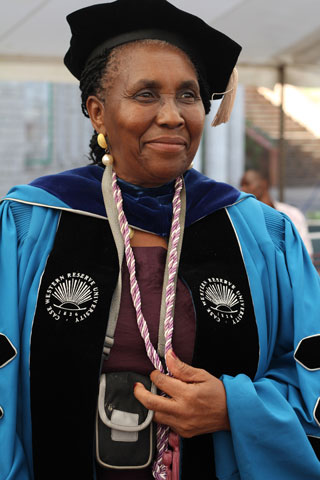
Auxilia Chideme-Munodawafa, professor and assistant dean at the Faculty of Health Sciences, Africa University, is well aware of those shortcomings and is working to bring training in palliative care to the continent.
Palliative care treats the whole person - body, mind and spirit. The treatment often involves a chaplain or spiritual leader, and the patient's family and friends take an active role in deciding how to care for the patient.
Africa University, a United Methodist-related institution, will begin offering a master's degree in palliative care next year using a module written by Chideme-Munodawafa.
Different cancers
"The type (and rates) of cancers presenting in Zimbabwe and some African countries ... are different from cancers in the U.S.," she said. For instance, breast and cervical cancer is higher among women in Africa than other countries and melanoma is not that common in Africa.
Chideme-Munodawafa serves on local, national and international medical boards. She is participating in the strategic five-year plan for cancer prevention and control in Zimbabwe for the Ministry of Health, Women and Child Welfare, 2013-17.
"We want to develop materials that are appropriate; it is a challenge that we are trying to work as a group together to encourage educators. The ball is in our court to produce resources."
Women with HIV/AIDs have a higher risk of developing cervical cancer, she said.
Many times, women come in for treatment at much later stages than women in the United States, where mammograms are more readily available and health insurance often prompts women to have yearly exams.
"Knowledge is very limited among doctors, nurses, community," Chideme-Munodawafa said. "Nurses are usually the first line of medical care. Many times, patients will go for weeks or months being treated for a lesion that the nurse thinks is just an infection when it is actually cancer." Educating nurses to recognize cancer is the first step toward saving lives.
The World Health Organization has issued a mandate for countries to develop cancer prevention and control standards, she added.
Answering a need
Africa University offers a post-basic bachelor of science degree in nursing; a bachelor of health services management; a diploma in public health and a master of public health in the Faculty of Health Sciences.
"Ours is the only program in Zimbabwe that is offering a four-year program to train students as managers to run regional or district health centers," Chideme-Munodawafa said. "Our grads are hot potatoes - they get jobs just like that," she said, smiling and snapping her fingers.
The continent suffers from brain drain, she added. "A lot of qualified, experienced people have left the country for greener pastures. There is no mentorship because most experienced people have left."
Giving back to Africa
Chideme-Munodawafa didn't want to be one of those who abandoned her home country.
"When I decided I had done it all, worked in the states, children all grown up, I wanted to come back home and give back," she said.
Even though she graduated from the University of Zimbabwe, when she heard about Africa University, she knew this was where she wanted to serve.
"There is comfort in a church-related university. Faith is very important for an ill person. When you approach cancer care, look at the patient in totality."
- Auxilia Chideme-Munodawafa, professor and assistant dean of Health Sciences, Africa University
"When I heard of Africa University with 20-plus countries represented, I thought what better way to give back to the country than to sit in a class and see a Zambian, see a Malawian, see a Zimbabwean, see a student from DRC. You start with them when they know nothing. By the end of the semester, you can see they now know something, and they all go back, not only to Zimbabwe, but (also) to different countries to give back. That gives me satisfaction."
Chideme-Munodawafa came to Africa University in 2010 from Cleveland, Ohio, where she was director and a faculty member in a palliative care, three-year, medical residency program. She worked at various hospitals in Zimbabwe before going for graduate studies in Ohio.
Chideme-Munodawafa said the "spiritual aspect" of Africa University also drew her.
"There is comfort in a church-related university. Faith is very important for an ill person. When you approach cancer care, look at the patient in totality.
"Cancer gives you time to think about life, what you have done, what you could do," Chideme-Munodawafa added. "When you go through all those emotions, the first thing they (cancer patient) think of is spiritual, is God. Coping is always spiritually centered."
*Gilbert is a multimedia reporter for the young adult content team at United Methodist Communications, Nashville, Tenn.
News media contact: Kathy L. Gilbert, Nashville, Tenn., (615) 742-5470 or [email protected].
Like what you're reading? Support the ministry of UM News! Your support ensures the latest denominational news, dynamic stories and informative articles will continue to connect our global community. Make a tax-deductible donation at ResourceUMC.org/GiveUMCom.


