
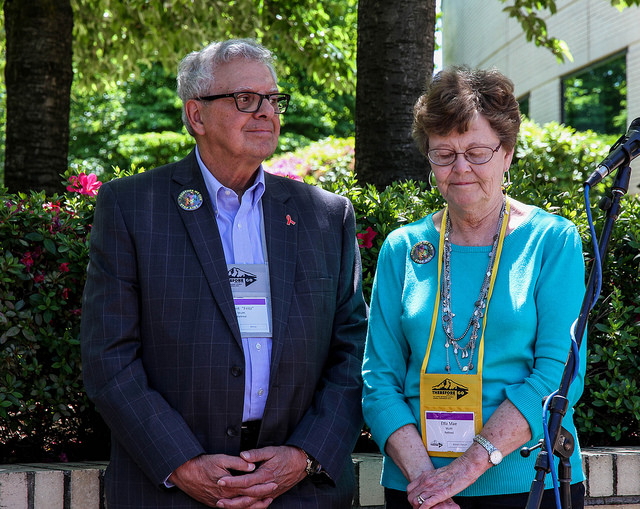
In a response of love and prayer, the 35 million people who have died of AIDS were remembered in a vigil outside the Oregon Convention Center as the 2016 General Conference meets to decide church law for the next four years.
“We live in a world with 38 million people who are living with AIDS and 35 million who have died,” said retired Bishop Albert Frederick Mutti. “Too much of the world ignores this pandemic.”
Mutti and his wife Etta Mae served as coordinators of the United Methodist Global AIDS Fund. They have been active in promoting the fund since the 2004 United Methodist General Conference approved it.
They wrote a book, "Dancing in a Wheelchair," after two of their three sons died of AIDS.
“We are determined to work together to promote the dignity, equality and rights of all people; discuss openly and accurately the basic facts about HIV and AIDS and about all the means of prevention,” Etta Mae read from an adaptation of “Religious Readers’ Commitment towards HIV/AIDS Issues” presented during the 15th International AIDS Conference in Bangkok in 2004.
According to UNAIDS estimates, 2.2 million children live with HIV, and the disease remains a threat to people of all ages and nationalities.
AIDS is not over
“AIDS is Not Over! ... Global Issues and the Church” was a daylong workshop featuring United Methodist leaders and laity from around the world, an AIDS scientist and people living with HIV/AIDS. Rose City Park United Methodist Church hosted the event, one day before the denomination’s 2016 General Conference.
“I think the theme of this event says it all: AIDS is not over yet,” said the Rev. Don Messer, who has worked to raise funds for AIDS since the 2004 United Methodist General Conference approved the Global Aids Fund. The church at that time committed to raise $3 million through apportionments and match it with an additional $5 million through Advance gifts.
The fund has raised more than $3.5 million as of today, and the money has gone to 284 projects in 44 countries, he said.
The United Methodist Global AIDS Fund Committee sponsored the vigil.
Gilbert is a multimedia news reporter for United Methodist News Service. Contact her at (615) 742-5470 or [email protected].
Like what you're reading? Support the ministry of UM News! Your support ensures the latest denominational news, dynamic stories and informative articles will continue to connect our global community. Make a tax-deductible donation at ResourceUMC.org/GiveUMCom.


